I'll be at CTIA on Tuesday the 12th. If you'll be there and want to chat, please drop me a note.
What if Palm made a smartphone and nobody cared?
These must be frustrating times for the people at Palm.
The company recently pre-announced that it's creating a 3G Treo for sale through Vodafone later this year. This was a very important breakthrough for Palm. It has been trying for years to get broader distribution for its smartphones in Europe, without great success. Now the world's largest mobile operator is embracing the company, and saying specifically that it'll offer the new Treo in at least the UK, Germany, Spain, Italy, and the Netherlands. That's a huge increase in reach for Palm, and it should help to produce incremental sales for the company.
What was Wall Street reaction to the announcement? Nothing. No change at all in the company's stock price.
I don't pretend to understand why stock prices move the way they do. Palm ought to be rewarded for this breakthrough. But there are also some reasons for caution. The first is that this will be a Windows Mobile Treo, not a Palm OS Treo. I believe there's pent-up demand in Europe for a well-made Palm OS 3G smartphone – Palm sold huge numbers of handhelds into Europe, especially Germany, and I'm sure some of those people would trade up to a well-designed 3G phone using the same OS. I'm less certain of the demand for a Windows Mobile Treo in Europe. There are already a lot Windows Mobile devices on the market there, so Palm is entering a crowded field.
Supposedly sales of the Windows Mobile Treo in the US have been disappointing, so Wall Street may be fearing the same thing will happen in Europe.
Of course, it's possible that Palm also has a Palm OS 3G Treo in the works for Europe. Palm doesn't like to pre-announce its Palm OS-based products (supposedly, the only reason it pre-announces the Windows Mobile-based ones is because the US government views any Microsoft deal as a "material event" that has to be announced early to prevent stock manipulation by insiders). The same requirements don't apply to Palm OS-based products, so it's very possible that Palm's going to ship a Palm OS Treo through Vodafone as well.
Regardless of which software ends up on the Vodafone devices, the other thing I'm not sure of is how well the Treo product design will play in the countries of Europe. I should explain this, for the benefit of my readers in the US.
Many Americans make the mistake of believing that Europe is full of Europeans. It's not. It's full of French people, Germans, Italians, British, and so on – each from very distinct cultures with very different beliefs and traditions. Other than the World Cup, I'm aware of only two truly pan-European cultural institutions. One is the Eurovision song contest, and I'm not going to even try to explain that. The other is the practice of displaying your mobile phone on the table during a meal.
Go to lunch or dinner in any country in Europe, and when everyone sits down they'll take out their mobile phones and put them on the table. There's even a proper place to put the phone, about like this:
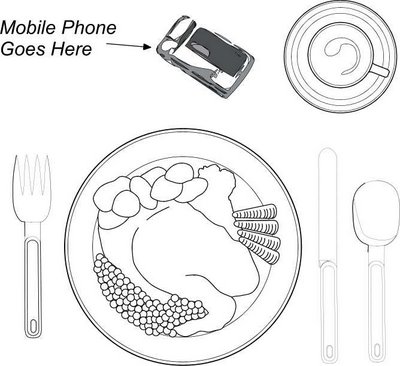
Note that you don't lay down the phone straight – it needs to look like you just casually dropped it on the table.
Then everyone at the table surreptitiously checks out everyone else's phone. There's a subtle hierarchy of status associated with which phone you carry. I haven't decoded all of it yet, but definitely you get some extra status for having what's perceived to be a stylish phone. Brand also plays a role, although I think that varies from country to country. For example, carrying a Siemens phone is OK in Germany, but will peg you as a cheapskate anywhere else in the western half of the continent. Nokia has good status, depending on the model you carry, and I think SonyEricsson gets you tagged as a little more creative than average. If you have a Motorola it says you're an American.
And then there's the Treo. I've been told by several European friends that slapping down a Treo on the table gets you labeled as a geek. And not a nice geek in the American sense (visionary and probably rich), but geek in the bad sense (socially misfit and physically underdeveloped). The keyboard, which American users tend to regard as a badge of business power and importance, comes across as pathetically computer-obsessed to a lot of folks in Europe. At least that's what I've been told by people over there.
It's possible that image is evolving as RIM and Nokia bring more keyboard-based phones to market. But if not, Palm will have a lot more trouble on its hands than just what OS it's running.
The other question about this hypothetical Vodafone Palm OS phone is whether Palm can even build it. As I've speculated before, it's not clear that the current version of Palm OS can easily be revised to work with the 3G networks in Europe. Now Brighthand has pointed out that PalmSource/Access missed its deadlines for delivering the next version of Palm OS, freeing Palm from a series of fairly substantial minimum payments it was required to make to Access.
If the Access platform won't be available in time, what else could Palm do to fill the gap? David Beers has compiled a lot of evidence indicating that Palm's working on its own Linux-based operating system for smartphones. I don't know if it actually is, but let's speculate irresponsibly for a moment.
Adapting Linux to mobile devices is not as easy as most people think – the OS was created for PCs and servers and doesn't naturally understand concepts like power conservation and limited memory. Palm certainly could be trying, perhaps with help from one of the companies already making working on mobile Linux, but it's not a slam dunk for a company of Palm's size.
We know for sure that Palm is working on a secret new product that's neither handheld nor smartphone. It's also not based on Palm OS, so the software for it must be something different. It could be Windows Mobile, but I'm betting that Palm is creating a new operating system for this new class of device. Would Palm work on two new operating systems at once? I doubt it. So maybe what Palm's doing is creating an OS for its new product category – now far advanced in development – and then adapting that OS to its smartphones as well. That OS might or might not be based on Linux.
If Palm did create its own OS, that would complete the circle of Palm's long, strange evolution – the company would be back under the management of its founders, owning its brand name, and with its own proprietary OS.
Again, I don't know if it'll actually happen, but the idea's kind of poetic, isn't it?
The company recently pre-announced that it's creating a 3G Treo for sale through Vodafone later this year. This was a very important breakthrough for Palm. It has been trying for years to get broader distribution for its smartphones in Europe, without great success. Now the world's largest mobile operator is embracing the company, and saying specifically that it'll offer the new Treo in at least the UK, Germany, Spain, Italy, and the Netherlands. That's a huge increase in reach for Palm, and it should help to produce incremental sales for the company.
What was Wall Street reaction to the announcement? Nothing. No change at all in the company's stock price.
I don't pretend to understand why stock prices move the way they do. Palm ought to be rewarded for this breakthrough. But there are also some reasons for caution. The first is that this will be a Windows Mobile Treo, not a Palm OS Treo. I believe there's pent-up demand in Europe for a well-made Palm OS 3G smartphone – Palm sold huge numbers of handhelds into Europe, especially Germany, and I'm sure some of those people would trade up to a well-designed 3G phone using the same OS. I'm less certain of the demand for a Windows Mobile Treo in Europe. There are already a lot Windows Mobile devices on the market there, so Palm is entering a crowded field.
Supposedly sales of the Windows Mobile Treo in the US have been disappointing, so Wall Street may be fearing the same thing will happen in Europe.
Of course, it's possible that Palm also has a Palm OS 3G Treo in the works for Europe. Palm doesn't like to pre-announce its Palm OS-based products (supposedly, the only reason it pre-announces the Windows Mobile-based ones is because the US government views any Microsoft deal as a "material event" that has to be announced early to prevent stock manipulation by insiders). The same requirements don't apply to Palm OS-based products, so it's very possible that Palm's going to ship a Palm OS Treo through Vodafone as well.
Regardless of which software ends up on the Vodafone devices, the other thing I'm not sure of is how well the Treo product design will play in the countries of Europe. I should explain this, for the benefit of my readers in the US.
Many Americans make the mistake of believing that Europe is full of Europeans. It's not. It's full of French people, Germans, Italians, British, and so on – each from very distinct cultures with very different beliefs and traditions. Other than the World Cup, I'm aware of only two truly pan-European cultural institutions. One is the Eurovision song contest, and I'm not going to even try to explain that. The other is the practice of displaying your mobile phone on the table during a meal.
Go to lunch or dinner in any country in Europe, and when everyone sits down they'll take out their mobile phones and put them on the table. There's even a proper place to put the phone, about like this:

Note that you don't lay down the phone straight – it needs to look like you just casually dropped it on the table.
Then everyone at the table surreptitiously checks out everyone else's phone. There's a subtle hierarchy of status associated with which phone you carry. I haven't decoded all of it yet, but definitely you get some extra status for having what's perceived to be a stylish phone. Brand also plays a role, although I think that varies from country to country. For example, carrying a Siemens phone is OK in Germany, but will peg you as a cheapskate anywhere else in the western half of the continent. Nokia has good status, depending on the model you carry, and I think SonyEricsson gets you tagged as a little more creative than average. If you have a Motorola it says you're an American.
And then there's the Treo. I've been told by several European friends that slapping down a Treo on the table gets you labeled as a geek. And not a nice geek in the American sense (visionary and probably rich), but geek in the bad sense (socially misfit and physically underdeveloped). The keyboard, which American users tend to regard as a badge of business power and importance, comes across as pathetically computer-obsessed to a lot of folks in Europe. At least that's what I've been told by people over there.
It's possible that image is evolving as RIM and Nokia bring more keyboard-based phones to market. But if not, Palm will have a lot more trouble on its hands than just what OS it's running.
The other question about this hypothetical Vodafone Palm OS phone is whether Palm can even build it. As I've speculated before, it's not clear that the current version of Palm OS can easily be revised to work with the 3G networks in Europe. Now Brighthand has pointed out that PalmSource/Access missed its deadlines for delivering the next version of Palm OS, freeing Palm from a series of fairly substantial minimum payments it was required to make to Access.
If the Access platform won't be available in time, what else could Palm do to fill the gap? David Beers has compiled a lot of evidence indicating that Palm's working on its own Linux-based operating system for smartphones. I don't know if it actually is, but let's speculate irresponsibly for a moment.
Adapting Linux to mobile devices is not as easy as most people think – the OS was created for PCs and servers and doesn't naturally understand concepts like power conservation and limited memory. Palm certainly could be trying, perhaps with help from one of the companies already making working on mobile Linux, but it's not a slam dunk for a company of Palm's size.
We know for sure that Palm is working on a secret new product that's neither handheld nor smartphone. It's also not based on Palm OS, so the software for it must be something different. It could be Windows Mobile, but I'm betting that Palm is creating a new operating system for this new class of device. Would Palm work on two new operating systems at once? I doubt it. So maybe what Palm's doing is creating an OS for its new product category – now far advanced in development – and then adapting that OS to its smartphones as well. That OS might or might not be based on Linux.
If Palm did create its own OS, that would complete the circle of Palm's long, strange evolution – the company would be back under the management of its founders, owning its brand name, and with its own proprietary OS.
Again, I don't know if it'll actually happen, but the idea's kind of poetic, isn't it?
What is Google's search share, really?
It sounds like such a simple question. But like an impressionist painting, the closer you look, the more the image deteriorates.
ComScore says Google accounts for 44% of Internet searches in the US.
Netratings (owned by the Nielsen survey people) says Google's share is 49%.
Hitwise says Google's share is 60%.
Alexa says Google's share is 85%.
What the heck is going on?
First of all, no one on Earth knows what Google's actual share is. In order to get that number, you'd have to know the exact number of searches conducted on every search engine on the Internet, and the search companies don't release that data. So various companies are using different methodologies to estimate the number.
Netratings and ComScore monitor panels of people who have web meters installed on their computers (similar to the way Nielsen measures TV ratings). Hitwise aggregates and weights the usage logs from ISPs. Alexa tracks web usage by people who have installed its toolbar.
The methodologies are different, but they shouldn't produce that much of a skew. Part of the disconnect may be due to differences in definitions. When is a search a search? Is it when someone goes to the search site, when they receive results from a search site, or when they actually click through on one of the results?
Alexa says it's measuring click-throughs. It's not clear what the other three are measuring, although I suspect that Netratings and ComScore are tracking searches conducted and not click-throughs. If either of them are just measuring visits to the search page, Yahoo's and MSN's traffic would be padded, because their homepages offer a lot more than a search box.
Even if Hitwise and Netratings are measuring actual searches, I guess it's possible that the average Google search generates more click-throughs than the average Yahoo search. That would explain the Alexa result – although I don't know why people would be more likely to click through on Google.
The disconnect is especially interesting to me because many weblogs report traffic that differs radically from the supposed search engine share. Many of them report more Google traffic than you'd expect from the ComScore and Netratings numbers.
(If you don't have your own website, I should give a little background – blog authors can get statistics showing where every visitor came from. We can't see who you are, but we can see which Internet domain you came from. If you used a search engine, we can see what query got you here and which search engine you used.)
The visitor logs for Mobile Opportunity show interesting trends from time to time. For example, my post on Adobe's plans to expand Flash into a platform got a fair number of readers from Adobe and Microsoft, but many more visits from the Yahoo corporate domain. Hmmmm. And for several months early this year, a lot of people at Motorola.com were searching online for the phrase "rokr failure."
As for which search engine generates the most traffic here, Google is the winner hands down, with 94% of the search engine referrals. MSN has 4%, and Yahoo only 2%. I don't know why that is. Maybe people looking for mobile-related information are more likely to use Google. Maybe Google drives more traffic toward weblogs in general, or specifically to Blogger-based weblogs (Google owns Blogger/Blogspot). Maybe people who do searches on Google are more likely to click through on the results.
Or maybe Google really is as dominant as Alexa says it is.
To test these some of questions, I did identical searches on Google, Yahoo, and MSN. I used "motorola rokr failure" as the search phrase because I knew Google ranked Mobile Opportunity high on that search.
Here are the top ten results for each:
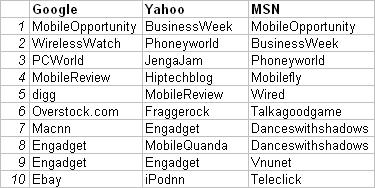
It's remarkable. No web page showed up in the top ten in all three search engines. There is almost no overlap between the top Google and Yahoo results, and MSN has a little bit of each. It's almost as if there were two separate Internets, one being indexed by Yahoo and the other being indexed by Google, with MSN trying to straddle them. I know that's not really the case, but clearly each of the search engines are using very different search algorithms.
I did a few other duplicate searches, and all showed the same sort of diversity. I couldn't spot any obvious biases in any of the engines – for example, Yahoo doesn't seem to be systematically excluding blogs. And I can't say that one search engine's results are objectively better than another's; they all found some good results and some clunkers (seriously, Google – you listed an Overstock auction when you didn't list BusinessWeek?)
So I don't know what's going on, other than that Yahoo's search engine doesn't like me.
I'm sure other people with more time and insight have investigated this issue. Please post a link if you know of a good article on the subject.
In the meantime, hello to all you searchers from Google, and I hope you found the information you needed.
ComScore says Google accounts for 44% of Internet searches in the US.
Netratings (owned by the Nielsen survey people) says Google's share is 49%.
Hitwise says Google's share is 60%.
Alexa says Google's share is 85%.
What the heck is going on?
First of all, no one on Earth knows what Google's actual share is. In order to get that number, you'd have to know the exact number of searches conducted on every search engine on the Internet, and the search companies don't release that data. So various companies are using different methodologies to estimate the number.
Netratings and ComScore monitor panels of people who have web meters installed on their computers (similar to the way Nielsen measures TV ratings). Hitwise aggregates and weights the usage logs from ISPs. Alexa tracks web usage by people who have installed its toolbar.
The methodologies are different, but they shouldn't produce that much of a skew. Part of the disconnect may be due to differences in definitions. When is a search a search? Is it when someone goes to the search site, when they receive results from a search site, or when they actually click through on one of the results?
Alexa says it's measuring click-throughs. It's not clear what the other three are measuring, although I suspect that Netratings and ComScore are tracking searches conducted and not click-throughs. If either of them are just measuring visits to the search page, Yahoo's and MSN's traffic would be padded, because their homepages offer a lot more than a search box.
Even if Hitwise and Netratings are measuring actual searches, I guess it's possible that the average Google search generates more click-throughs than the average Yahoo search. That would explain the Alexa result – although I don't know why people would be more likely to click through on Google.
The disconnect is especially interesting to me because many weblogs report traffic that differs radically from the supposed search engine share. Many of them report more Google traffic than you'd expect from the ComScore and Netratings numbers.
(If you don't have your own website, I should give a little background – blog authors can get statistics showing where every visitor came from. We can't see who you are, but we can see which Internet domain you came from. If you used a search engine, we can see what query got you here and which search engine you used.)
The visitor logs for Mobile Opportunity show interesting trends from time to time. For example, my post on Adobe's plans to expand Flash into a platform got a fair number of readers from Adobe and Microsoft, but many more visits from the Yahoo corporate domain. Hmmmm. And for several months early this year, a lot of people at Motorola.com were searching online for the phrase "rokr failure."
As for which search engine generates the most traffic here, Google is the winner hands down, with 94% of the search engine referrals. MSN has 4%, and Yahoo only 2%. I don't know why that is. Maybe people looking for mobile-related information are more likely to use Google. Maybe Google drives more traffic toward weblogs in general, or specifically to Blogger-based weblogs (Google owns Blogger/Blogspot). Maybe people who do searches on Google are more likely to click through on the results.
Or maybe Google really is as dominant as Alexa says it is.
To test these some of questions, I did identical searches on Google, Yahoo, and MSN. I used "motorola rokr failure" as the search phrase because I knew Google ranked Mobile Opportunity high on that search.
Here are the top ten results for each:
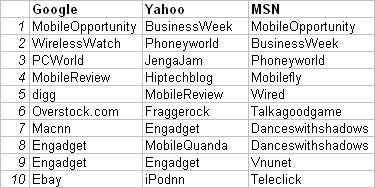
It's remarkable. No web page showed up in the top ten in all three search engines. There is almost no overlap between the top Google and Yahoo results, and MSN has a little bit of each. It's almost as if there were two separate Internets, one being indexed by Yahoo and the other being indexed by Google, with MSN trying to straddle them. I know that's not really the case, but clearly each of the search engines are using very different search algorithms.
I did a few other duplicate searches, and all showed the same sort of diversity. I couldn't spot any obvious biases in any of the engines – for example, Yahoo doesn't seem to be systematically excluding blogs. And I can't say that one search engine's results are objectively better than another's; they all found some good results and some clunkers (seriously, Google – you listed an Overstock auction when you didn't list BusinessWeek?)
So I don't know what's going on, other than that Yahoo's search engine doesn't like me.
I'm sure other people with more time and insight have investigated this issue. Please post a link if you know of a good article on the subject.
In the meantime, hello to all you searchers from Google, and I hope you found the information you needed.
What a difference three years makes
In 2003, Po Bronson wrote an influential article in Wired labeling Silicon Valley the new Detroit. Three years later, the article reads as both visionary and completely off base.
The visionary part was Bronson's prediction that Silicon Valley wouldn't return to being a lifestyle trend-setter.
"It was a new culture that both captured the world's imagination and had it running scared. Rich people in New York felt poor. Smart people in Redmond felt stupid. Producers in Hollywood spoke a whole new lingo. Every Fortune 500 company felt vulnerable to itty-bitty startups. Silicon Valley was an argument in the form of a place. It argued for a new way to live, a new relationship between owners and employees, a new bond between work and play."
Bronson was right in declaring this idea dead. Today you don't find a lot of people around the world who want to live the Silicon Valley lifestyle (or who even believe there is one). Most established companies have gone back to ignoring the tech industry, and the wild parties of the Bubble period seem to be a thing of the past.
But Bronson also predicted an end to the potency of Silicon Valley companies themselves.
"I doubt startups will ever become commonplace again....The hype machine keeps puffing, but the truth is that the pace of change in Silicon Valley is no longer special or extraordinary. In the past few years, Hollywood has been transformed by reality television, which has created new fortunes and new stars. Washington has swapped out an administration of 24,000 Democrats and replaced it with 24,000 Republicans. Wall Street has been altered by new rules governing conflicts of interest. The music and book industries have far more new products running through their pipelines than the tech industry."
Three years on, venture funding hasn't rebounded much, but startups are commonplace anyway. The scope of change in online software is breath-taking, and it feels like we're only scratching the surface of what's to come. Apple has the entire music industry on the run, and a company called Google – not even mentioned in Bronson's article – is re-inventing advertising. High tech isn't necessarily sexy, but it's definitely dangerous. I personally think it's more dangerous than it was at the peak of the bubble in 2000, because the software startups today are much more efficient (enabling a lot of low-cost experiments), and because the rest of the world has turned its back on the industry, allowing surprises to bubble up unnoticed.
I don't want to beat up on Po Bronson; it's more or less impossible to predict the future. But it's good to ask why he was partly right and partly wrong, because that may help us anticipate what's coming next.
Soon after the Bubble burst, it felt like everything associated with it was garbage – the culture, business models, and the technology. It turns out that the bubble culture really was an illusion. Partying every night and jumping jobs twice a year rich turns out to be economically unsustainable, not to mention physically exhausting. And the huge bolus of venture capital that the Valley struggled to digest (and largely wasted) shows no signs of returning.
But the technology was still maturing, and the business models were just getting started. Once the stupid, weedy startups were cleared out, we were left with a crop of extremely efficient new companies, and new technologies and businesses that were just starting to have an impact. That crop is only now starting to flower, and we won't see its full impact until the end of the decade at the earliest. But to me it's already clear that the impact will be enormous.
So, is Silicon Valley dead? Yes, as a cultural icon. But as a disruptive economic force, it was just taking a rest.
The visionary part was Bronson's prediction that Silicon Valley wouldn't return to being a lifestyle trend-setter.
"It was a new culture that both captured the world's imagination and had it running scared. Rich people in New York felt poor. Smart people in Redmond felt stupid. Producers in Hollywood spoke a whole new lingo. Every Fortune 500 company felt vulnerable to itty-bitty startups. Silicon Valley was an argument in the form of a place. It argued for a new way to live, a new relationship between owners and employees, a new bond between work and play."
Bronson was right in declaring this idea dead. Today you don't find a lot of people around the world who want to live the Silicon Valley lifestyle (or who even believe there is one). Most established companies have gone back to ignoring the tech industry, and the wild parties of the Bubble period seem to be a thing of the past.
But Bronson also predicted an end to the potency of Silicon Valley companies themselves.
"I doubt startups will ever become commonplace again....The hype machine keeps puffing, but the truth is that the pace of change in Silicon Valley is no longer special or extraordinary. In the past few years, Hollywood has been transformed by reality television, which has created new fortunes and new stars. Washington has swapped out an administration of 24,000 Democrats and replaced it with 24,000 Republicans. Wall Street has been altered by new rules governing conflicts of interest. The music and book industries have far more new products running through their pipelines than the tech industry."
Three years on, venture funding hasn't rebounded much, but startups are commonplace anyway. The scope of change in online software is breath-taking, and it feels like we're only scratching the surface of what's to come. Apple has the entire music industry on the run, and a company called Google – not even mentioned in Bronson's article – is re-inventing advertising. High tech isn't necessarily sexy, but it's definitely dangerous. I personally think it's more dangerous than it was at the peak of the bubble in 2000, because the software startups today are much more efficient (enabling a lot of low-cost experiments), and because the rest of the world has turned its back on the industry, allowing surprises to bubble up unnoticed.
I don't want to beat up on Po Bronson; it's more or less impossible to predict the future. But it's good to ask why he was partly right and partly wrong, because that may help us anticipate what's coming next.
Soon after the Bubble burst, it felt like everything associated with it was garbage – the culture, business models, and the technology. It turns out that the bubble culture really was an illusion. Partying every night and jumping jobs twice a year rich turns out to be economically unsustainable, not to mention physically exhausting. And the huge bolus of venture capital that the Valley struggled to digest (and largely wasted) shows no signs of returning.
But the technology was still maturing, and the business models were just getting started. Once the stupid, weedy startups were cleared out, we were left with a crop of extremely efficient new companies, and new technologies and businesses that were just starting to have an impact. That crop is only now starting to flower, and we won't see its full impact until the end of the decade at the earliest. But to me it's already clear that the impact will be enormous.
So, is Silicon Valley dead? Yes, as a cultural icon. But as a disruptive economic force, it was just taking a rest.
The online revolution in market research
The Web is making enormous changes in how market research is done. I just wrote about it on my other weblog, Stop Flying Blind, and thought some of you might be interested.
Carnival of the Mobilists #37

Welcome to the 37th Carnival of the Mobilists. If you're not familiar with the Carnival, it's a weekly collection of posts submitted by mobile-related weblogs. Each week is hosted by a different blogger. I have the honor of being this week's host.
The idea of the Carnival is to create more visibility for people doing commentary on the mobile industry. So please click on some of the fine articles below. You'll make a blogger's day.
What is a carnival anyway?
Say the word "Carnival" and you'll conjure up different images around the world. A Brazilian may think of incredible costumes and samba schools. Someone from the Caribbean is more likely to think of steel drum bands. An Italian might think of elegant masks in Venice.
Where I grew up, the word "carnival" brings to mind the sideshow of a traveling circus. The elephants and clowns were in the big tent, while the carnival was the place for the games (inevitably rigged so you couldn't win), rides (dangerously rickety), and oddities. No carnival was complete without a carnival barker, the guy who enticed people to pay to see the bearded lady and the man who ate radio parts.
Which type of Carnival are we running this week? Maybe a little of each...

Samba time. About the closest thing to a samba school in mobile-land is the ongoing debate over the fate of mobile data. Will it ever really take off? Is there a killer app? Like a samba school, the discussions are almost endless and very complex, and it seems like the same schools of thought come up again year after year.
The mobile mono-culture. Stephanie Rieger writes a very interesting commentary on regional differences in culture, and asks why despite the diversity of the world's cultures, so many mobile games and content are the same worldwide. She suggests we need infrastructure that enables much easier creation and distribution of locally-produced content. Amen.
Let the users create their own content. This one isn't strictly mobile, but I think it's interesting in light of Stephanie's post. Anders Borg discusses how user-generated content can sustain an online community, even in the face of big competitors.
Will mobile TV be a killer app? Kevin Evans is a newcomer to the Carnival, and he starts off with a nice article summarizing some of the danger signs surrounding mobile TV. Is it another SMS, or another WAP?
What if you built a smartphone and nobody cared? Steve and Rafe over at All About Symbian mix it up on the subject of whether smartphone users know they can add applications, whether they should care about it, and whether that will change in the future. It's a good discussion, and a subject near and dear to my heart.

Beautiful noise. In the hierarchy of musical instruments, the steel drum isn't very high up. Mozart never composed for it, and you don't see a lot of them in the world's great orchestras. But even though they don't get much attention, they make a beautiful noise. I'm not quite sure how to draw an analogy from this to the mobile market, but maybe our equivalent of steel drums would be the mobile devices that aren't mobile phones. They're not always as well publicized as the phones, but they have their own special charms.
The better $100 PC. David Beers injects himself into the $100 laptop PC debate with a post suggesting that a dockable mobile phone might be a much better investment for the developing world. He makes an interesting case, and he apparently got some pointed replies from $100 PC supporters after Robert Scoble flagged his earlier comments on the subject.
I'm reminded of a conference I went to earlier this year, where there was a speaker who's active in education for developing countries. He was asked about the $100 PC, and his response was to gently suggest that it might be nice to buy those kids a few books first.
Goodbye LifeDrive? If you follow the online rumors, the Palm LifeDrive has been reported close to extinction more often than the spotted owl. The saga continued this week as Palm reportedly has stopped shipping the LifeDrive to Europe because it includes hazardous substances that are no longer legal in the EU. Tam Hanna asks whether this signals the end of the LifeDrive.
iPod RIP. By far the best cat fight of the week is the discussion spawned by Tomi Ahonen's lengthy post declaring the death of the iPod at the hands of the MP3-capable phone. "The battle is totally over. Apple cannot recover," he writes. Tomi makes the mobile-phone-conquers-all argument very forcefully and in great detail. Check it out and decide for yourself.

Elegance and sophistication. What could match the elegance of a Venetian masked ball? I'm not sure, but most of us would agree that the average mobile phone user interface doesn't come close. A couple of posts supported that point this week.
Is it a bug or a feature? MobHappy talks about mobile phone usability this week, noting a recent study which reported that 63% of the mobile phones returned as defective actually have nothing wrong with them. (Or that is to say, whatever's wrong with them was designed in deliberately.) The post discusses why this happens, what it costs the industry, and what we should do about it.
Mobile interface and Google's mobile plans (not). MoJordy reports on a recent seminar on mobile Web trends. The speakers were from GotoMedia and Google. The Google discussion, unfortunately, was focused more on what's wrong with the industry rather than what Google plans to do about it. Still, there were some very interesting tidbits.

The Sideshow. Ladies and gentlemen, boys and girls, step right up to see the most amazing, the most colossal, the most spine-tingling posts in the mobile world this week. (Well, actually these are just the posts that didn't fit into the other three categories.) I must warn you, ladies and gentlemen, some of these posts might provoke or amuse you, and if you're not careful you might actually learn a thing or two.
Tagging on the go. MPulse is creating a tagging and content aggregation system for mobile Web content, and building some interesting functionality into it. MoPocket has a very nice overview of the product, complete with lots of screen shots, something that I really appreciate in any product discussion.
MinuteWatcher vs. TMobile. Darla Mack comments on TMobile's recent decision to block access to Minute Watcher, a service that tracks mobile phone usage. She feels it's not a self-serving move by TMobile.
Skepticism about the hosted Blackberry server. Enough of this consumer stuff, let's talk mobile enterprise. Daniel Taylor is very skeptical about the ability of RIM's new hosted Blackberry server product to increase Blackberry sales in small and medium businesses.
Barcode status. The Pondering Primate discusses the status of various standards for phone-readable barcodes.
Unimpressed with Motorola's mobile plans. Strong disappointment about the new phones coming from Motorola was expressed by Tarek Speaks Mobile.
Will the operators control the mobile Internet? It just wouldn't be a carnival without a little gratuitous nudity, and Open Gardens provides it along with an interesting commentary on the speculation that "naked" SIP will outsell IMS in the mobile world, undercutting the operators' ability to control and tax the mobile Internet.
Post of the week
As host of the Carnival, I get to choose a post of the week. The winner gets acclaim, and is eligible to be voted the Post of the Month, which carries a $250 prize from Khosla Ventures. Tomi's iPod post is definitely the most passionate (and longest), Stephanie's was very insightful, and I really like the way Kevin Evans thinks. But the point-counterpoint at All About Symbian was my favorite, so that's the post of the week. Congratulations, guys!
Next week, the Carnival will be at Howard Rheingold's SmartMobs. See you there!
[PS: If you subscribe to the RSS feed from my site, you may have received multiple copies of this post. I apologize -- Blogger has been giving me some formatting trouble. Again.]
Dell's flaming laptop hits the big time
The infamous flaming Dell laptop finally made the mainstream press this week, with an article in the New York Times. If you somehow missed the original story, a Dell laptop did a Burning Man imitation at a conference in Japan. Someone took pictures (let's hear it for camera phones), and the photos made it onto the Inquirer web site. From there they spread all over the web, and eventually to the Times.
The Times views the burning laptop as a parable about Dell customer service, but actually if it's a parable about anything, it's on batteries and our attitudes toward technology. Most of us don't realize just how much energy has been packed into the average mobile device battery. If you release that energy all at once, it can easily cause a nasty fire. A company called Valence, which says it has less dangerous battery technology, distributes fun information on exploding batteries:
Here's a picture of a mobile device battery bursting into flame:

And here's a quote:
"In the last two years alone, the US Product Safety Commission has received approximately 83 reports of incidences of cell phones exploding and/or catching fire injuring consumers due to their batteries. One incident was reported by Curtis Sathre who said 'It was like a bomb going off. His 13-year-old son Michael stood stunned, his ears ringing, hand gushing blood and body covered in black ash. In a split second, fragments from Michael's exploding cell phone had hit him between the eyes and lodged in the ceiling of the family's home in Oceanside, Calif.'"
Four or five years ago, I attended a tech conference called Power. It was a meeting of the leading battery technology companies in high tech. I was there to talk about the future of mobile devices and to tell them what we needed from future batteries. (Our message: more, more, more. Their message: wait for fuel cells. I'm still waiting.)
One of the other speakers was a guy from Dell, and he showed a picture of a laptop that had been destroyed by a battery fire. Cracked screens, blackened plastic, etc. Nasty stuff. He asked, "what if this happens on an airplane?"
(Good question. I hope the answer is that a flight attendant would grab a fire extinguisher and put out the fire, but it would be an unpleasant and dangerous situation, especially since the battery is feeding on its own energy when it burns.)
Anyway, the point being made by the Dell guy was that mobile battery technology needs incredibly stringent quality controls, far beyond typical quality standards. One failure in a million would have laptops and phones melting down every week. The failure rate needs to be more like one in a billion, which is an incredibly difficult task. Meanwhile, we keep on trying to cram as much energy as possible into our mobile devices.
Just one failure in a bad place, the Dell guy said, could hurt the whole industry. Despite a lot of scares since then, the explosive battery story has never really taken off with the general public. People view the incidents as isolated quality control issues, rather than what they really are – symptoms of a technology being pushed to the edge. I don't know if the exploding notebook in Japan will be the crossover event that makes people pay more attention, but it's interesting to see it in the mainstream media. Fortunately, this fire wasn't on a plane.
The lesson in all of this? I think it's given best by one of the photos from the Inquirer website:
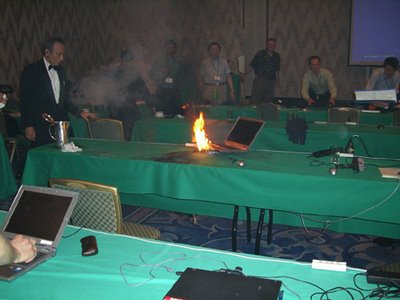
Check out the guy in he left foreground. While the Dell burns itself out, he's typing away on his own laptop.
The fact is that we aren't going to give up our mobile devices, so we're all going to live with some risk. But please be careful about buying off-brand lithium ion batteries. You want to get them from a company that's obsessive about quality control.
The Times views the burning laptop as a parable about Dell customer service, but actually if it's a parable about anything, it's on batteries and our attitudes toward technology. Most of us don't realize just how much energy has been packed into the average mobile device battery. If you release that energy all at once, it can easily cause a nasty fire. A company called Valence, which says it has less dangerous battery technology, distributes fun information on exploding batteries:
Here's a picture of a mobile device battery bursting into flame:

And here's a quote:
"In the last two years alone, the US Product Safety Commission has received approximately 83 reports of incidences of cell phones exploding and/or catching fire injuring consumers due to their batteries. One incident was reported by Curtis Sathre who said 'It was like a bomb going off. His 13-year-old son Michael stood stunned, his ears ringing, hand gushing blood and body covered in black ash. In a split second, fragments from Michael's exploding cell phone had hit him between the eyes and lodged in the ceiling of the family's home in Oceanside, Calif.'"
Four or five years ago, I attended a tech conference called Power. It was a meeting of the leading battery technology companies in high tech. I was there to talk about the future of mobile devices and to tell them what we needed from future batteries. (Our message: more, more, more. Their message: wait for fuel cells. I'm still waiting.)
One of the other speakers was a guy from Dell, and he showed a picture of a laptop that had been destroyed by a battery fire. Cracked screens, blackened plastic, etc. Nasty stuff. He asked, "what if this happens on an airplane?"
(Good question. I hope the answer is that a flight attendant would grab a fire extinguisher and put out the fire, but it would be an unpleasant and dangerous situation, especially since the battery is feeding on its own energy when it burns.)
Anyway, the point being made by the Dell guy was that mobile battery technology needs incredibly stringent quality controls, far beyond typical quality standards. One failure in a million would have laptops and phones melting down every week. The failure rate needs to be more like one in a billion, which is an incredibly difficult task. Meanwhile, we keep on trying to cram as much energy as possible into our mobile devices.
Just one failure in a bad place, the Dell guy said, could hurt the whole industry. Despite a lot of scares since then, the explosive battery story has never really taken off with the general public. People view the incidents as isolated quality control issues, rather than what they really are – symptoms of a technology being pushed to the edge. I don't know if the exploding notebook in Japan will be the crossover event that makes people pay more attention, but it's interesting to see it in the mainstream media. Fortunately, this fire wasn't on a plane.
The lesson in all of this? I think it's given best by one of the photos from the Inquirer website:
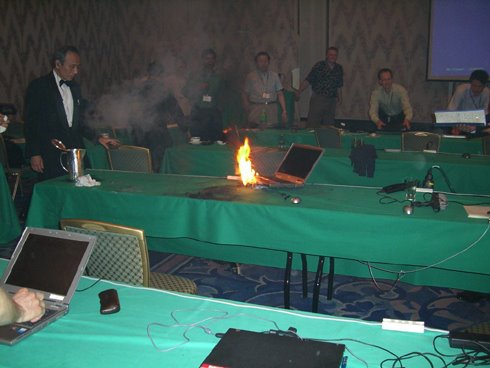
Check out the guy in he left foreground. While the Dell burns itself out, he's typing away on his own laptop.
The fact is that we aren't going to give up our mobile devices, so we're all going to live with some risk. But please be careful about buying off-brand lithium ion batteries. You want to get them from a company that's obsessive about quality control.
Subscribe to:
Posts (Atom)