skip to main |
skip to sidebar
-
Download Game Galaga for Nokia 5800, N97, X6, 5230, 5233, 5235 and 5530
-
Motorola Mobility Brings Android™ to its Iconic MING™ Line with Three New Smartphones for China
-
Download Game Badman Brothers for Nokia 5800, N97, X6, 5230 and 5530
-
Download Game Gish Reloaded for Nokia 5800, N97, X6, 5235 and 5530
-
Early Problems with the "3G" in the iPhone 3G
PDA 24/7 just ran an interview with me. In one of my answers, I talked about which device companies "get it" – which ones understand how to make a truly effective smart mobile solution. Looking back at my answer, I realized I had left out a couple of companies. I want to correct that oversight.
Before I list the companies, I should explain what I mean by "get it." I think that a truly effective smart mobile device must be both focused and integrated. By focused, I mean that it must first and foremost solve one particular problem for a particular type of user. Kitchen sink products that try to be everything for everyone sell to enthusiasts but no one else. The companies that get it specialize in leaving out features that aren't essential to the core product.
By integrated, I mean that the product must combine hardware and software (and in some cases wireless services) seamlessly to produce a product that just works. People usually tend to use mobile devices in short spurts while they are on the go. This makes them very intolerant of even small usability problems that might be overlooked on a PC. If the user must hassle with configuration, or if the user experience isn't dead simple, you're back to selling to the enthusiasts.
Most companies in the mobile market don't know to design like this, either because they don't know how to make hardware and software together, because they're not good at usability, or because they don't know how to focus on solving a single problem. The lack of these skills is holding back progress in the mobile market, so it's worthwhile to study the companies that know how to do it. Here are the ones on my list:
Nintendo: Differentiation, not features. Frequently written off by the feature-centric press, Nintendo has continued to succeed because it focuses on a particular market (gaming) and type of customer (young people), and it adds features that do special things for them. My favorite example is the Nintendo DS gaming device. A technophile would ask for WiFi, a high-res screen, and a faster processor. Instead Nintendo added a second screen – and a touchscreen at that. Nintendo then designed applications that take advantage of the touchscreen to create a unique gaming experience.
This is a classic example of designing for the solution. The traditional PC-style design approach says you have to be "up to date" in all of your specs in order to sell well. Nintendo realized that its customers don't care abut features as much as they care about the gaming experience. Nintendo doesn't add features, it adds differentiation.
I don't know if Nintendo will manage to survive forever in the face of the overwhelming financial muscle of Sony and Microsoft, but if it loses I think it'll be because it was spent into oblivion, not because it lost touch with its customers.
Apple: A solution, not a product. It's hard to remember today, but there was a time when MP3 players were viewed as a curious little niche, and many people were skeptical that they'd ever amount to a truly large category. Apple changed that.
The folks at Apple realized they weren't actually selling a music player, they were selling a music purchase and playback system. I think their integration of the whole thing, from iTunes out, is what made the iPod take off.
Apple has wisely resisted most of the advice to load new features into the iPod. Although video has been added, I think it's the exception that proves the rule. Apple could have opened up the OS to third party apps, added a touch screen, built in WiFi and Bluetooth, and an SD slot. Apple could, in short, have transformed the iPod into a Pocket PC. Smart move that they didn't.
In addition to creating a nice business for Apple, this systems focus creates huge barriers to competitive entry and commoditization. To match Apple's solution, a company needs to duplicate the iPod itself, the iTunes music store, and all of the business development deals that Apple has made with the music industry. It's not impossible for a competitor to replicate this, but it's enormously more difficult than copying a piece of hardware, and it takes a lot more investment. The hardware-cloning shops of Asia, looking at that huge mountain to climb, tend to focus their efforts elsewhere.
Apple's well aware that it gets it. Here's Steve Jobs in Rolling Stone magazine: "We do, I think, very good hardware design; we do very good industrial design; and we write very good system and application software. And we're really good at packaging that all together into a product. We're the only people left in the computer industry that do that. And we're really the only people in the consumer-electronics industry that go deep in software in consumer products."
Steve's exaggerating a little, but after all the times he's personally been written off by the industry, I think he's entitled to brag.
RIM Blackberry: Patience pays off. You've heard it before – the old folks who reminisce and say things like, "I remember ol' Georgie Bush when he was just a little so-and-so getting blitzed at frat parties." Well, I remember RIM when it was a weird little Canadian upstart making e-mail pagers. The company wasn't flashy. It didn't hold big parties like us important companies in Silicon Valley, its products couldn't be bought in consumer electronics stores, and oh by the way it ran on an obsolete paging network.
RIM's current success was many years in the making. It carefully built up a franchise in targeted corporate markets. Selling to those companies takes years of patient work, while they do trial deployments and make you prove yourself. RIM gradually got its servers into a huge number of companies, which resulted in an explosion of device sales once the trial deployments were finished. RIM also took the time to create a very reliable e-mail management network, something that is not at all easy to do. It integrated its products very nicely with Outlook, the leading corporate e-mail system. It carefully honed the user experience for mobile e-mail users. And for its first few years it rented time on a paging network that had excess capacity and was therefore inexpensive.
I'm not completely comfortable with everything RIM's done. The company was very aggressive at enforcing its patents against competitors, which set the stage for others to do the same thing to it. And it has been very slow to deliver on its promises to let its service run on other companies' devices. But to me, the most important lesson from RIM was its single-minded focus on doing e-mail right and building its market over time. It had a vision, and it methodically implemented that vision over a period of many years – far longer than most Silicon Valley companies would persist at anything.
Palm: Obsession with detail. I wasn't with Palm during the days when they first designed the Pilot, unfortunately. But I spent a lot of time with people who were there, and the thing about them that impressed me most was their passionate obsession with tiny details.
They could sweat pixel placement and interface flow better than any bunch of people I've met before or since. It wasn't a science they were practicing, it was a craft in which they went over and over and over the details of how a typical user would operate the product, constantly asking how they could save that user a half-second in time or a moment of confusion.
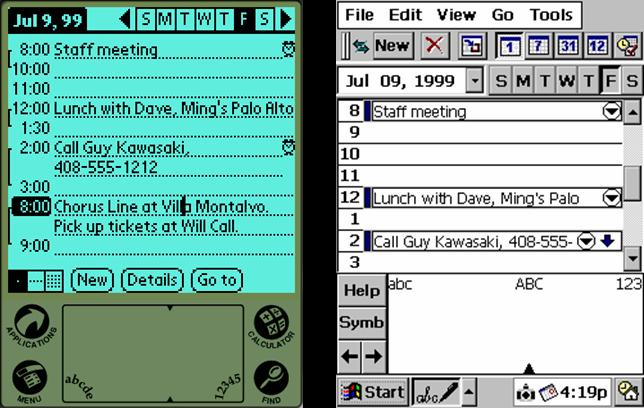
The interfaces they designed weren't always pretty. In fact, they were often darned ugly. But they were amazingly efficient in the way they used screen real estate. Here's one of my favorite examples:
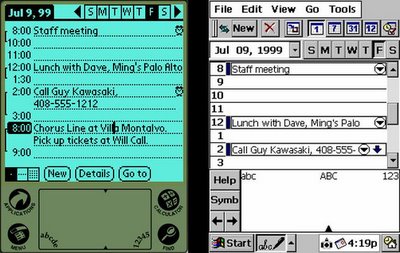
This is Palm (left) and Pocket PC (right) circa 1999. I deliberately chose an old example because I don't want to get sidetracked into an argument about whose interface is better today.
Some important things to notice in these images:
--The Pocket PC screen has about 40 clickable icons and controls, the Palm one about 24. More isn't better in this case, because the Pocket PC screen is bewilderingly complex.
--It's hard to see from a static screen, but the Palm calendar lets you tap in an entry and edit it directly (you can see the text cursor in the word "villa"). On Pocket PC, tapping in an appointment opens up a separate dialog box to edit the item. That's a waste of time.
--Although the Palm screen has a smaller active area, you can read more of the calendar than you can on Pocket PC. That's because Palm blanks out unused hours, whereas Pocket PC tries to replicate the look of Outlook, where every hour is displayed. That works much better on a PC than it does on a tiny handheld screen.
Those little touches like editing in place and hiding unused hours didn't just happen, they were the result of many hours of agonizing effort by the designers at Palm.
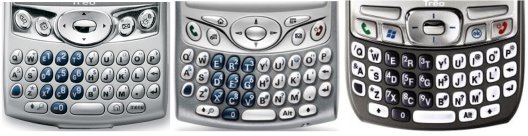
A more recent example -- look how the Treo keyboard has evolved:
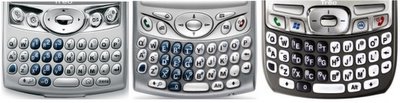
From left to right, these are the Treo 600, the Treo 650, and the Treo 700. Look carefully, and you can see how the designers at Palm are thinking. In each product generation, they've rounded the corners of the case a little more. This makes the device look and feel thinner. They've added more of a "smile" to the keyboard (which makes it easier to round the edges), and they've steadily increased the color contrast between the keys and background. The buttons themselves have become more square, which gives more room to print letters and icons on them. Squaring the keys also makes them larger, which may make it easier to press them with a thumb (although I worry that it also has the effect of making the keys closer together). Overall, Palm is gradually figuring out how to make the best use of every millimeter available to them.
This sort of incremental, obsessive rethinking is typical of Palm's best designers. Nothing's ever perfect.
Although Palm spends a lot of time on hardware and user interface, the thing Palm hasn't tried lately is creating an online or wireless service to go along with its devices. Palm dabbled in that once with its Palm.net service for the Palm VII, and it worked very nicely. Unfortunately the company didn't build on it. It will be interesting to see if a future Palm solution includes an online component.
Danger: Lots of potential. I think Danger deserves honorable mention here. They haven't been as successful as the other companies I listed, but I admire their focus on making a communicator for the youth market. Even though they're stuck with the weakest major US carrier, they've produced pretty good sales – in the monthly unit numbers I used to get, the Danger device often outsold any single model of RIM Blackberry at TMobile.
This level of success has been achieved even though the Danger device lacks an MP3 playback capability, something that's almost essential for the youth market. If Apple really wanted to create a great music phone, they ought to build iPod capability into a Danger device.
There you are, my four (and a half) companies that "get" the smart mobile market. What do you think? Does anyone else belong on the list?
"The first thing we do, let's kill all the carriers."
--Henry VI Part 2, as performed by the Silicon Valley Royal Shakespeare Company
I want to let you in on a little secret: the company most disliked by people in Silicon Valley is not Microsoft. It's not Google either. And no, it's not Intel, Apple, eBay, or even SCO.
Don't get me wrong, there are plenty of people who want those companies dead, but even the hostility toward Microsoft at the peak of its power pales in comparison to the contempt that people in Silicon Valley reserve for the companies that own the pipes: the carriers, networks, publishers, and content distributors who deliver entertainment and communication to consumers.
Most of the nastiness is expressed in private conversations in hallways and restaurants, but occasionally a bit of it boils over into public view...
"Carriers haven't been hot-houses of innovation, they've been charnel houses."
--Nathan Torkington of O'Reilly Radar
"The post-millenium world’s biggest adversity is the monopolistic control over the broadband pipes in many countries including United States."
--Om Malik of Business 2.0
(Silly me, I thought it was terrorism or maybe global warming.)
"It's amazing how the labels always seem to come up with new ways of screwing artists: if they're not cheating them out of royalties, they're systematically alienating their fan-base."
--Author and commentator Cory Doctorow
"Apple's never been very good at going through corporate orifices in order to get at the end users. And if we can't do it with 500 companies, you can imagine it's even harder when there are only four."
--Steve Jobs, on selling products through the US operators.
(Everyone in Silicon Valley knew which orifice he meant.)
Why's there so much "negative energy?" There are cultural disconnects and lingering bitterness over business deals that went bad during the bubble years, but the main issue is that the pipe companies are just plain in the way of what Silicon Valley wants to do.
For example:
No recording of digital radio. The music industry is lobbying for legislation that, if I understand it correctly, would:
--Prohibit recording digital radio broadcasts (satellite or terrestrial) in less than half-hour chunks.
--Prohibit recording digital radio based on any user preferences, including artists, genres, and song titles.
--Prohibit disaggregation of the recordings (ie, cutting out the commercials).
--Prohibit any recording at all onto any removable media or digital outputs.
Basically, it not only prohibits any TiVo style services for digital radio, it also bans almost any practical recording of digital radio.
High pricing and limited availability of eBooks. Ebooks are much cheaper to produce than printed books. An ebook doesn't have to be printed, distributed, stored on a shelf, or returned if it doesn't sell. Despite these savings, and their potential to make books available to more people, the publishing industry doesn't make many best-sellers available as e-books until they have been on the market for a while. For example, I just checked the NY Times hardcover bestseller list, and I couldn't find any of them on eReader.com, which claims to be the world's biggest ebook store.
Even when books are made available, most of the publishing industry insists that ebooks have to be sold for virtually the same price as printed books, even though they are massively cheaper to produce. Check out these books that were featured on the home page of eReader:
SuperFoods HealthStyle
Print price: $16.47 on Amazon
ebook price: $17.96 on eReader
Star Wars: Dark Nest, Book 2
Print price: $6.99 on Amazon
ebook price: $6.64 on eReader
The Five Lessons a Millionaire Taught Me
Print price: $10.17 on Amazon
eBook price: $8.54 on eReader
As far as I can determine, the publishers' main motivation for doing all of this is to protect the current book sales channels. The publishers are also afraid of ebook piracy. I think most of them would be happier if the whole ebook concept just went away.
That's good news for the Barnes & Nobles of the world, but it cripples the adoption of ebooks. Consumers want to read what's popular now, and they rightly ask why they should pay the same price for a digital copy as they pay for a tangible object. In 1999 I worked for SoftBook Press, an e-book company. This issue helped to drive them out of business.
Mobile phone companies: paternalism and slow innovation. The mobile phone industry is notorious for trying to create "walled gardens," tightly controlled collections of content and services for which they charge substantial fees. They tend to put obstacles in the way of open, unlimited access to the Internet, and are much slower to enable new services than Web companies are. I've had some mobile software developers tell me they were forced out of business because their funding ran out before the operators gave them permission to operate.
There are sometimes good reasons for the operators' caution – they've been burned by a lot of failed data services (can you say WAP?), and they're afraid rogue software might somehow attack and destroy their networks. But the feeling among many tech companies is that the operators are using this as an excuse rather than actually trying to solve the problems. They believe the security fears are just a smokescreen for trying to extract more money from users and software companies. After all, the world's ISPs have managed to live with open access over phone lines and cable networks for years, and nobody's network has been destroyed.
The operators are also seen as paternalistic toward users. I have vivid memories of a meeting with a major US operator in which we discussed the fact that a very popular phone in Europe had low sales in the US. I cited that as an example of how different the markets are around the world. "Oh, no, I can explain that," the operator replied. "We don't like that company and we won't let them sell their phones here."
That attitude, in which the operator does the thinking for the customer, is incredibly uncomfortable to most Silicon Valley companies. They are used to selling directly to end users, and don't want to work through anyone else (thus Steve Jobs' comment about "orifices"). They want the operators to be neutral providers of all products and services, enabling customers to make their own product decisions. That's the way the wired Internet works, and Silicon Valley wants the same thing in wireless.
Differential pricing on broadband. BellSouth and a number of other ISPs are starting to talk about charging websites for priority delivery of high-speed data. Aside from all the hostility this is generating among users who already paid for high-speed service, such a fee on high-speed delivery is seen as a barrier to small companies creating new data-heavy services. Such companies are often the most innovative, so this could have a chilling effect on Web innovation. As US chief justice John Marshall put it, "the power to tax involves the ability to destroy."
Those are just a few of many, many, many examples. Taken together, they are creating an almost endless appetite in Silicon Valley for business plans that feature the destruction of carriers and content publishers, even if the plans are longshots. For example, I think a lot of the enthusiasm around here for WiFi and VOIP is driven by a visceral hope that someone will find a way to use them to bring down the phone and cable companies.
From what I hear, most of the pipe companies hate and fear Silicon Valley right back. Here's a nice article from the LA Times on Hollywood's paranoia about Google.
I'm not trying to say either side is inherently evil. The industries just have different histories, perspectives, and interests. They don't see the world the same way, and they want different things. It's fair to ask if they might be able to learn to cooperate over time. Can't we reason together? Can't we find a common ground? Can't we all just get along?
Nah.
This isn't just a misunderstanding, it's a collision of market forces. It's going to be a fight to the death, or at least a fight to the severe disabling head wound. No amount of diplomacy can change that. Besides, I think it would be wrong to try. If we simplify the pipes in the right way, I think it would be a big benefit for consumers, for content creators, and for the economy as a whole.
The problem (and the opportunity)
Over the years, a series of elaborate, multi-step business mechanisms have evolved in order to move entertainment and communication from creators to consumers. (Books, for example, go from authors to agents to publishing houses to printers to bookstores to readers.) Those systems all have three things in common. First, in most cases, the vast majority of the money paid by the consumer is absorbed by middlemen rather than the content creators. Second, the middlemen view their points of control as entitlements, and will fight like rabid wolverines to keep them.
And third, the Internet and new technologies create potential mechanisms to break their control, radically simplify the distribution chain, and enable a much higher percentage of the total revenue to flow back to content creators.
Today there's intense interest in some of the benefits we could get from new distribution channels. For example, the Long Tail weblog is focused on how new forms of distribution can make it economically viable to create content for narrow vertical markets (the "long tail" at the end of the demand curve).
But many of the ideas aren't new. The late Peter Drucker once predicted that electronic publishing was on the verge of making magazines obsolete.* Today, 28 years after he made that prediction, electronic publishing is still on the verge of making magazines obsolete. This is typical of much of the analysis of new content channels – it tends to focus on the benefits and gloss over the process of getting from here to there. We assume the benefits are so compelling that it'll just happen. But in my experience the real world doesn't usually work that way. If you dig into the details, there's usually a tipping point that combines economic models, new technology, and new business infrastructure that must be created before a new channel takes off. If any element is missing, the transition never happens at all.
The barriers are very different in each industry, which means the pipes won't all change at once, and some of them may not change at all. To figure out what needs to be done, you have to look at each case individually.
That's what I plan to do over the next few weeks. The first one I'm going to cover is music.
(Sorry to leave you hanging, but if I try to write this thing all at once I won't post anything until March.)
__________
*Adventures of a Bystander, Peter Drucker, 1978. If you don't already have this book, you should get it. Then check out the chapter on Henry Luce.
Today we have a great case study in how incomplete statistics can confuse people about the use of data services on mobile phones.
A Nokia manager recently gave a talk on the use of data services on mobiles. The presentation said that 63% of packet traffic generated by smartphones is Web browsing. Unfortunately, the presentation is no longer posted, but it was excerpted by Simon Judge's weblog, and subsequently reposted by Russell Beattie of Yahoo, who runs a very high-traffic mobile weblog that's a great info resource. Russell headlined his post, "Browsing: The Mobile Data Killer App."
When I looked at the source data, I couldn't find evidence to support that conclusion. I am not trying to pick on Russell here – the problem is not with his post, but with the incomplete data from Nokia. I'm hoping that when I can finally see the full presentation it'll have better documentation, but the pieces I've found so far are not encouraging.
If you've used a Nokia Series 60 smartphone, you'll know that they're not really all that smart. Most of them are not good e-mail clients because they don't have keyboards, and it's hard to find a lot of third party apps. Browsing is one of the most usable data features in the phones, so I'm not surprised that it's generating most of the data traffic. In the few slides I saw, Nokia didn't tell us the total amount of data traffic generated by the phones, so it's possible that browsing is generating 63% of a very small number.
That possibility is supported by another curious statistic on the slide – only 60% of the users have sent even one MMS (photo) message, and the people who do use MMS send an average of only 1-2 MMS messages per month. That means the average Series 60 phone is generating at best about one MMS message per month. When the carriers subsidized those camera phones to the tune of one or two hundred dollars each, it was with the expectation that they would produce a heck of a lot more MMS traffic than that. At that rate, the subsidy will never pay for itself, and the operators of the world have basically given free electronic cameras to several hundred million people and made no net profit from the exercise.
Simon's weblog also referenced a press release from Telephia, a mobile phone research company, that seems to have some similar statistical fuzziness. It says a survey shows much more aggressive mobile data usage by 3G users compared to non-3G users. For example, it says 56% of the 3G users browse, compared to 39% of non-3G users. 35% download video clips, compared to 11% of non-3G users. And so on. Unfortunately, what the press release doesn't say is what those 3G users did with their phones before they upgraded to 3G. Did 3G cause people to use more data, or did the heaviest users of data migrate to 3G? Without a before and after look at the billing history of the people who switched to 3G, we can't tell.
It's possible that Telephia did track the data usage of individuals, but the press release doesn't say so, and I doubt they did it because running a study like that is wickedly expensive. Without more specific information, we can't tell if 3G is actually increasing traffic and billing, or just giving a new (and heavily subsidized) toy to people who were already using a lot of mobile data.
Again, my point here is not that Simon and Russell are wrong, it's just that you have to ask a lot of probing questions about any industry statistics – especially those that claim to have discovered a killer app.
Scott McNealy as quoted by the Register:
"I guarantee you it will be hard to sell an iPod five or seven years from now when every cell phone can access your entire music library wherever you are."
Scott, I guarantee you that even if it's easy for any phone to access your online music library five years from now, most users will prefer to store the music locally so they don't have to pay a big wireless download fee every time they want to listen to Bohemian Rhapsody, and so the song won't stop in the middle when they go out of coverage.
Google's new video store seems to be up and running. I say "seems to be" because when I looked at it my first reaction was, "Is that it? You guys used a CES keynote to announce that?" The interface is simple, as you'd expect from Google, but in this case simple means simplistic and primitive. The home page features three types of video – for sale, most popular, and random. To examine for-sale videos by category, you use a drop-down menu that lists each series available: classics like MacGyver, Star Trek Deep Space Nine, and Survivor Guatemala. This interface isn't going to scale to handle more than 20 or 30 series, and even now it does almost nothing to invite browsing or easy exploration.
The press has been saying that Google Video sets up a direct confrontation between Google and Apple's iTunes. If this is the best Google can do, iTunes is going to win in a walkover.
I have to assume Google is working on a better interface, but the fact that they made such a prominent launch event for something so disappointing implies to me that their marketing judgment isn't very good these days.
Despite all of that, I think Google Video is incredibly important. Not because it puts Google in the video business (I don't think all that many people will pay to watch videos on their PCs), but because of the infrastructure behind it. Google now has a billing engine.
I haven't been able to find all the details on how Google's billing works, but so far it looks fairly well thought-through. You can read a couple of articles here and here. The owner gets 70% of the revenue, and Google keeps 30%. That's a bit high; I think the right cut is 20%. The minimum price for a video is five cents, which really impressed me. The credit card companies don't like to process charges that small, so I don't know how Google's doing it, but it's a very good thing because it encourages impulse buying. It looks like we're finally going to get an Internet micropayment system with critical mass!
Google also reserves the right to take a bigger cut of your revenue if you consume an unusual amount of resources (I presume that means if your video is so popular that Google has to buy a new server to host it). The exact circumstances in which Google will take more are not spelled out, which makes me deeply uncomfortable.
Questions aside, the terms are a lot better than what mobile software companies get from online stores like PalmGear and Handango, which can keep 50% or more of your revenue. And that's my point. Now that Google has a billing mechanism, it can apply it to any form of electronic content – software, photos, e-books, music, articles, analyst reports, and so on. I think you could eventually see purchasing built right into search results – along with the option to translate a web page, you could have the option to buy a piece of content.
The next logical step is for Google to tie the billing engine to Google Base, so people can sell any electronic file through Google. This is potentially very powerful. Think of a small software developer looking to sell an application. Today they need to either sell through an online store (which takes a huge cut) or set up their own e-commerce site (which is a big pain in the neck). It's going to be enormously tempting to just offer your stuff through Google instead.
The Google vs. Apple video competition will be interesting, but ultimately I think video's a sideshow. Google's gradually setting itself up to be the middleman for anything that can be shipped electronically. I think that's the real importance of the Google Video announcement.
I'd like to thank the folks at PDA 24-7 for naming Mobile Opportunity one of the two best mobile-related weblogs of 2005.
This would probably be a good time to say what I'm hoping to accomplish with this blog. I set it up as a way to share what I've learned about mobile computing, plus any other interesting tech-related information I run into in the course of my consulting work. So you're going to get a mix of mobile and non-mobile information. I'm not trying to advocate any particular company or product; I just want to help grow the industry and help users make well-informed decisions.
I'm trying for quality rather than quantity. I expect to post one or two times a week on average. Blogger produces an RSS feed, and I think that's a great way to read the material since I'm not posting every day.
I have received one report of a validation problem with my feed. I use Bloglines, and I know the feed works fine there. But if you run into problems, please contact me via the address here. Also please let know if you have questions or want to suggest any topics for me to cover.
Thanks for visiting.
Yes and no.
But mostly no. It doesn't matter the way the OS companies want it to.
Recently two telecom analysts in Europe published essays saying that there isn't going to be a winner in the mobile OS wars. The UK research firm ARC Chart wrote, "far from the market consolidating around one or two of major OS platforms, the number of middleware systems for which applications can be developed for is actually increasing.... The mobile OS story is no longer simply about a war between Microsoft and Nokia."
(Actually, the story was never simply between Microsoft and Nokia, even if you're watching only the European market. But that doesn't invalidate their main point.)
Then analyst Dean Bubley chimed in: "Let's face it, heterogeneity in mobile phone OS is permanent. At the bare minimum, Nokia will continue to champion Symbian, Motorola will push Linux, HTC is making a good living with Windows Mobile, and assorted proprietary OS's continue to make traction because consumers don't care.... OS diversity is a baseline. Most manufacturers recognise this, and most mobile operators as well."
Unfortunately, ARC Chart went on to theorize that middleware software platforms are going to take on the standard-setting role that the OS was supposed to play. They cite products like Brew, Savaje, and Action Engine as examples.
I don't think so, not if they behave the way the mobile OS vendors have behaved. I think the most important words were Dean's: consumers don't care. I wouldn't make the statement so categorically, but I think it is true that most customers don't care. Here's why.
The PC fallacy
As I mentioned in my post on the Myth of the Smartphone Market, one of the most common mistakes made by people in the mobile industry is assuming that their market will work like the PC market does. More often than not, it doesn't. If you use PC assumptions and PC reflexes to run a mobile company, chances are you'll lose your shirt.
This is why people who've worked a long time in the few really successful mobile data companies, like RIM and Palm, sometimes come off as smug and dismissive when they get advice from outsiders. If you approach them from a PC perspective, they'll tune you out faster than I tune out country music when I run into it on the radio.
One of the most basic assumptions of the PC world is that one OS eventually wins. Even if two operating systems start out even, one of them eventually gets a little better sales. Seeing a better chance of selling applications on that platform, more developers concentrate on it. The higher number of apps brings in more customers, who draw more developers, who attract even more customers. The process feeds off itself, and pretty soon one OS has 90% of the market and the other is called Macintosh.
For years almost everyone (including me) assumed the same effect would operate in mobile devices. But does it? Let's look at the evidence.
At the end of the century, the Palm OS took a commanding lead in mobile application development. The company's developer base grew from about 3,000 registered developers in 1998 to 23,000 in 1999 to 130,000 in 2000. The application base grew at the same rate, vastly outstripping everything else on the market. By all the rules of the PC market, this should have been the end of the game. As licensing increased the base of Palm OS devices, every other mobile platform should have been wiped out of existence.
But it didn't happen.
There are a lot of reasons why. Microsoft and Nokia were both willing to endlessly subsidize competing platforms, for example. But another key factor was that the "network effect," the bandwagon process in which a leading platform sucks up all the customers, simply didn't work. The users didn't behave the way they were supposed to.
It's the solution, stupid
What are the two most successful smart mobile devices on the market today? iPod and RIM Blackberry. What operating systems do they run?
Uh, well...
Last I heard, the iPod runs a mashup of software from Portal Player and Pixo. RIM runs its own embedded OS (I don't know if it's proprietary or derived from an outside product), plus Java. Neither of them have fully mature software platforms with a large range of third party applications, and yet they outsell the products that do.
"Wait," someone might object. "Those products just sell the best because they work best. If someone had a really good product on an open operating system, it might sell the best." And that's exactly my point. In PCs, the industry-standard operating system can propel even inferior hardware designs to leading sales (ask any Mac owner). The PC OS generates demand. In mobile devices, the "solution" – the device's main functionality – is usually what generates demand. The mobile OS doesn't matter. Or a more accurate statement would be, something else matters a lot more.
This wouldn't be as much of a problem if the mobile device companies were good at creating mobile data solutions on their own. Then they'd pick the OS with the best plumbing and build a great product on top of it. The OS still wouldn't matter to most users (it would be equivalent to a no-name embedded RTOS, something like TTPCom's Ajar or OpenWave's client software), but at least you could count on it to be an element in the best mobile devices.
Symbian has tried to follow this route. It's owned by mobile phone companies, and they generally don't want it to have anything to do with creating end-user value – the phone companies, particularly Nokia, view that as their turf. The restrictions are so tight that Colly Myers, former head of Symbian, says the company shouldn't have even tried to create a user interface for its product.
But most mobile device companies, especially the big ones, are terrible at creating integrated hardware-software solutions. They're hardware companies, not software companies. The mobile operators are little better; they generally understand voice but not data. So you get a three-way traffic jam of OS vendor, hardware company, and operator (if the device is a phone), none of whom are in a position to architect the whole solution and make mobile data sing.
I do think there's hope for an application platform to establish itself as a standard in the mobile world, but it needs to be structured and managed differently from anything that's on the market today. I'll write about that later this month. In the meantime, the industry needs to understand that smart mobile devices today are basically appliances. Most people buy them to solve one major problem in their lives, and they'll favor the device that is the best solution to that particular problem. Blackberry is the best solution for mobile e-mail, so people buy it even though it sucks at almost every other function. iPod is the best solution for mobile music, so people buy it even though it can't do much of anything else.
There are a relatively small number of users, like me, who care so much about having a multifunction mobile device that we'll pay more and compromise on other features (such as weight and simplicity) to get it. The Palm OS ones are very loyal to Palm OS, and the Windows Mobile ones are very loyal to Windows Mobile. Although we're very noisy on the web, we're actually a relatively small percentage of the population. There aren't enough of us to create the sort of mass horizontal market the consumer electronics and phone companies are looking for.
Does that mean mobile operating systems are dead? Nah, but if the OS companies want to have a major impact on the market, they need to step up to providing full solutions to major user problems, rather than just plumbing. Picture a version of Windows Mobile that includes a well integrated system for downloading and playing music. Or a version of Palm OS that comes bundled with a great corporate e-mail solution and software to handle attachments. Those mobile software products could sell well. What's dead (or at least uninteresting and low value) is mobile operating systems that try to succeed by just being great infrastructure. That worked in PCs, but it won't work in mobility.