I went to two conferences this week: the CTIA telephony conference in Los Angeles and The Future of Web Apps in San Francisco. It's always interesting to travel between the Bay Area and southern California. This is going to irritate Bay Area partisans who like to look down on LA, but I think the cultures are almost identical in the two areas. The main difference is that drivers on the freeway in southern California are more likely to yield the lane when you put on your turn signal (the standard behavior in the Bay Area is to speed up to protect your turf).
There are huge economic differences between north and south, though. Los Angeles and the sprawl around it make up an intensely vibrant, wildly diversified economy. No industry dominates. The place is a huge cultural melting pot, and many fashion and social trends incubate there first before they spread around the world.
By contrast, the Bay Area, and especially Silicon Valley, is more like a hothouse full of orchids. There's less diversity, and the atmosphere is a little more inward-focused, a half-step out of sync with the rest of the world.
The vibrancy of Los Angeles outside the Convention Center made a striking contrast to the sleepy atmosphere inside at CTIA. There were very few new products on display, and I didn't see anything that generated intense excitement (the biggest crowd of the day turned out for a stunt bike exhibit). Even the press coverage from the show focused heavily on business worries -- the failure of mobile video to take off, lack of profitability in mobile games, and speculation about mobile advertising.
Later in the week, a two-day conference on web apps was held in the Palace of Fine Arts in San Francisco. The Palace is Greco-Roman fantasy temple left over from the San Francisco world's fair of a hundred years ago, and it's across the street from the newly-built headquarters of the Lucas film empire (where you can see a life-size bronze statue of Yoda). It's hard to picture a more fairy-tale setting for a conference.
And yet, the presentations inside were sizzling with energy. We heard from companies that are creating important new businesses and making meaningful differences in the lives of millions of users – organizations like Flickr, Digg, and Dogster. Silicon Valley may indeed be a hothouse, but it's turning out some very promising orchids right now.
There's a collision coming between the wireless world and the web, and I think it won't be pretty. The best way to describe it is by analogy. Picture a raging river fed by the meltwater of a hundred glaciers. The jagged river valley is suddenly blocked by a dam. What happens?
The water starts to rise, of course. If the dam is well operated, the water can be harnessed to generate power. But if the spillway stays closed, the water will eventually pour over the top of the dam and rip it apart.
The river is the torrent of innovation happening in web apps right now. The dam is the carriers who won't allow that innovation to run freely on their networks. They haven't figured out how to set up spillways and generators, let along operate them, so the pressure of the water keeps growing as web innovation gets further and further in front of what you can do on the wireless networks.
At some point one of the carriers is going to give in, or a technological change will give the web apps crowd unrestricted access to a mobile wireless platform with broad coverage. When that happens, I think the pent up innovation and new business models in the web will sweep through the wireless world like a flood. The longer the pressure builds up, the faster the change will be when it happens – and the more likely that many of the major carriers will be swept aside in the process.
I know this is a very broad and vague-sounding prediction, and if you're confused or skeptical I don't blame you. Next week I'll write in more detail about both shows, to give you the details on what I mean and why I'm saying it.
__________
Thanks very much to David Beers at Software Everywhere for naming my post on European and American mobile phone use the post of the week in the latest Carnival of the Mobilists. There's a lot of interesting material in this week's Carnival.

Good luck naming your phones, Nokia
By now you've probably seen the news that Nokia is going to start naming its phones just like the Razr, rather than assigning them numbers.
I'm tempted to make an unkind comment about Nokia once again playing catch-up to others in the industry – first camera phones, then flip phones (or clamshells, as some parts of the world call them), then ultra-thin phones, and now named phones. There's a pattern here, and it's not very comfortable for a company that wants to be seen as a market leader.
But actually I sympathize with Nokia's situation, and I think they are making a noble effort in this case. I also think it won't be fully successful, and I'd like to explain why.
In many years of work at various tech companies, I've been through dozens of naming exercises. Every company that has half a brain somewhere in its marketing department wants to use real names for its products rather than numbers. Names are easier to communicate, and easier for customers to remember. A good name will also have some emotional resonance to it, meaning you need to spend less money marketing it.
But there are several huge problems with using real words as product names.
First, most of the good names are already taken. The situation is a lot like trying to find an interesting and unique URL for a website. Years ago, companies grabbed virtually every interesting name, and a lot of the ugly ones too. When I was at Apple, for example, we tried to secure rights to the names of every prominent variety of apple. Fuji was already taken by the Japanese film company, but we bagged several others. Pippin was one of the big prizes. Because it sounded cute, and we saved it for years before finally blowing it on a multimedia console.
When a company looks for a product name, typically what you'll do is brainstorm a couple of dozen possible names that sound right and maybe have some sort of link to the way you want the product to be perceived. There are always a couple of favorites on the list, and the rest are backups. You then turn the list over to the lawyers to check for conflicts with existing trademarks. When the list comes back a couple of weeks later, the lawyers have inevitably crossed off all the names you liked and also most of the ones you were lukewarm about. Of the four that are left, two will turn out to be either unpronounceable or pornographic in Japanese. You end up looking at the two remaining possibilities and trying to convince yourself that you can live with something that made you want to puke a couple of weeks ago.
This is how one version of Palm OS ended up with the name "Garnet," by the way.
After going through this process a few times, you realize that you're spending far too much money and time on lawyers and naming consultants. So you decide it would be much more convenient and efficient to use numbers or letters instead. You come up with a clever numbering and lettering scheme. Maybe you name your product after the year in which it's released (Windows 95). Or you come up with a clever letter scheme using macho letters like "x," "z," and "f" (Macintosh IIfx). You spend a lot of time explaining the new scheme to the press and customers.
Even though this reduces your trademark search fees, there are still problems to watch out for. Different cultures are afraid of different numbers. In much of Europe and the US, the number 13 is not welcome. You'll terrify some Christians if you use three sixes in a product name, because they see that as the sign of the devil. In Japan and China, the word for "4" sounds a lot like the word for "death," so you can't use that (supposedly, the fear is so strong that the death rate in Asia is higher on days that have a four in them). Is it the fear that's killing people, or does the number itself do them in? Hard to say for sure. If you check out Nokia's product list you'll see that the company is very aware of these issues – there is no four series, there are no products with three sixes in the name, and I could find no 13s at all.
Within 18 months, any numbering and lettering scheme that you choose will start to break down. Maybe you'll still be selling Windows 95 in 1997 and everyone will laugh at you. Or as you come up with new products, you'll have to figure out how to fit them into the existing scheme. You run out of numbers, or have to add more letters to the mix. One day you find yourself trying to explain to a roomful of press people the difference between the 2253xt and the 2253xz. They're all staring at you completely blank-faced, and you wonder why you're wasting your life working on garbage like this. You resolve that the next generation of products will have real names. And the process begins again.
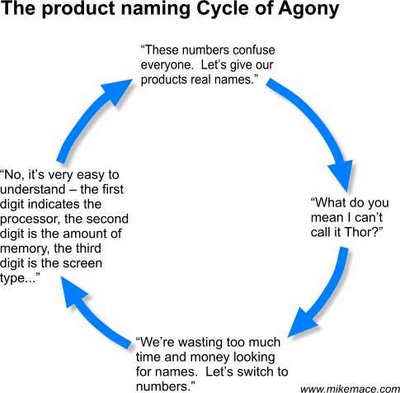
The full cycle from name to numbers and back to names usually takes about six years. Almost every tech company that sells to consumers goes through it. The main exception I'm aware of is Apple. Steve Jobs insists on real names, and is willing to spend what it takes to get them. But he also produces many fewer new products every year than Nokia does.
Motorola was brilliant to use common words with most of the vowels removed from them; you get the image associated with the name, without the trademark fight. But now that's been done, and I doubt Nokia will be able to come up with a similar brainstorm. It produces so many products that it'll be extremely difficult to name all of them, especially if the name searches start to delay product launches. So instead I think Nokia is likely to name families of products, with letters and numbers indicating the actual models. That will work for a while, but some day Nokia will be trying to name a new product family, and the lawyers will report that the only two names they can get clearance for are RinGo and n-Gage. At that point pure numbers will start to look mighty attractive again.
I'm tempted to make an unkind comment about Nokia once again playing catch-up to others in the industry – first camera phones, then flip phones (or clamshells, as some parts of the world call them), then ultra-thin phones, and now named phones. There's a pattern here, and it's not very comfortable for a company that wants to be seen as a market leader.
But actually I sympathize with Nokia's situation, and I think they are making a noble effort in this case. I also think it won't be fully successful, and I'd like to explain why.
In many years of work at various tech companies, I've been through dozens of naming exercises. Every company that has half a brain somewhere in its marketing department wants to use real names for its products rather than numbers. Names are easier to communicate, and easier for customers to remember. A good name will also have some emotional resonance to it, meaning you need to spend less money marketing it.
But there are several huge problems with using real words as product names.
First, most of the good names are already taken. The situation is a lot like trying to find an interesting and unique URL for a website. Years ago, companies grabbed virtually every interesting name, and a lot of the ugly ones too. When I was at Apple, for example, we tried to secure rights to the names of every prominent variety of apple. Fuji was already taken by the Japanese film company, but we bagged several others. Pippin was one of the big prizes. Because it sounded cute, and we saved it for years before finally blowing it on a multimedia console.
When a company looks for a product name, typically what you'll do is brainstorm a couple of dozen possible names that sound right and maybe have some sort of link to the way you want the product to be perceived. There are always a couple of favorites on the list, and the rest are backups. You then turn the list over to the lawyers to check for conflicts with existing trademarks. When the list comes back a couple of weeks later, the lawyers have inevitably crossed off all the names you liked and also most of the ones you were lukewarm about. Of the four that are left, two will turn out to be either unpronounceable or pornographic in Japanese. You end up looking at the two remaining possibilities and trying to convince yourself that you can live with something that made you want to puke a couple of weeks ago.
This is how one version of Palm OS ended up with the name "Garnet," by the way.
After going through this process a few times, you realize that you're spending far too much money and time on lawyers and naming consultants. So you decide it would be much more convenient and efficient to use numbers or letters instead. You come up with a clever numbering and lettering scheme. Maybe you name your product after the year in which it's released (Windows 95). Or you come up with a clever letter scheme using macho letters like "x," "z," and "f" (Macintosh IIfx). You spend a lot of time explaining the new scheme to the press and customers.
Even though this reduces your trademark search fees, there are still problems to watch out for. Different cultures are afraid of different numbers. In much of Europe and the US, the number 13 is not welcome. You'll terrify some Christians if you use three sixes in a product name, because they see that as the sign of the devil. In Japan and China, the word for "4" sounds a lot like the word for "death," so you can't use that (supposedly, the fear is so strong that the death rate in Asia is higher on days that have a four in them). Is it the fear that's killing people, or does the number itself do them in? Hard to say for sure. If you check out Nokia's product list you'll see that the company is very aware of these issues – there is no four series, there are no products with three sixes in the name, and I could find no 13s at all.
Within 18 months, any numbering and lettering scheme that you choose will start to break down. Maybe you'll still be selling Windows 95 in 1997 and everyone will laugh at you. Or as you come up with new products, you'll have to figure out how to fit them into the existing scheme. You run out of numbers, or have to add more letters to the mix. One day you find yourself trying to explain to a roomful of press people the difference between the 2253xt and the 2253xz. They're all staring at you completely blank-faced, and you wonder why you're wasting your life working on garbage like this. You resolve that the next generation of products will have real names. And the process begins again.

The full cycle from name to numbers and back to names usually takes about six years. Almost every tech company that sells to consumers goes through it. The main exception I'm aware of is Apple. Steve Jobs insists on real names, and is willing to spend what it takes to get them. But he also produces many fewer new products every year than Nokia does.
Motorola was brilliant to use common words with most of the vowels removed from them; you get the image associated with the name, without the trademark fight. But now that's been done, and I doubt Nokia will be able to come up with a similar brainstorm. It produces so many products that it'll be extremely difficult to name all of them, especially if the name searches start to delay product launches. So instead I think Nokia is likely to name families of products, with letters and numbers indicating the actual models. That will work for a while, but some day Nokia will be trying to name a new product family, and the lawyers will report that the only two names they can get clearance for are RinGo and n-Gage. At that point pure numbers will start to look mighty attractive again.
European vs. American mobile phone use
In last week's post about Palm's phone plans, I made a passing comment about the right way to display your mobile phone at dinner in Europe. It turned out to be the most popular part of the post, and produced a couple of requests that I say more comparing European and American attitudes toward mobile phones. I don't pretend to the world's expert on the subject, but I'll summarize what I've seen. Here goes:
In the US, a cellphone is a tool. In Europe, a mobile phone is a lifestyle.
I guess I ought to give a few details. Let me start with a disclaimer: It's very dangerous to talk about "Europeans" as if they're some sort of unified cultural group. Europe is a continent of many nationalities, and each one has a different culture and history. National regulations on phones also differ dramatically within Europe, which has an important impact on mobile use.
I saw a good example of this in the responses to my last post. I said all Europeans put their mobile phones on the table during a meal. I got replies from some countries agreeing with me, and others saying I was completely wrong. It turns out the table thing differs from country to country.
It's only slightly less hazardous to talk about a "typical" American mobile phone user. The culture in the US is more uniform than it is in Europe, but there are profound differences between various market segments. The average 16-year-old in the US views a mobile phone very differently than the average 40-year-old. (Come to think of it, I suspect average 40-year-old mobile users in Berlin and Chicago probably have more in common with each other than either of them have with the 16-year-old.)
Now that I've hedged thoroughly, here are those details:
Vocabulary
The differences start with the words we use to talk about the industry. In Europe, a mobile phone is usually called (in English-speaking countries) a "mobile." As in, "I'll ring your mobile." In the US, mobile phones are most often called "cellphones," and that's sometimes shortened: "I'll call your cell."
The term differs in other European countries, of course (for example, Hermann on Brighthand says the term in Germany is "handy.") I do know that if you say "cellphone" pretty much anywhere in Europe, people will look at you like you're a dork. Found that out the hard way.
Occasionally young people in the US use the term "mobile," but it's not very widespread. I try to use the term "mobile phone" in this website because it's understood on both continents.
There are also differences in the terms used to describe the companies that sell mobile phone services. In the US they are generally called "carriers." But the second easiest way to piss off a European mobile exec is to call his or her company a carrier. They are "operators." As the distinction was explained to me, an operator actively runs a network, while a carrier merely delivers something passively.
(In case you're wondering, the first easiest way to piss off a European mobile exec is to ask how his MMS revenues are doing.)
The operator vs. carrier thing is very confusing in the US, because to most Americans an "operator" is a person who runs a switchboard. The archetypal operator is Ernestine, a character created by actress Lily Tomlin. She snorted annoyingly, was rude, and reveled in her ability to manipulate customers:

"Here at the Phone Company we handle eighty-four billion calls a year. Serving everyone from presidents and kings to scum of the earth. (snort) We realize that every so often you can't get an operator, for no apparent reason your phone goes out of order [snatches plug out of switchboard], or perhaps you get charged for a call you didn't make. We don't care. Watch this [bangs on a switch panel like a cheap piano] just lost Peoria. (snort) You see, this phone system consists of a multibillion-dollar matrix of space-age technology that is so sophisticated, even we can't handle it. But that's your problem, isn't it? Next time you complain about your phone service, why don't you try using two Dixie cups with a string. We don't care. We don't have to. (snort) We're the Phone Company!"
–Ernestine
Some people might say that's a good metaphor for a mobile phone company, but it's hard for an American to understand why any company would want to apply the term to itself.
The mobile phone culture
To me, one of the most pronounced differences between mobile use in the US and Europe is that Europe has a more developed mobile phone culture. There are huge variations in attitude from person to person, but on average, people in Europe expect the mobile to play a more prominent, recognized role in the structure of society, and many people look to the mobile as a central source of new innovations. The belief is almost that the mobile phone has a manifest destiny to subsume everything else. This love affair with the mobile phone is far more common in Europe than it is in America.
You can find a good example of this attitude in an essay about the future, on the website of the Club of Amsterdam, a think tank based in the Netherlands:
"Every machine will be a mobile phone, talking to their owner but mainly to other machines.... In 2020 the world is one big video screen, one big video camera, one big mobile phone.... The mobile will act as a "trust machine". It will be our most important lifestyle instrument. It will probably be decomposed with its core elements scattered all over and inside our body."
People in the US can be just as enthusiastic about mobilizing technology, but they often think in terms of shrinking and mobilizing the PC and Internet, rather than growing the cellphone. In the US, the cellphone is often viewed as a necessary tool rather than something to love. For example, an MIT survey in 2004 found that Americans rated the cellphone number one in the list of inventions they hate but can't live without, edging out the dreaded alarm clock.
If you're still having trouble picturing the difference in attitudes, look at it this way – many people in Europe feel about their mobiles the way that Californians feel about their cars.
Okay? Got it now?
The European love of the mobile phone has several facets to it...
Fashion. To many people in Europe, their mobile phone seems to be a fashion statement. It says something about you, much like your clothing. Americans also care about the look of their phones (just take a look at my daughter's Razr, covered in stick-on jewels and shiny dangling beady things). But in general I don't think Americans identify with the phone as deeply.
It seems much more common for someone in Europe to change phones than it is for someone in the US. All phones in Europe are GSM, and people generally understand that you can pop out your SIM card and pop it into a new phone anytime you want. The mobile is just a skin that you wrap around your phone contract. Major retail chains, like Carphone Warehouse, sell large numbers of mobile phones independent of any operator.
Although you can do the same sort of phone swap in the US if you have a GSM phone, it seems like relatively few people do it, and very few phones are sold outside of the carriers' stores. I'm not sure why. I think awareness of the capability is lower (I'll bet a majority of American GSM users couldn't even find their SIM card). And of course many mobile phone users in the US are on CDMA, forcing them to go through the carrier if they want to switch phones. But also, I think there's just less desire to constantly update your phone in the US, because people don't pay as much attention to it.
Design. This is related to the fashion topic, but it deserves a separate discussion because it's so surprising, at least to me. In most consumer goods, there's an approximate consensus on design between the US and Europe. You can find exceptions, but in general clothing, pop music, cars, and furniture considered to be cool in one continent are admired in the other. In fact, a lot of Americans think of "European design" as automatically stylish. But mobile phone styling and features often polarize people in the US and Europe. In Europe, people generally hate external antennas on a phone. In the US, most people don't notice the antenna, and if they do notice it they may well like it because they assume it'll give better coverage.
Many people in Europe love candybar phones. Most Americans think they look cheap and dislike them. Instead, many Americans love flip phones. I think they feel the flip cover prevents accidental calls, and keeps the screen from getting scratched. Maybe they also feel a bit like Captain Kirk when they flip open the phone.
Many Europeans hate flip phones. I don't know why (although I'll speculate that the flip cover makes it inconvenient to send and receive a lot of SMS messages).
SMS vs. IM. Speaking of SMS, it's vastly more popular in Europe than it is in the US. Some of this difference is generational – young people in the US are much more likely to use SMS, whereas it's extremely rare among older Americans. Some of the difference is also training – most Americans don't have a clue how to enter text on a keypad. But even among young Americans, who do the most texting, I think PC-based instant messaging is still the king, now often tied to webcams.
History helps to explain the difference. The US started with a more PC-centric culture, and then IM was pushed aggressively by AOL in the United States, years before many mobile phones here were SMS-capable. There was no great champion for instant messaging in Europe, and besides PCs with Internet connections were less common there in the early days of IM. So SMS had a lot less competition.
Because of differences in mobile phone billing plans, I'm told that sending an SMS was often much cheaper than making a voice call in Europe. US mobile plans, with their large blocks of monthly minutes, supposedly create less of an incentive to use SMS. (In fact, many American mobile plans don't by default include any pre-paid text messages; you pay separately for each one. There's an amusing television commercial by one of the US mobile carriers showing a father relentlessly pursuing his teenage daughter around town – not to keep her out of trouble with her boyfriend, but to keep her from sending text messages on her phone.)
I did a quick spot check of Orange (UK) and Cingular (US) mobile plan charges, to look at the current price differential between voice and text. The main difference was actually that everything in the UK cost more than it does in the US, perhaps due to the horrific dollar-pound exchange rate. The difference between the US and UK in treatment of text messages was not as dramatic as I expected, but it was there. Today the US and UK both charge more for voice than text, but the plans I looked at in the UK almost all either bundled text messages in the base plan, or had options to get a lot of text messages for free if you spent a certain amount on your voice calls. In the US, text messages were always an option that you had to purchase separately, and there was no opportunity to get free text messages. Basically, you have to plan on spending extra if you want to do texting in the US.
(The details: Using a prepaid plan, Cingular in the US will sell you 900 minutes a month for $60, but you'll have to pay $5 extra per month to get 200 text messages. That same $60 spent with Orange in the UK will get you just 325 voice minutes, but 150 text messages are included in the base price. The UK plan creates a strong incentive to substitute text for a voice call when you can.
(If you look at pay as you go plans, Orange charges 38-76 cents a minute for voice calls [depending on whether the call is to a mobile or a land line], and 19 cents for each text message. So a text message is half to a quarter the price of a voice call. However, Orange also gives you 1,000 free text messages if you spend more than $19 a month. Most people would end up getting the free texting, so their effective price for text messaging drops to almost zero. Cingular charges you about 25 cents a minute for voice calls, and five cents per text message. Texting is one fifth the price of a voice call, actually a better ratio than Orange. However, there's no option to get free text messages, so you know you're paying for them no matter what.)
Differences in market structure
Operator power. In general, the US carriers have more power over their customers than the European operators do, for several reasons. The first is that pay as you go plans are much more popular in Europe than they are in the US. In some countries (Italy, for example), almost everyone was on pay as you go the last time I checked. In other places in Europe, users are split between pay as you go and contracts. But I don't know of any place in Europe where as many people are on contracts as they are in the US (please speak up if I've got that wrong – it's hard to find numbers on the percent of users on each type of payment program).
The second difference is mobile phone number portability (which lets you keep your number if you switch mobile operators). Many countries in Europe had it years before it came into the United States. For example, the UK got portability in 1998, Spain and Sweden in 2000, and Italy in 2001. Americans didn't get it until the end of 2003.
Another important difference is that in parts of Europe phone subsidies are illegal. I know about this one because at Palm I used to track the sales prices of mobile phones, and they varied wildly from country to country. I finally figured out that the subsidies were skewing the numbers. The subsidy laws are changing, and they may be allowed in most countries by now.
I think the relatively weaker customer control of European operators has driven faster innovation in Europe, because the operators have to do more to attract customers. They also can't lock a phone vendor out of the market completely, the way the US carriers have been strangling SonyEricsson.
Mobile versus fixed. Fixed-line phone companies in Europe are often monopolies, legendary for high costs and poor service. I have been told by many friends in Europe that it was faster and cheaper to get a mobile phone there than to wait for a land line, which drove very rapid movement toward mobiles. In the US, land line phone service is generally reliable, quick to install, and cheap, so there's much less incentive to get away from it. Some younger people in the US are starting to get rid of their land lines, but the movement is much slower than in Europe.
Reliability of coverage. In much of Europe, mobile phone coverage is more or less ubiquitous. There are always exceptions, of course, but generally you can make a voice call anytime you want to.
This really came home to me recently when I had the good fortune of taking a driving vacation in the fjords of western Norway. That's some of the most mountainous landscape in Europe, but I never noticed a spot where I was out of coverage (check out this coverage map). Contrast that to a driving vacation in the western US, where once you get out of the cities it is almost impossible to get a signal anywhere. For example, when I was in Grand Canyon National Park in Arizona a couple of years ago, I couldn't get a mobile phone signal anywhere in the park.
The usual American excuse for its poor coverage is that US population densities are low. That doesn't hold up to close examination – Norway has about 15 people per square kilometer, the same density as Arizona, which is not exactly crowded. The US overall has about 33, more than double Norway's density. I think Europe is just more dedicated to universal mobile coverage.
Brands. The prominence of mobile phone brands varies tremendously from continent to continent, and even from country to country in Europe. In general, Nokia is much better known and respected in Europe. Motorola is much better known and respected in the US (although it doesn't have the rock star status that Nokia has in Europe). And there are national champions like Siemens, which is heavily respected in Germany but nowhere else I know of. Samsung's brand awareness has been steadily rising in both the US and Europe, and LG is trying to tail along after it.
The differences over Nokia are the most surprising to my friends in Europe. Throughout Europe, and actually most of the world, Nokia is one of the top elite brands, like Nike in sports or Microsoft in computers. It produces an immediate aura of respectability. In the US, Nokia is lost in the crowd of semi-anonymous Euro-brands -- names like Saab or Peugeot that you've heard of but have never experienced personally.
I think Nokia recently compounded this problem with its "It's your life in there" television commercials in the US. The commercial that stuck in my mind was about "Jill," who praises the phone's ability to delete an ex-boyfriend from her phone's address book:
"It is so great because when you go to the phone and you delete and your phone asks 'Are you sure?' You look at your phone and you're like, 'oh yeah, I'm sure.'"
She then gives one of the most annoying, braying laughs I've heard on TV since...well. Ernestine.
I understand what Nokia was trying to do – it was making a sophisticated effort to tap into the mobile phone culture in the US. You can read a detailed ethnographic analysis of the ad campaign here. The problem for me was that, first, the mobile phone culture Nokia's trying to tap into is pretty weak in the US; and second, that Jill has just a whiff of trailer trash about her.
(Nokia has pulled the website for the campaign, which perhaps tells you how well it was received, but you can still find the commercial on the site of the agency that created it. Just follow this link and move your mouse around on the slider at the bottom of the page until you find Jill. You can also check out the other losers Nokia featured in the series.)
Americans tend to respond best to aspirational ads that make them feel good about themselves for buying a product. So buying a Mac will give you kinship with Einstein and Gandhi, which is outrageous but Steve Jobs can pull that off. Nokia's unintended message was that a Nokia phone will turn you into "a sniveling Sex in the City wannabe," as Gizmodo put it.
I think this is typical of Nokia's inability to connect with the American public.
What about the rest of the world?
There are even bigger variations in the mobile market in other parts of the world, but I didn't have the time (or the knowledge) to discuss all of them here. Mobile phone services and features in Japan and Korea make both Americans and Europeans look like techno-hicks. In Japan, the operators have so much power that phones are sold virtually unbranded, and Japanese phone manufacturers struggle to operate anywhere else in the world because the required reflexes are so different. It will be interesting to see what happens in Japan when number portability is implemented there, in late October. Surveys have said that large numbers of Japanese mobile phone users, especially those on Vodafone, would switch operators if the could.
The market worldwide is so complex that I think it's impossible for any one person to understand it all. So please help me out -- if I missed your country, or if you'd like to add to or correct something I said above, please post a comment.
________
Thanks to Steve at 3-Lib for including my post from last week in the latest Carnival of the Mobilists. Check it out here for a collection of some of the week's best writing about the mobile industry.
In the US, a cellphone is a tool. In Europe, a mobile phone is a lifestyle.
I guess I ought to give a few details. Let me start with a disclaimer: It's very dangerous to talk about "Europeans" as if they're some sort of unified cultural group. Europe is a continent of many nationalities, and each one has a different culture and history. National regulations on phones also differ dramatically within Europe, which has an important impact on mobile use.
I saw a good example of this in the responses to my last post. I said all Europeans put their mobile phones on the table during a meal. I got replies from some countries agreeing with me, and others saying I was completely wrong. It turns out the table thing differs from country to country.
It's only slightly less hazardous to talk about a "typical" American mobile phone user. The culture in the US is more uniform than it is in Europe, but there are profound differences between various market segments. The average 16-year-old in the US views a mobile phone very differently than the average 40-year-old. (Come to think of it, I suspect average 40-year-old mobile users in Berlin and Chicago probably have more in common with each other than either of them have with the 16-year-old.)
Now that I've hedged thoroughly, here are those details:
Vocabulary
The differences start with the words we use to talk about the industry. In Europe, a mobile phone is usually called (in English-speaking countries) a "mobile." As in, "I'll ring your mobile." In the US, mobile phones are most often called "cellphones," and that's sometimes shortened: "I'll call your cell."
The term differs in other European countries, of course (for example, Hermann on Brighthand says the term in Germany is "handy.") I do know that if you say "cellphone" pretty much anywhere in Europe, people will look at you like you're a dork. Found that out the hard way.
Occasionally young people in the US use the term "mobile," but it's not very widespread. I try to use the term "mobile phone" in this website because it's understood on both continents.
There are also differences in the terms used to describe the companies that sell mobile phone services. In the US they are generally called "carriers." But the second easiest way to piss off a European mobile exec is to call his or her company a carrier. They are "operators." As the distinction was explained to me, an operator actively runs a network, while a carrier merely delivers something passively.
(In case you're wondering, the first easiest way to piss off a European mobile exec is to ask how his MMS revenues are doing.)
The operator vs. carrier thing is very confusing in the US, because to most Americans an "operator" is a person who runs a switchboard. The archetypal operator is Ernestine, a character created by actress Lily Tomlin. She snorted annoyingly, was rude, and reveled in her ability to manipulate customers:

"Here at the Phone Company we handle eighty-four billion calls a year. Serving everyone from presidents and kings to scum of the earth. (snort) We realize that every so often you can't get an operator, for no apparent reason your phone goes out of order [snatches plug out of switchboard], or perhaps you get charged for a call you didn't make. We don't care. Watch this [bangs on a switch panel like a cheap piano] just lost Peoria. (snort) You see, this phone system consists of a multibillion-dollar matrix of space-age technology that is so sophisticated, even we can't handle it. But that's your problem, isn't it? Next time you complain about your phone service, why don't you try using two Dixie cups with a string. We don't care. We don't have to. (snort) We're the Phone Company!"
–Ernestine
Some people might say that's a good metaphor for a mobile phone company, but it's hard for an American to understand why any company would want to apply the term to itself.
The mobile phone culture
To me, one of the most pronounced differences between mobile use in the US and Europe is that Europe has a more developed mobile phone culture. There are huge variations in attitude from person to person, but on average, people in Europe expect the mobile to play a more prominent, recognized role in the structure of society, and many people look to the mobile as a central source of new innovations. The belief is almost that the mobile phone has a manifest destiny to subsume everything else. This love affair with the mobile phone is far more common in Europe than it is in America.
You can find a good example of this attitude in an essay about the future, on the website of the Club of Amsterdam, a think tank based in the Netherlands:
"Every machine will be a mobile phone, talking to their owner but mainly to other machines.... In 2020 the world is one big video screen, one big video camera, one big mobile phone.... The mobile will act as a "trust machine". It will be our most important lifestyle instrument. It will probably be decomposed with its core elements scattered all over and inside our body."
People in the US can be just as enthusiastic about mobilizing technology, but they often think in terms of shrinking and mobilizing the PC and Internet, rather than growing the cellphone. In the US, the cellphone is often viewed as a necessary tool rather than something to love. For example, an MIT survey in 2004 found that Americans rated the cellphone number one in the list of inventions they hate but can't live without, edging out the dreaded alarm clock.
If you're still having trouble picturing the difference in attitudes, look at it this way – many people in Europe feel about their mobiles the way that Californians feel about their cars.
Okay? Got it now?
The European love of the mobile phone has several facets to it...
Fashion. To many people in Europe, their mobile phone seems to be a fashion statement. It says something about you, much like your clothing. Americans also care about the look of their phones (just take a look at my daughter's Razr, covered in stick-on jewels and shiny dangling beady things). But in general I don't think Americans identify with the phone as deeply.
It seems much more common for someone in Europe to change phones than it is for someone in the US. All phones in Europe are GSM, and people generally understand that you can pop out your SIM card and pop it into a new phone anytime you want. The mobile is just a skin that you wrap around your phone contract. Major retail chains, like Carphone Warehouse, sell large numbers of mobile phones independent of any operator.
Although you can do the same sort of phone swap in the US if you have a GSM phone, it seems like relatively few people do it, and very few phones are sold outside of the carriers' stores. I'm not sure why. I think awareness of the capability is lower (I'll bet a majority of American GSM users couldn't even find their SIM card). And of course many mobile phone users in the US are on CDMA, forcing them to go through the carrier if they want to switch phones. But also, I think there's just less desire to constantly update your phone in the US, because people don't pay as much attention to it.
Design. This is related to the fashion topic, but it deserves a separate discussion because it's so surprising, at least to me. In most consumer goods, there's an approximate consensus on design between the US and Europe. You can find exceptions, but in general clothing, pop music, cars, and furniture considered to be cool in one continent are admired in the other. In fact, a lot of Americans think of "European design" as automatically stylish. But mobile phone styling and features often polarize people in the US and Europe. In Europe, people generally hate external antennas on a phone. In the US, most people don't notice the antenna, and if they do notice it they may well like it because they assume it'll give better coverage.
Many people in Europe love candybar phones. Most Americans think they look cheap and dislike them. Instead, many Americans love flip phones. I think they feel the flip cover prevents accidental calls, and keeps the screen from getting scratched. Maybe they also feel a bit like Captain Kirk when they flip open the phone.
Many Europeans hate flip phones. I don't know why (although I'll speculate that the flip cover makes it inconvenient to send and receive a lot of SMS messages).
SMS vs. IM. Speaking of SMS, it's vastly more popular in Europe than it is in the US. Some of this difference is generational – young people in the US are much more likely to use SMS, whereas it's extremely rare among older Americans. Some of the difference is also training – most Americans don't have a clue how to enter text on a keypad. But even among young Americans, who do the most texting, I think PC-based instant messaging is still the king, now often tied to webcams.
History helps to explain the difference. The US started with a more PC-centric culture, and then IM was pushed aggressively by AOL in the United States, years before many mobile phones here were SMS-capable. There was no great champion for instant messaging in Europe, and besides PCs with Internet connections were less common there in the early days of IM. So SMS had a lot less competition.
Because of differences in mobile phone billing plans, I'm told that sending an SMS was often much cheaper than making a voice call in Europe. US mobile plans, with their large blocks of monthly minutes, supposedly create less of an incentive to use SMS. (In fact, many American mobile plans don't by default include any pre-paid text messages; you pay separately for each one. There's an amusing television commercial by one of the US mobile carriers showing a father relentlessly pursuing his teenage daughter around town – not to keep her out of trouble with her boyfriend, but to keep her from sending text messages on her phone.)
I did a quick spot check of Orange (UK) and Cingular (US) mobile plan charges, to look at the current price differential between voice and text. The main difference was actually that everything in the UK cost more than it does in the US, perhaps due to the horrific dollar-pound exchange rate. The difference between the US and UK in treatment of text messages was not as dramatic as I expected, but it was there. Today the US and UK both charge more for voice than text, but the plans I looked at in the UK almost all either bundled text messages in the base plan, or had options to get a lot of text messages for free if you spent a certain amount on your voice calls. In the US, text messages were always an option that you had to purchase separately, and there was no opportunity to get free text messages. Basically, you have to plan on spending extra if you want to do texting in the US.
(The details: Using a prepaid plan, Cingular in the US will sell you 900 minutes a month for $60, but you'll have to pay $5 extra per month to get 200 text messages. That same $60 spent with Orange in the UK will get you just 325 voice minutes, but 150 text messages are included in the base price. The UK plan creates a strong incentive to substitute text for a voice call when you can.
(If you look at pay as you go plans, Orange charges 38-76 cents a minute for voice calls [depending on whether the call is to a mobile or a land line], and 19 cents for each text message. So a text message is half to a quarter the price of a voice call. However, Orange also gives you 1,000 free text messages if you spend more than $19 a month. Most people would end up getting the free texting, so their effective price for text messaging drops to almost zero. Cingular charges you about 25 cents a minute for voice calls, and five cents per text message. Texting is one fifth the price of a voice call, actually a better ratio than Orange. However, there's no option to get free text messages, so you know you're paying for them no matter what.)
Differences in market structure
Operator power. In general, the US carriers have more power over their customers than the European operators do, for several reasons. The first is that pay as you go plans are much more popular in Europe than they are in the US. In some countries (Italy, for example), almost everyone was on pay as you go the last time I checked. In other places in Europe, users are split between pay as you go and contracts. But I don't know of any place in Europe where as many people are on contracts as they are in the US (please speak up if I've got that wrong – it's hard to find numbers on the percent of users on each type of payment program).
The second difference is mobile phone number portability (which lets you keep your number if you switch mobile operators). Many countries in Europe had it years before it came into the United States. For example, the UK got portability in 1998, Spain and Sweden in 2000, and Italy in 2001. Americans didn't get it until the end of 2003.
Another important difference is that in parts of Europe phone subsidies are illegal. I know about this one because at Palm I used to track the sales prices of mobile phones, and they varied wildly from country to country. I finally figured out that the subsidies were skewing the numbers. The subsidy laws are changing, and they may be allowed in most countries by now.
I think the relatively weaker customer control of European operators has driven faster innovation in Europe, because the operators have to do more to attract customers. They also can't lock a phone vendor out of the market completely, the way the US carriers have been strangling SonyEricsson.
Mobile versus fixed. Fixed-line phone companies in Europe are often monopolies, legendary for high costs and poor service. I have been told by many friends in Europe that it was faster and cheaper to get a mobile phone there than to wait for a land line, which drove very rapid movement toward mobiles. In the US, land line phone service is generally reliable, quick to install, and cheap, so there's much less incentive to get away from it. Some younger people in the US are starting to get rid of their land lines, but the movement is much slower than in Europe.
Reliability of coverage. In much of Europe, mobile phone coverage is more or less ubiquitous. There are always exceptions, of course, but generally you can make a voice call anytime you want to.
This really came home to me recently when I had the good fortune of taking a driving vacation in the fjords of western Norway. That's some of the most mountainous landscape in Europe, but I never noticed a spot where I was out of coverage (check out this coverage map). Contrast that to a driving vacation in the western US, where once you get out of the cities it is almost impossible to get a signal anywhere. For example, when I was in Grand Canyon National Park in Arizona a couple of years ago, I couldn't get a mobile phone signal anywhere in the park.
The usual American excuse for its poor coverage is that US population densities are low. That doesn't hold up to close examination – Norway has about 15 people per square kilometer, the same density as Arizona, which is not exactly crowded. The US overall has about 33, more than double Norway's density. I think Europe is just more dedicated to universal mobile coverage.
Brands. The prominence of mobile phone brands varies tremendously from continent to continent, and even from country to country in Europe. In general, Nokia is much better known and respected in Europe. Motorola is much better known and respected in the US (although it doesn't have the rock star status that Nokia has in Europe). And there are national champions like Siemens, which is heavily respected in Germany but nowhere else I know of. Samsung's brand awareness has been steadily rising in both the US and Europe, and LG is trying to tail along after it.
The differences over Nokia are the most surprising to my friends in Europe. Throughout Europe, and actually most of the world, Nokia is one of the top elite brands, like Nike in sports or Microsoft in computers. It produces an immediate aura of respectability. In the US, Nokia is lost in the crowd of semi-anonymous Euro-brands -- names like Saab or Peugeot that you've heard of but have never experienced personally.
I think Nokia recently compounded this problem with its "It's your life in there" television commercials in the US. The commercial that stuck in my mind was about "Jill," who praises the phone's ability to delete an ex-boyfriend from her phone's address book:
"It is so great because when you go to the phone and you delete and your phone asks 'Are you sure?' You look at your phone and you're like, 'oh yeah, I'm sure.'"
She then gives one of the most annoying, braying laughs I've heard on TV since...well. Ernestine.
I understand what Nokia was trying to do – it was making a sophisticated effort to tap into the mobile phone culture in the US. You can read a detailed ethnographic analysis of the ad campaign here. The problem for me was that, first, the mobile phone culture Nokia's trying to tap into is pretty weak in the US; and second, that Jill has just a whiff of trailer trash about her.
(Nokia has pulled the website for the campaign, which perhaps tells you how well it was received, but you can still find the commercial on the site of the agency that created it. Just follow this link and move your mouse around on the slider at the bottom of the page until you find Jill. You can also check out the other losers Nokia featured in the series.)
Americans tend to respond best to aspirational ads that make them feel good about themselves for buying a product. So buying a Mac will give you kinship with Einstein and Gandhi, which is outrageous but Steve Jobs can pull that off. Nokia's unintended message was that a Nokia phone will turn you into "a sniveling Sex in the City wannabe," as Gizmodo put it.
I think this is typical of Nokia's inability to connect with the American public.
What about the rest of the world?
There are even bigger variations in the mobile market in other parts of the world, but I didn't have the time (or the knowledge) to discuss all of them here. Mobile phone services and features in Japan and Korea make both Americans and Europeans look like techno-hicks. In Japan, the operators have so much power that phones are sold virtually unbranded, and Japanese phone manufacturers struggle to operate anywhere else in the world because the required reflexes are so different. It will be interesting to see what happens in Japan when number portability is implemented there, in late October. Surveys have said that large numbers of Japanese mobile phone users, especially those on Vodafone, would switch operators if the could.
The market worldwide is so complex that I think it's impossible for any one person to understand it all. So please help me out -- if I missed your country, or if you'd like to add to or correct something I said above, please post a comment.
________
Thanks to Steve at 3-Lib for including my post from last week in the latest Carnival of the Mobilists. Check it out here for a collection of some of the week's best writing about the mobile industry.
Going to CTIA
I'll be at CTIA on Tuesday the 12th. If you'll be there and want to chat, please drop me a note.
What if Palm made a smartphone and nobody cared?
These must be frustrating times for the people at Palm.
The company recently pre-announced that it's creating a 3G Treo for sale through Vodafone later this year. This was a very important breakthrough for Palm. It has been trying for years to get broader distribution for its smartphones in Europe, without great success. Now the world's largest mobile operator is embracing the company, and saying specifically that it'll offer the new Treo in at least the UK, Germany, Spain, Italy, and the Netherlands. That's a huge increase in reach for Palm, and it should help to produce incremental sales for the company.
What was Wall Street reaction to the announcement? Nothing. No change at all in the company's stock price.
I don't pretend to understand why stock prices move the way they do. Palm ought to be rewarded for this breakthrough. But there are also some reasons for caution. The first is that this will be a Windows Mobile Treo, not a Palm OS Treo. I believe there's pent-up demand in Europe for a well-made Palm OS 3G smartphone – Palm sold huge numbers of handhelds into Europe, especially Germany, and I'm sure some of those people would trade up to a well-designed 3G phone using the same OS. I'm less certain of the demand for a Windows Mobile Treo in Europe. There are already a lot Windows Mobile devices on the market there, so Palm is entering a crowded field.
Supposedly sales of the Windows Mobile Treo in the US have been disappointing, so Wall Street may be fearing the same thing will happen in Europe.
Of course, it's possible that Palm also has a Palm OS 3G Treo in the works for Europe. Palm doesn't like to pre-announce its Palm OS-based products (supposedly, the only reason it pre-announces the Windows Mobile-based ones is because the US government views any Microsoft deal as a "material event" that has to be announced early to prevent stock manipulation by insiders). The same requirements don't apply to Palm OS-based products, so it's very possible that Palm's going to ship a Palm OS Treo through Vodafone as well.
Regardless of which software ends up on the Vodafone devices, the other thing I'm not sure of is how well the Treo product design will play in the countries of Europe. I should explain this, for the benefit of my readers in the US.
Many Americans make the mistake of believing that Europe is full of Europeans. It's not. It's full of French people, Germans, Italians, British, and so on – each from very distinct cultures with very different beliefs and traditions. Other than the World Cup, I'm aware of only two truly pan-European cultural institutions. One is the Eurovision song contest, and I'm not going to even try to explain that. The other is the practice of displaying your mobile phone on the table during a meal.
Go to lunch or dinner in any country in Europe, and when everyone sits down they'll take out their mobile phones and put them on the table. There's even a proper place to put the phone, about like this:
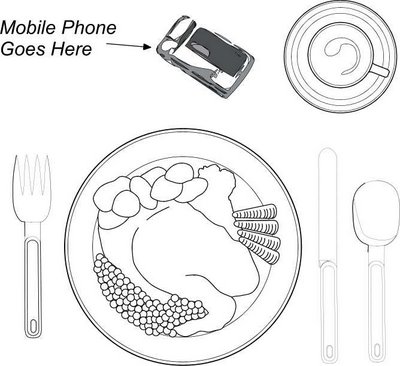
Note that you don't lay down the phone straight – it needs to look like you just casually dropped it on the table.
Then everyone at the table surreptitiously checks out everyone else's phone. There's a subtle hierarchy of status associated with which phone you carry. I haven't decoded all of it yet, but definitely you get some extra status for having what's perceived to be a stylish phone. Brand also plays a role, although I think that varies from country to country. For example, carrying a Siemens phone is OK in Germany, but will peg you as a cheapskate anywhere else in the western half of the continent. Nokia has good status, depending on the model you carry, and I think SonyEricsson gets you tagged as a little more creative than average. If you have a Motorola it says you're an American.
And then there's the Treo. I've been told by several European friends that slapping down a Treo on the table gets you labeled as a geek. And not a nice geek in the American sense (visionary and probably rich), but geek in the bad sense (socially misfit and physically underdeveloped). The keyboard, which American users tend to regard as a badge of business power and importance, comes across as pathetically computer-obsessed to a lot of folks in Europe. At least that's what I've been told by people over there.
It's possible that image is evolving as RIM and Nokia bring more keyboard-based phones to market. But if not, Palm will have a lot more trouble on its hands than just what OS it's running.
The other question about this hypothetical Vodafone Palm OS phone is whether Palm can even build it. As I've speculated before, it's not clear that the current version of Palm OS can easily be revised to work with the 3G networks in Europe. Now Brighthand has pointed out that PalmSource/Access missed its deadlines for delivering the next version of Palm OS, freeing Palm from a series of fairly substantial minimum payments it was required to make to Access.
If the Access platform won't be available in time, what else could Palm do to fill the gap? David Beers has compiled a lot of evidence indicating that Palm's working on its own Linux-based operating system for smartphones. I don't know if it actually is, but let's speculate irresponsibly for a moment.
Adapting Linux to mobile devices is not as easy as most people think – the OS was created for PCs and servers and doesn't naturally understand concepts like power conservation and limited memory. Palm certainly could be trying, perhaps with help from one of the companies already making working on mobile Linux, but it's not a slam dunk for a company of Palm's size.
We know for sure that Palm is working on a secret new product that's neither handheld nor smartphone. It's also not based on Palm OS, so the software for it must be something different. It could be Windows Mobile, but I'm betting that Palm is creating a new operating system for this new class of device. Would Palm work on two new operating systems at once? I doubt it. So maybe what Palm's doing is creating an OS for its new product category – now far advanced in development – and then adapting that OS to its smartphones as well. That OS might or might not be based on Linux.
If Palm did create its own OS, that would complete the circle of Palm's long, strange evolution – the company would be back under the management of its founders, owning its brand name, and with its own proprietary OS.
Again, I don't know if it'll actually happen, but the idea's kind of poetic, isn't it?
The company recently pre-announced that it's creating a 3G Treo for sale through Vodafone later this year. This was a very important breakthrough for Palm. It has been trying for years to get broader distribution for its smartphones in Europe, without great success. Now the world's largest mobile operator is embracing the company, and saying specifically that it'll offer the new Treo in at least the UK, Germany, Spain, Italy, and the Netherlands. That's a huge increase in reach for Palm, and it should help to produce incremental sales for the company.
What was Wall Street reaction to the announcement? Nothing. No change at all in the company's stock price.
I don't pretend to understand why stock prices move the way they do. Palm ought to be rewarded for this breakthrough. But there are also some reasons for caution. The first is that this will be a Windows Mobile Treo, not a Palm OS Treo. I believe there's pent-up demand in Europe for a well-made Palm OS 3G smartphone – Palm sold huge numbers of handhelds into Europe, especially Germany, and I'm sure some of those people would trade up to a well-designed 3G phone using the same OS. I'm less certain of the demand for a Windows Mobile Treo in Europe. There are already a lot Windows Mobile devices on the market there, so Palm is entering a crowded field.
Supposedly sales of the Windows Mobile Treo in the US have been disappointing, so Wall Street may be fearing the same thing will happen in Europe.
Of course, it's possible that Palm also has a Palm OS 3G Treo in the works for Europe. Palm doesn't like to pre-announce its Palm OS-based products (supposedly, the only reason it pre-announces the Windows Mobile-based ones is because the US government views any Microsoft deal as a "material event" that has to be announced early to prevent stock manipulation by insiders). The same requirements don't apply to Palm OS-based products, so it's very possible that Palm's going to ship a Palm OS Treo through Vodafone as well.
Regardless of which software ends up on the Vodafone devices, the other thing I'm not sure of is how well the Treo product design will play in the countries of Europe. I should explain this, for the benefit of my readers in the US.
Many Americans make the mistake of believing that Europe is full of Europeans. It's not. It's full of French people, Germans, Italians, British, and so on – each from very distinct cultures with very different beliefs and traditions. Other than the World Cup, I'm aware of only two truly pan-European cultural institutions. One is the Eurovision song contest, and I'm not going to even try to explain that. The other is the practice of displaying your mobile phone on the table during a meal.
Go to lunch or dinner in any country in Europe, and when everyone sits down they'll take out their mobile phones and put them on the table. There's even a proper place to put the phone, about like this:

Note that you don't lay down the phone straight – it needs to look like you just casually dropped it on the table.
Then everyone at the table surreptitiously checks out everyone else's phone. There's a subtle hierarchy of status associated with which phone you carry. I haven't decoded all of it yet, but definitely you get some extra status for having what's perceived to be a stylish phone. Brand also plays a role, although I think that varies from country to country. For example, carrying a Siemens phone is OK in Germany, but will peg you as a cheapskate anywhere else in the western half of the continent. Nokia has good status, depending on the model you carry, and I think SonyEricsson gets you tagged as a little more creative than average. If you have a Motorola it says you're an American.
And then there's the Treo. I've been told by several European friends that slapping down a Treo on the table gets you labeled as a geek. And not a nice geek in the American sense (visionary and probably rich), but geek in the bad sense (socially misfit and physically underdeveloped). The keyboard, which American users tend to regard as a badge of business power and importance, comes across as pathetically computer-obsessed to a lot of folks in Europe. At least that's what I've been told by people over there.
It's possible that image is evolving as RIM and Nokia bring more keyboard-based phones to market. But if not, Palm will have a lot more trouble on its hands than just what OS it's running.
The other question about this hypothetical Vodafone Palm OS phone is whether Palm can even build it. As I've speculated before, it's not clear that the current version of Palm OS can easily be revised to work with the 3G networks in Europe. Now Brighthand has pointed out that PalmSource/Access missed its deadlines for delivering the next version of Palm OS, freeing Palm from a series of fairly substantial minimum payments it was required to make to Access.
If the Access platform won't be available in time, what else could Palm do to fill the gap? David Beers has compiled a lot of evidence indicating that Palm's working on its own Linux-based operating system for smartphones. I don't know if it actually is, but let's speculate irresponsibly for a moment.
Adapting Linux to mobile devices is not as easy as most people think – the OS was created for PCs and servers and doesn't naturally understand concepts like power conservation and limited memory. Palm certainly could be trying, perhaps with help from one of the companies already making working on mobile Linux, but it's not a slam dunk for a company of Palm's size.
We know for sure that Palm is working on a secret new product that's neither handheld nor smartphone. It's also not based on Palm OS, so the software for it must be something different. It could be Windows Mobile, but I'm betting that Palm is creating a new operating system for this new class of device. Would Palm work on two new operating systems at once? I doubt it. So maybe what Palm's doing is creating an OS for its new product category – now far advanced in development – and then adapting that OS to its smartphones as well. That OS might or might not be based on Linux.
If Palm did create its own OS, that would complete the circle of Palm's long, strange evolution – the company would be back under the management of its founders, owning its brand name, and with its own proprietary OS.
Again, I don't know if it'll actually happen, but the idea's kind of poetic, isn't it?
What is Google's search share, really?
It sounds like such a simple question. But like an impressionist painting, the closer you look, the more the image deteriorates.
ComScore says Google accounts for 44% of Internet searches in the US.
Netratings (owned by the Nielsen survey people) says Google's share is 49%.
Hitwise says Google's share is 60%.
Alexa says Google's share is 85%.
What the heck is going on?
First of all, no one on Earth knows what Google's actual share is. In order to get that number, you'd have to know the exact number of searches conducted on every search engine on the Internet, and the search companies don't release that data. So various companies are using different methodologies to estimate the number.
Netratings and ComScore monitor panels of people who have web meters installed on their computers (similar to the way Nielsen measures TV ratings). Hitwise aggregates and weights the usage logs from ISPs. Alexa tracks web usage by people who have installed its toolbar.
The methodologies are different, but they shouldn't produce that much of a skew. Part of the disconnect may be due to differences in definitions. When is a search a search? Is it when someone goes to the search site, when they receive results from a search site, or when they actually click through on one of the results?
Alexa says it's measuring click-throughs. It's not clear what the other three are measuring, although I suspect that Netratings and ComScore are tracking searches conducted and not click-throughs. If either of them are just measuring visits to the search page, Yahoo's and MSN's traffic would be padded, because their homepages offer a lot more than a search box.
Even if Hitwise and Netratings are measuring actual searches, I guess it's possible that the average Google search generates more click-throughs than the average Yahoo search. That would explain the Alexa result – although I don't know why people would be more likely to click through on Google.
The disconnect is especially interesting to me because many weblogs report traffic that differs radically from the supposed search engine share. Many of them report more Google traffic than you'd expect from the ComScore and Netratings numbers.
(If you don't have your own website, I should give a little background – blog authors can get statistics showing where every visitor came from. We can't see who you are, but we can see which Internet domain you came from. If you used a search engine, we can see what query got you here and which search engine you used.)
The visitor logs for Mobile Opportunity show interesting trends from time to time. For example, my post on Adobe's plans to expand Flash into a platform got a fair number of readers from Adobe and Microsoft, but many more visits from the Yahoo corporate domain. Hmmmm. And for several months early this year, a lot of people at Motorola.com were searching online for the phrase "rokr failure."
As for which search engine generates the most traffic here, Google is the winner hands down, with 94% of the search engine referrals. MSN has 4%, and Yahoo only 2%. I don't know why that is. Maybe people looking for mobile-related information are more likely to use Google. Maybe Google drives more traffic toward weblogs in general, or specifically to Blogger-based weblogs (Google owns Blogger/Blogspot). Maybe people who do searches on Google are more likely to click through on the results.
Or maybe Google really is as dominant as Alexa says it is.
To test these some of questions, I did identical searches on Google, Yahoo, and MSN. I used "motorola rokr failure" as the search phrase because I knew Google ranked Mobile Opportunity high on that search.
Here are the top ten results for each:
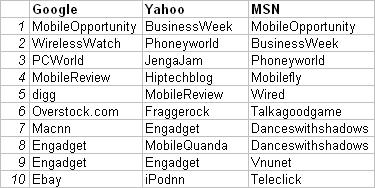
It's remarkable. No web page showed up in the top ten in all three search engines. There is almost no overlap between the top Google and Yahoo results, and MSN has a little bit of each. It's almost as if there were two separate Internets, one being indexed by Yahoo and the other being indexed by Google, with MSN trying to straddle them. I know that's not really the case, but clearly each of the search engines are using very different search algorithms.
I did a few other duplicate searches, and all showed the same sort of diversity. I couldn't spot any obvious biases in any of the engines – for example, Yahoo doesn't seem to be systematically excluding blogs. And I can't say that one search engine's results are objectively better than another's; they all found some good results and some clunkers (seriously, Google – you listed an Overstock auction when you didn't list BusinessWeek?)
So I don't know what's going on, other than that Yahoo's search engine doesn't like me.
I'm sure other people with more time and insight have investigated this issue. Please post a link if you know of a good article on the subject.
In the meantime, hello to all you searchers from Google, and I hope you found the information you needed.
ComScore says Google accounts for 44% of Internet searches in the US.
Netratings (owned by the Nielsen survey people) says Google's share is 49%.
Hitwise says Google's share is 60%.
Alexa says Google's share is 85%.
What the heck is going on?
First of all, no one on Earth knows what Google's actual share is. In order to get that number, you'd have to know the exact number of searches conducted on every search engine on the Internet, and the search companies don't release that data. So various companies are using different methodologies to estimate the number.
Netratings and ComScore monitor panels of people who have web meters installed on their computers (similar to the way Nielsen measures TV ratings). Hitwise aggregates and weights the usage logs from ISPs. Alexa tracks web usage by people who have installed its toolbar.
The methodologies are different, but they shouldn't produce that much of a skew. Part of the disconnect may be due to differences in definitions. When is a search a search? Is it when someone goes to the search site, when they receive results from a search site, or when they actually click through on one of the results?
Alexa says it's measuring click-throughs. It's not clear what the other three are measuring, although I suspect that Netratings and ComScore are tracking searches conducted and not click-throughs. If either of them are just measuring visits to the search page, Yahoo's and MSN's traffic would be padded, because their homepages offer a lot more than a search box.
Even if Hitwise and Netratings are measuring actual searches, I guess it's possible that the average Google search generates more click-throughs than the average Yahoo search. That would explain the Alexa result – although I don't know why people would be more likely to click through on Google.
The disconnect is especially interesting to me because many weblogs report traffic that differs radically from the supposed search engine share. Many of them report more Google traffic than you'd expect from the ComScore and Netratings numbers.
(If you don't have your own website, I should give a little background – blog authors can get statistics showing where every visitor came from. We can't see who you are, but we can see which Internet domain you came from. If you used a search engine, we can see what query got you here and which search engine you used.)
The visitor logs for Mobile Opportunity show interesting trends from time to time. For example, my post on Adobe's plans to expand Flash into a platform got a fair number of readers from Adobe and Microsoft, but many more visits from the Yahoo corporate domain. Hmmmm. And for several months early this year, a lot of people at Motorola.com were searching online for the phrase "rokr failure."
As for which search engine generates the most traffic here, Google is the winner hands down, with 94% of the search engine referrals. MSN has 4%, and Yahoo only 2%. I don't know why that is. Maybe people looking for mobile-related information are more likely to use Google. Maybe Google drives more traffic toward weblogs in general, or specifically to Blogger-based weblogs (Google owns Blogger/Blogspot). Maybe people who do searches on Google are more likely to click through on the results.
Or maybe Google really is as dominant as Alexa says it is.
To test these some of questions, I did identical searches on Google, Yahoo, and MSN. I used "motorola rokr failure" as the search phrase because I knew Google ranked Mobile Opportunity high on that search.
Here are the top ten results for each:
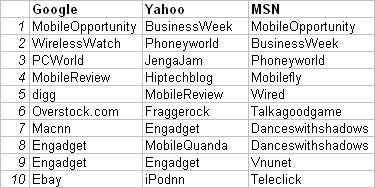
It's remarkable. No web page showed up in the top ten in all three search engines. There is almost no overlap between the top Google and Yahoo results, and MSN has a little bit of each. It's almost as if there were two separate Internets, one being indexed by Yahoo and the other being indexed by Google, with MSN trying to straddle them. I know that's not really the case, but clearly each of the search engines are using very different search algorithms.
I did a few other duplicate searches, and all showed the same sort of diversity. I couldn't spot any obvious biases in any of the engines – for example, Yahoo doesn't seem to be systematically excluding blogs. And I can't say that one search engine's results are objectively better than another's; they all found some good results and some clunkers (seriously, Google – you listed an Overstock auction when you didn't list BusinessWeek?)
So I don't know what's going on, other than that Yahoo's search engine doesn't like me.
I'm sure other people with more time and insight have investigated this issue. Please post a link if you know of a good article on the subject.
In the meantime, hello to all you searchers from Google, and I hope you found the information you needed.
What a difference three years makes
In 2003, Po Bronson wrote an influential article in Wired labeling Silicon Valley the new Detroit. Three years later, the article reads as both visionary and completely off base.
The visionary part was Bronson's prediction that Silicon Valley wouldn't return to being a lifestyle trend-setter.
"It was a new culture that both captured the world's imagination and had it running scared. Rich people in New York felt poor. Smart people in Redmond felt stupid. Producers in Hollywood spoke a whole new lingo. Every Fortune 500 company felt vulnerable to itty-bitty startups. Silicon Valley was an argument in the form of a place. It argued for a new way to live, a new relationship between owners and employees, a new bond between work and play."
Bronson was right in declaring this idea dead. Today you don't find a lot of people around the world who want to live the Silicon Valley lifestyle (or who even believe there is one). Most established companies have gone back to ignoring the tech industry, and the wild parties of the Bubble period seem to be a thing of the past.
But Bronson also predicted an end to the potency of Silicon Valley companies themselves.
"I doubt startups will ever become commonplace again....The hype machine keeps puffing, but the truth is that the pace of change in Silicon Valley is no longer special or extraordinary. In the past few years, Hollywood has been transformed by reality television, which has created new fortunes and new stars. Washington has swapped out an administration of 24,000 Democrats and replaced it with 24,000 Republicans. Wall Street has been altered by new rules governing conflicts of interest. The music and book industries have far more new products running through their pipelines than the tech industry."
Three years on, venture funding hasn't rebounded much, but startups are commonplace anyway. The scope of change in online software is breath-taking, and it feels like we're only scratching the surface of what's to come. Apple has the entire music industry on the run, and a company called Google – not even mentioned in Bronson's article – is re-inventing advertising. High tech isn't necessarily sexy, but it's definitely dangerous. I personally think it's more dangerous than it was at the peak of the bubble in 2000, because the software startups today are much more efficient (enabling a lot of low-cost experiments), and because the rest of the world has turned its back on the industry, allowing surprises to bubble up unnoticed.
I don't want to beat up on Po Bronson; it's more or less impossible to predict the future. But it's good to ask why he was partly right and partly wrong, because that may help us anticipate what's coming next.
Soon after the Bubble burst, it felt like everything associated with it was garbage – the culture, business models, and the technology. It turns out that the bubble culture really was an illusion. Partying every night and jumping jobs twice a year rich turns out to be economically unsustainable, not to mention physically exhausting. And the huge bolus of venture capital that the Valley struggled to digest (and largely wasted) shows no signs of returning.
But the technology was still maturing, and the business models were just getting started. Once the stupid, weedy startups were cleared out, we were left with a crop of extremely efficient new companies, and new technologies and businesses that were just starting to have an impact. That crop is only now starting to flower, and we won't see its full impact until the end of the decade at the earliest. But to me it's already clear that the impact will be enormous.
So, is Silicon Valley dead? Yes, as a cultural icon. But as a disruptive economic force, it was just taking a rest.
The visionary part was Bronson's prediction that Silicon Valley wouldn't return to being a lifestyle trend-setter.
"It was a new culture that both captured the world's imagination and had it running scared. Rich people in New York felt poor. Smart people in Redmond felt stupid. Producers in Hollywood spoke a whole new lingo. Every Fortune 500 company felt vulnerable to itty-bitty startups. Silicon Valley was an argument in the form of a place. It argued for a new way to live, a new relationship between owners and employees, a new bond between work and play."
Bronson was right in declaring this idea dead. Today you don't find a lot of people around the world who want to live the Silicon Valley lifestyle (or who even believe there is one). Most established companies have gone back to ignoring the tech industry, and the wild parties of the Bubble period seem to be a thing of the past.
But Bronson also predicted an end to the potency of Silicon Valley companies themselves.
"I doubt startups will ever become commonplace again....The hype machine keeps puffing, but the truth is that the pace of change in Silicon Valley is no longer special or extraordinary. In the past few years, Hollywood has been transformed by reality television, which has created new fortunes and new stars. Washington has swapped out an administration of 24,000 Democrats and replaced it with 24,000 Republicans. Wall Street has been altered by new rules governing conflicts of interest. The music and book industries have far more new products running through their pipelines than the tech industry."
Three years on, venture funding hasn't rebounded much, but startups are commonplace anyway. The scope of change in online software is breath-taking, and it feels like we're only scratching the surface of what's to come. Apple has the entire music industry on the run, and a company called Google – not even mentioned in Bronson's article – is re-inventing advertising. High tech isn't necessarily sexy, but it's definitely dangerous. I personally think it's more dangerous than it was at the peak of the bubble in 2000, because the software startups today are much more efficient (enabling a lot of low-cost experiments), and because the rest of the world has turned its back on the industry, allowing surprises to bubble up unnoticed.
I don't want to beat up on Po Bronson; it's more or less impossible to predict the future. But it's good to ask why he was partly right and partly wrong, because that may help us anticipate what's coming next.
Soon after the Bubble burst, it felt like everything associated with it was garbage – the culture, business models, and the technology. It turns out that the bubble culture really was an illusion. Partying every night and jumping jobs twice a year rich turns out to be economically unsustainable, not to mention physically exhausting. And the huge bolus of venture capital that the Valley struggled to digest (and largely wasted) shows no signs of returning.
But the technology was still maturing, and the business models were just getting started. Once the stupid, weedy startups were cleared out, we were left with a crop of extremely efficient new companies, and new technologies and businesses that were just starting to have an impact. That crop is only now starting to flower, and we won't see its full impact until the end of the decade at the earliest. But to me it's already clear that the impact will be enormous.
So, is Silicon Valley dead? Yes, as a cultural icon. But as a disruptive economic force, it was just taking a rest.
Subscribe to:
Posts (Atom)