Mobile Telephone Evidence
SMS texts to audio - mobile to landlines For those for you who are unaware, SMS messages can now be sent to landline telephones by dialling a landline destination number. The landline telephone receiving the message does not need to have text capability to read the messages. Instead, the text messages are translated andconverted into audio speech. Whilst this seems a good idea, some problems
Mobile Telephone Evidence
7F10:6F44
For those of you who have attended my GSM Mobile Telephone SIM forensic Card training courses will know the user content elementary file (EF LND) Last Number Dialled. We know from the GSM SIM Standard that this EF is optional, but once allocated and activated in SIM, has a number of mandatory features. The EF stores the number dialled by the user. In the words of the academic authors
For those of you who have attended my GSM Mobile Telephone SIM forensic Card training courses will know the user content elementary file (EF LND) Last Number Dialled. We know from the GSM SIM Standard that this EF is optional, but once allocated and activated in SIM, has a number of mandatory features. The EF stores the number dialled by the user. In the words of the academic authors
List of free open source software (Mac & Win)
Two essential websites that list the best open source software:
Right now I'm giving Democracy Player a try. The player enables subscription to video RSS feeds and is available for all major platforms. Sounds interesting!
Right now I'm giving Democracy Player a try. The player enables subscription to video RSS feeds and is available for all major platforms. Sounds interesting!
My favorite education/learning quotes
 In this post I'd like to provide a list to some of my favorite education/learning related quotes. Why? Because I think they can be used to as an reflection on what we are doing as educators and how is this affecting our students - and although thinking reflection will not by itself make big changes in our work, it can be the first step toward great new practices and ideas that can make a change.
Plato:
“Someday, in the distant future, our grandchildren's grandchildren will develop a new equivalent of our classrooms. They will spend many hours in front of boxes with fires glowing within. May they have the wisdom to know the difference between light and knowledge.”
“Do not train a child to learn by force or harshness; but direct them to it by what amuses their minds, so that you may be better able to discover with accuracy the peculiar bent of the genius of each.”
Socrates:
“Education is the kindling of a flame, not the filling of a vessel”
Chinese proverb:
“Tell me and I'll forget; show me and I may remember; involve me and I'll understand.”
Oscar Wilde:
“Everybody who is incapable of learning has taken to teaching.”
Albert Einstein:
“It is a miracle that curiosity survives formal education.”
“The only thing that interferes with my learning is my education.”
Robert Frost:
“Education is the ability to listen to almost anything without losing your temper.”
“There are two kinds of teachers: the kind that fill you with so much quail shot that you can't move, and the kind that just gives you a little prod behind and you jump to the skies.”
Tom Bodett:
“The difference between school and life? In school, you're taught a lesson and then given a test. In life, you're given a test that teaches you a lesson.”
Roger Lewin:
“Too often students are given answers to remember, rather than problems to solve”
All quotes were found on ThinkExist.com - have fun at finding your favorite quotes!
Tips & tricks for online tutoring
Since the first day I've found the work of an online tutor highly challenging and engaging. The biggest challenge for me is finding ways in which to direct and motivate students with their course activities, and getting to know individual needs and expectations of my students. At the end of the study year 2005/2006 I carried out a survey about student satisfaction with the work of their online tutor. In this post I'd like to present student opinions about my work, while a more detailed presentation of the survey will be included in my diploma (after I study some more advanced statistics ;) ).
So, what did the students like most about my work?
(I picked some of the responses - the only change I made was the translation from Slovenian to English)
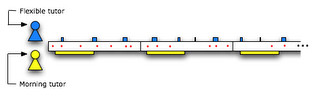
And here's another trick - it's better to log in the system a few times a day than to spend a certain amount of hours online once a day. The picture I made displays this concept. The red dots represent activities that require response, the rectangles (the color matches the color of the tutor) represent the time each tutor spends online - we can see that in the case of the Morning tutor (that is online online for X numbers in the mornings) the response time for certain activities is much longer than in the case of the Flexible tutor (that also works less because he responds to student needs).
 While I was tutoring the course, I checked for new posts AT LEAST 3 times a day - first thing in the morning, in the afternoon, and in the evening; and that is how I was able to quickly respond to all questions and all unexpected situations. And why is that so? Because one of the advantages of e-learning is the flexibility in time and space - students can freely choose when and where they will work from. Some do it when they get to the office in the morning, some do it in the afternoons, and some in late evening after they put their kids to bed. And if you as an online tutor want to be there for them you have to keep track of all these groups (luckily for me we don't have students in different time zones or I'd probably be awoke by concern in the middle of the night to check the evening activities of american students and morning activities of asian students ;) ).
Yes, being an online tutor (in my opinion) definitely isn't a straight 8 hours work. In hours it may seem like you don't too much, but you do have to work practically all day and even during weekends. Plus you have to predicts the needy situation that will require more of your attention, but in the end, for me, it's a fun and exciting job as few others.
And here are some of my favorite links related to the the subject of this post (alphabetically):
So, what did the students like most about my work?
(I picked some of the responses - the only change I made was the translation from Slovenian to English)
- An unobtrusive way of presenting information.
- That the tutor participated whenever it was necessary and that she always helped us when we were stuck.
- Kindness, immediate answers, professional attitude.
- Objectivity.
- The tutor's interventions in our discussion were good and she guided us.
- Encouraging words, quick response in case of problems, relaxed atmosphere.
- That she always responded when she was asked to and when she sensed that we were going astray from out discussions or that she encouraged us when we despaired.
- Actually, I got more than I expected.
And here's another trick - it's better to log in the system a few times a day than to spend a certain amount of hours online once a day. The picture I made displays this concept. The red dots represent activities that require response, the rectangles (the color matches the color of the tutor) represent the time each tutor spends online - we can see that in the case of the Morning tutor (that is online online for X numbers in the mornings) the response time for certain activities is much longer than in the case of the Flexible tutor (that also works less because he responds to student needs).
 While I was tutoring the course, I checked for new posts AT LEAST 3 times a day - first thing in the morning, in the afternoon, and in the evening; and that is how I was able to quickly respond to all questions and all unexpected situations. And why is that so? Because one of the advantages of e-learning is the flexibility in time and space - students can freely choose when and where they will work from. Some do it when they get to the office in the morning, some do it in the afternoons, and some in late evening after they put their kids to bed. And if you as an online tutor want to be there for them you have to keep track of all these groups (luckily for me we don't have students in different time zones or I'd probably be awoke by concern in the middle of the night to check the evening activities of american students and morning activities of asian students ;) ).
Yes, being an online tutor (in my opinion) definitely isn't a straight 8 hours work. In hours it may seem like you don't too much, but you do have to work practically all day and even during weekends. Plus you have to predicts the needy situation that will require more of your attention, but in the end, for me, it's a fun and exciting job as few others.
And here are some of my favorite links related to the the subject of this post (alphabetically):
- Clive Shepherd: In search of the perfect e-tutor
- LearnDirect: Online tutor
- Maggie McPherson and Miguel Baptista Nunes: The Role of Tutors as an Integral Part of Online Learning Support
- Scot Headley: Five Roles I Play in Online Courses
Apple Dashboard Widgets on Windows
So, what can you do if you're stuck on Windows and want to use Apple Dashboard Widgets? You can go to Widgetop - a site that imitates Mac OS X widgets in your browsers (the site supposedly works best with Firefox). The whole thing isn't as pretty as the real thing of course, but if you want pretty you stick to Mac OS X ;)
Creating Passionate Users
Marketing professionals are already aware of the importance of user attitudes towards products. User loyalty can be won by regularly exceeding user expectations and giving them just that extra bit more to create passionate and thus loyal users. Products that consumers mark as good are on a good path, but those that users mark as very good or even excellent have the potential of gaining user loyalty.
And while most of the really successful companies are trying to catch up with the consumer centered production, or educational system is still ages behind. From my experience of formal education schools are run for school's sake - meaning that they don't really try to create knowledge, but to achieve preset goals that don't really care about the participants (and here I mean both teachers and students). Teachers must "teach" a certain quantity of facts that students will forget in a few months anyway - but hey! the school's plan was carried out! And the evaluation only takes place a few times a year and few care to wonder if what is being taught is really being learnt.
Surely, these days learner centered design is a big word, but (speaking from my personal experience) it is still too slow in catching up with real life education. And that is why I think it is important for educators to actively think about the needs of our students and share our experience with other educator - and more than ever the technology to do it is now at hand.
Blogs are certainly a great way to stimulate reflection and share ideas, and one blog I will certainly keep an eye on is Creating Passionate Users. The reading of this blog was actually what motivated me to write this post, and although there are still many interesting posts I have to catch up, I'd suggest reading the article Crash course in learning theory as a starting point in this great blog. Click, click - this blog certainly goes to my favorite RSS feeds!
And while most of the really successful companies are trying to catch up with the consumer centered production, or educational system is still ages behind. From my experience of formal education schools are run for school's sake - meaning that they don't really try to create knowledge, but to achieve preset goals that don't really care about the participants (and here I mean both teachers and students). Teachers must "teach" a certain quantity of facts that students will forget in a few months anyway - but hey! the school's plan was carried out! And the evaluation only takes place a few times a year and few care to wonder if what is being taught is really being learnt.
Surely, these days learner centered design is a big word, but (speaking from my personal experience) it is still too slow in catching up with real life education. And that is why I think it is important for educators to actively think about the needs of our students and share our experience with other educator - and more than ever the technology to do it is now at hand.
Blogs are certainly a great way to stimulate reflection and share ideas, and one blog I will certainly keep an eye on is Creating Passionate Users. The reading of this blog was actually what motivated me to write this post, and although there are still many interesting posts I have to catch up, I'd suggest reading the article Crash course in learning theory as a starting point in this great blog. Click, click - this blog certainly goes to my favorite RSS feeds!
Subscribe to:
Posts (Atom)