Product management is becoming a hot topic in Silicon Valley. The UC Berkeley business school had me speak at a seminar on the subject last week, a lot of consultants are focusing on it, and it seems to be getting a lot more buzz than I remember seeing in the past.
A product manager is the person in a company who translates customer needs into product features. He or she is not necessarily an engineer, but tells the engineers what to build (assuming you work in a company where the engineers do what anyone else tells them to do). When product management works well, a company has a much better chance of producing a successful product.
Recently I ran across an almost year-old summary of a presentation given by Rob Haitani of Palm. He's the author of the original Zen of Palm, the presentation that codified Palm's early design philosophy. The Zen of Palm is widely misunderstood as a kind of dogmatic belief that handheld computers should have only a few simplistic features (which is about as accurate as saying that basketball is a game in which people throw a ball). Actually it was a pretty subtle strategy, and the presentation was a fantastic tool for indoctrinating new hires.
Although Haitani's title at Palm isn't product manager, that's what he does. The article gives a nice overview of some of his ideas. I think it's a good reference for product managers in any industry.
A fun read
I've had Telepocalypse in my blogroll for a while, but I never explained why. Marvin Geddes is a telecom consultant living in Scotland. He's interesting and acerbic and he has the deep pool of skepticism that seems to develop in many people who work closely with wireless operators in the US and Europe.
He also writes extremely well, which makes his weblog a nice mix of information and entertainment. For example, here's his description of the psychology of an operator offering data services:
"Owning a communications network is rather like being the in posession of Tolkien’s Ring. It slowly corrupts and drives mad the keeper. 'I’ll capture your value, all my beautiful bits, preciousssss bits'."
And then there's a little gem that I won't even try to describe. You just have to read it for yourself. Maybe you have to be a parent to fully appreciate it, but it still makes me laugh every time I read it.
He also writes extremely well, which makes his weblog a nice mix of information and entertainment. For example, here's his description of the psychology of an operator offering data services:
"Owning a communications network is rather like being the in posession of Tolkien’s Ring. It slowly corrupts and drives mad the keeper. 'I’ll capture your value, all my beautiful bits, preciousssss bits'."
And then there's a little gem that I won't even try to describe. You just have to read it for yourself. Maybe you have to be a parent to fully appreciate it, but it still makes me laugh every time I read it.
Going to CTIA
I'll be at the CTIA conference in Las Vegas next week. Please drop me a note if you'll be there and would like to talk. When I get back I'll blog on anything interesting that I saw.
News flash: KPMG discovers world is round
Forgive me for the cynical headline -- I actually think we should view this as progress. The accounting and consulting firm KPMG just announced it has discovered that most mobile phone customers aren't willing to pay anything extra for new features or services on their phones. In particular, only about 30% of users were willing to pay more than a 10% surcharge. The figures came from a survey of about 3,500 mobile phone users around the world.
How much mobile phone users are willing to pay for enhanced services:
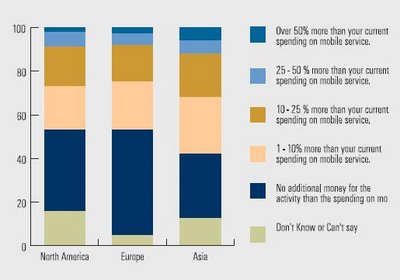
What's more, KPMG discovered that the mobile users who are willing to pay more fall into different usage segments: "Operators need to stride further by segmenting the market, potentially between 'entertainment users' and 'information users.'"
This isn't news to anyone who has been paying close attention to mobile users. Forrester wrote about it in 2002, Jupiter Research wrote about it in 2003, and we found the same thing in our research at PalmSource.
Unfortunately, it doesn't seem like the message has been getting across, because folks like Reuters and the Financial Times are treating the report as important news. That's okay with me -- the more repetition the story gets, the better the chance that it'll finally sink in.
The other notable part of the report was its commentary on business models. The report noted that since different people want different things, operators can't put themselves in the business of dictating what features customers will want:
"Beware of the 'killer app' trap....The opportunity to serve media-hungry consumers is there for the taking, but...those carriers that try to 'wall in' the types of services they offer - or hang their hopes on one particular application or service - are likely to fail to meet customer expectations....Carriers will not be able to meet customer needs alone - thus the importance of sharing their customers' wallets with other partners."
In other words, the right business model is the one employed by NTT DoCoMo in iMode – open your network to independent developers, let them offer whatever apps and services they want, and take a cut of the developers' billings. Seems obvious, but most operators are still trying to do all the thinking for their customers.
Even though the findings of the survey aren't revolutionary, I think the whitepaper is a worthwhile read. It summarizes the key issues better than just about any single document I've seen.
How much mobile phone users are willing to pay for enhanced services:

What's more, KPMG discovered that the mobile users who are willing to pay more fall into different usage segments: "Operators need to stride further by segmenting the market, potentially between 'entertainment users' and 'information users.'"
This isn't news to anyone who has been paying close attention to mobile users. Forrester wrote about it in 2002, Jupiter Research wrote about it in 2003, and we found the same thing in our research at PalmSource.
Unfortunately, it doesn't seem like the message has been getting across, because folks like Reuters and the Financial Times are treating the report as important news. That's okay with me -- the more repetition the story gets, the better the chance that it'll finally sink in.
The other notable part of the report was its commentary on business models. The report noted that since different people want different things, operators can't put themselves in the business of dictating what features customers will want:
"Beware of the 'killer app' trap....The opportunity to serve media-hungry consumers is there for the taking, but...those carriers that try to 'wall in' the types of services they offer - or hang their hopes on one particular application or service - are likely to fail to meet customer expectations....Carriers will not be able to meet customer needs alone - thus the importance of sharing their customers' wallets with other partners."
In other words, the right business model is the one employed by NTT DoCoMo in iMode – open your network to independent developers, let them offer whatever apps and services they want, and take a cut of the developers' billings. Seems obvious, but most operators are still trying to do all the thinking for their customers.
Even though the findings of the survey aren't revolutionary, I think the whitepaper is a worthwhile read. It summarizes the key issues better than just about any single document I've seen.
What's going on in Japan?
I have to admit that I'm a bit of a Japan-o-phile. My relationship with the place started when I was a competitive analyst at Apple, which paid me to fly over there and wander the Akihabara electronics district buying interesting products (you never appreciate the really good jobs until you're reminiscing about them).
If you've never been to Akihabara, it's an area of maybe six or seven square blocks packed with electronics department stores, many of them six or eight stories tall. There's also a warren of tiny shopfront cubicles selling individual components – capacitors in one, switches in another, ICs in a third.
It all makes Fry's Electronics, the geek electronics mecca of Silicon Valley, look like a lemonade stand.
The great thing about Akihabara is the intense variety of electronic stuff. I remember standing in awe before a wall with more than a hundred shavers, each with a slightly different mix of features. And the mobile phones! Shapes and colors and especially features years before they appear anywhere else.
Now Apple's long behind me and nobody's paying me to go play in Japan anymore, which is frustrating because I'm losing touch with the trends. The tech press and analysts aren't much help because they mostly ignore Japan. But I've found two websites that help.
The first site is Wireless Watch Japan. I've spent a long time looking for the ultimate English-language site for mobile news from Japan, and I haven't found it yet (post a comment if you have advice). But Wireless Watch is pretty good – it posts a lot of news, which is all consolidated to the RSS feed (the feed seems to have more articles than the homepage). The downside is that it truncates its articles and you have to pay $200 a year to get the full text. Still, it's a good place to follow sagas like Vodafone's sad exit from Japan after it bought and then screwed up the former J-Phone. Plus the website carries a running tally of the subscribers to each of the Japanese operators (just over half of Japanese mobile users are now on 3G, by the way).
The second site is What Japan Thinks. This is a collection of translated market research studies, exploring strange and interesting aspects of Japanese culture. Many of the studies are tech-related, which makes the website a mix of useful and truly bizarre information. Recent tidbits: 25% of Japanese people surveyed said they use their mobile phones more than three hours a day, only 1.4% of Japanese coffee shop users go there to use a personal computer, and the three most popular cuts of grilled meat in Japan are beef ribs, chicken thighs, and tongue. Who knew?
The methodology of the studies varies from strong to completely invalid (for instance, the one on phone usage was apparently self-selected, which biases a study strongly toward enthusiasts). So you need to read the details of each report very carefully. But the information's often thought-provoking, and I can't find anything else like it in English.
I'd love to find similar sites for other Asian countries. If you know of any, or if you have other suggestions for Japan, please post a comment. In the meantime, although the ones I've listed here are not as good as a trip to Akihabara, at least you don't have to spend ten hours crammed into JAL coach to get there.
If you've never been to Akihabara, it's an area of maybe six or seven square blocks packed with electronics department stores, many of them six or eight stories tall. There's also a warren of tiny shopfront cubicles selling individual components – capacitors in one, switches in another, ICs in a third.
It all makes Fry's Electronics, the geek electronics mecca of Silicon Valley, look like a lemonade stand.
The great thing about Akihabara is the intense variety of electronic stuff. I remember standing in awe before a wall with more than a hundred shavers, each with a slightly different mix of features. And the mobile phones! Shapes and colors and especially features years before they appear anywhere else.
Now Apple's long behind me and nobody's paying me to go play in Japan anymore, which is frustrating because I'm losing touch with the trends. The tech press and analysts aren't much help because they mostly ignore Japan. But I've found two websites that help.
The first site is Wireless Watch Japan. I've spent a long time looking for the ultimate English-language site for mobile news from Japan, and I haven't found it yet (post a comment if you have advice). But Wireless Watch is pretty good – it posts a lot of news, which is all consolidated to the RSS feed (the feed seems to have more articles than the homepage). The downside is that it truncates its articles and you have to pay $200 a year to get the full text. Still, it's a good place to follow sagas like Vodafone's sad exit from Japan after it bought and then screwed up the former J-Phone. Plus the website carries a running tally of the subscribers to each of the Japanese operators (just over half of Japanese mobile users are now on 3G, by the way).
The second site is What Japan Thinks. This is a collection of translated market research studies, exploring strange and interesting aspects of Japanese culture. Many of the studies are tech-related, which makes the website a mix of useful and truly bizarre information. Recent tidbits: 25% of Japanese people surveyed said they use their mobile phones more than three hours a day, only 1.4% of Japanese coffee shop users go there to use a personal computer, and the three most popular cuts of grilled meat in Japan are beef ribs, chicken thighs, and tongue. Who knew?
The methodology of the studies varies from strong to completely invalid (for instance, the one on phone usage was apparently self-selected, which biases a study strongly toward enthusiasts). So you need to read the details of each report very carefully. But the information's often thought-provoking, and I can't find anything else like it in English.
I'd love to find similar sites for other Asian countries. If you know of any, or if you have other suggestions for Japan, please post a comment. In the meantime, although the ones I've listed here are not as good as a trip to Akihabara, at least you don't have to spend ten hours crammed into JAL coach to get there.
The single-chip smartphone sideshow
There's been a very interesting discussion in response to my post about the Access Linux Platform, but one of the comments deserved a more lengthy response. Catherine White of Llamagraphics wrote:
"The cost of devices is a big factor for the carriers, who often subsidize the cost of the handsets. Having the OS and phone driver support on one chip, as it is for Symbian is an advantage in keeping the cost of the smartphones down so that the increase in revenues from increased ARPU from data traffic is actually realized on the bottom line."
The Register has been touting this issue since last December, and I've heard it a few times from Symbian as well.
The case for a single-chip smartphone makes intuitive sense. Most smartphones today require two microprocessors in them – one to run the smartphone operating system, and another to run the radio. This has some advantages. When there are two separate chips, it's pretty hard for a virus or other nasty software running on the smartphone OS to mess with the network. But having two chips adds cost, and when you're selling millions of phones even a small expense adds up. So a smartphone that needed only a single chip ought to have a major advantage.
To run on a single chip, the smartphone OS must have what's called "hard real-time" capabilities. That means the operating system manages its own activities rigorously, so it can get out of the way when the phone needs to do something time-critical, like transmitting your voice or answering a call. If the smartphone OS doesn't support hard real-time, it might accidentally cause a call to drop, or generate sputters in voice coverage.
Symbian OS was re-architected in version 8 to have hard real-time capabilities. Currently Palm OS doesn't, and The Register reports that Windows Mobile can't yet run on single processor phones either. If hard real-time is so useful, you might ask, why doesn't every mobile OS have it? One answer is battery life.
Most mobile operating systems save battery power by going to sleep all the time. Like a lazy dog on a warm summer day, a good mobile OS will nod off whenever it can. Even when the system looks attentive (the screen is lit and an application is running), the OS slows the processor and turns off features if it can. I remember a Palm OS engineer telling me proudly that the OS even caught a little shut-eye between blinks of the cursor. As long as the OS can wake up fast enough that you can't tell the difference, it's free to sleep almost all the time. This reduces the power used by the system, and extends battery life.
Adding hard real-time capabilities to a mobile OS is like bringing home your firstborn child. All of a sudden you're responsible for a bunch of tasks that might happen at any moment, and you have to stay attentive to them all the time. You never really sleep properly again.
So getting a mobile OS to work in hard real-time without trashing battery life is a neat trick, and it's great that Symbian did it. But I'm not sure how important of an accomplishment it really is. I've been watching that single-chip issue get more and more attention over the last year or so. A first it was very persuasive to me, but the more I looked into it, the less impressive it seemed. Now I think it's mostly a red herring. Here's why.
Do smartphone prices matter?
That's the first question to ask. Prices should matter – it stands to reason that if you make a smartphone cheaper, more people will buy it, and they'll use more data services. But that's true only if there are a lot of people out there who want smartphones and can't afford them. My sense is that most of the people who really want smartphones today can afford them. Smartphones are professional tools for people who need to do heavy-duty communication and data management. Professionals can generally afford a couple of hundred dollars extra for a phone. More to the point, people who honestly can't afford a smartphone are also going to have a lot of trouble paying for the advanced data services that go with them.
I've seen confirmation of this in the customer research I've been involved in. There's a big gulf between the people who want advanced phone features (a minority of all phone users) and those who don't. Price matters a lot to young people who want entertainment phones, because they don't have much money to begin with. But it's not the most important issue to mobile professionals who want databases or advanced communication. Those people will happily pay extra to get a better product. So the cost savings of one chip vs. two chips would come into play only if the two products were otherwise identical. If there are any other differentiators, a small difference in price takes a back seat.
This seems to be confirmed in the market. For example, PalmSource didn't see big explosions in demand when Palm OS licensees discounted their smartphones. But the most memorable thing to me was what happened when Orange in the UK discounted its first Windows Mobile smartphones. Demand went up – but only because less sophisticated users started buying the products. They didn't use much data, and more worrisome for Orange, those less sophisticated users needed oodles of tech support. We surveyed the users later and they reported making an average of seven support calls each. Tech support calls are enormously expensive for the carriers – a single call per user is probably enough to wipe out all of the cost savings from using one chip vs. two chips.
So saving a few bucks on the chip cost isn't decisive to most smartphone users, and probably isn't decisive to mobile operators. The only other party in a position to care is the phone manufacturers. Reducing the cost of a smartphone won't necessarily increase their sales, but if they make a few bucks more per smartphone they'll still be extremely happy. So, exactly how much money do you save by using a single-processor smartphone design?
Anyone have a hard number on that?
The answer's not straightforward, because some mobile microprocessor companies are now making "dual core" chip packages that combine two processor cores and are priced very much like individual processors. This lets a non-realtime mobile OS get many of the cost advantages of being single processor without restructuring the whole OS, and with less fear that a rogue mobile app could interfere with the radio.
The most prominent of these dual-core processors is the Texas Instruments OMAP (Open Multimedia Application Platform) family. When I was at PalmSource, we calculated that a smartphone based on the OMAP chips could reach down into featurephone price points.
It's very hard to find OMAP price figures on the Internet. TI doesn't quote prices in public, but even if it did, the price you really pay depends on how many chips you buy and how badly TI wants you as a customer. Microprocessor Report estimated that typical OMAP prices are in the sub-$20 range .
Say you could cut that price in half by using a low-end single core chip. I sincerely doubt the savings would be that big, but let's use it as an example. Given typical manufacturer and channel markups, that might cut the end-user price of the handset by at most about $30. Nice, but not enough to dramatically change demand.
Qualcomm has also been working on dual-core chips for use in smartphones, specifically for 3G CDMA networks. If you're interested in speculating about future industry alliances, here are a couple of fun data points: First, Qualcomm is creating a version of Linux that will run on its smartphone chips. Second, Qualcomm and Access are already working together to enable iMode to work with the Qualcomm chips. Gee, I wonder if they've had any discussions about Linux.
Not all phone chip companies are making dual core parts, so an OS that can run single-core will have a wider variety of parts and probably somewhat better pricing as a result. But it's not nearly as big an advantage as you'd think.
So, to sum it all up, having a single-processor smartphone OS is very nice for a phone hardware company. It will give you a wider selection of processors, which may save you some money. That fact would probably help an OS company attract more licensees. But a single-processor OS doesn't have a decisive advantage in the market because the price savings aren't that enormous, and because price isn't the main barrier to smartphone adoption anyway.
I think the single-processor OS debate is mostly a red herring. It's a distraction from the genuine, urgent problem facing most smartphone companies – creating products that solve real problems, and that large numbers of users will actually want to buy.
"The cost of devices is a big factor for the carriers, who often subsidize the cost of the handsets. Having the OS and phone driver support on one chip, as it is for Symbian is an advantage in keeping the cost of the smartphones down so that the increase in revenues from increased ARPU from data traffic is actually realized on the bottom line."
The Register has been touting this issue since last December, and I've heard it a few times from Symbian as well.
The case for a single-chip smartphone makes intuitive sense. Most smartphones today require two microprocessors in them – one to run the smartphone operating system, and another to run the radio. This has some advantages. When there are two separate chips, it's pretty hard for a virus or other nasty software running on the smartphone OS to mess with the network. But having two chips adds cost, and when you're selling millions of phones even a small expense adds up. So a smartphone that needed only a single chip ought to have a major advantage.
To run on a single chip, the smartphone OS must have what's called "hard real-time" capabilities. That means the operating system manages its own activities rigorously, so it can get out of the way when the phone needs to do something time-critical, like transmitting your voice or answering a call. If the smartphone OS doesn't support hard real-time, it might accidentally cause a call to drop, or generate sputters in voice coverage.
Symbian OS was re-architected in version 8 to have hard real-time capabilities. Currently Palm OS doesn't, and The Register reports that Windows Mobile can't yet run on single processor phones either. If hard real-time is so useful, you might ask, why doesn't every mobile OS have it? One answer is battery life.
Most mobile operating systems save battery power by going to sleep all the time. Like a lazy dog on a warm summer day, a good mobile OS will nod off whenever it can. Even when the system looks attentive (the screen is lit and an application is running), the OS slows the processor and turns off features if it can. I remember a Palm OS engineer telling me proudly that the OS even caught a little shut-eye between blinks of the cursor. As long as the OS can wake up fast enough that you can't tell the difference, it's free to sleep almost all the time. This reduces the power used by the system, and extends battery life.
Adding hard real-time capabilities to a mobile OS is like bringing home your firstborn child. All of a sudden you're responsible for a bunch of tasks that might happen at any moment, and you have to stay attentive to them all the time. You never really sleep properly again.
So getting a mobile OS to work in hard real-time without trashing battery life is a neat trick, and it's great that Symbian did it. But I'm not sure how important of an accomplishment it really is. I've been watching that single-chip issue get more and more attention over the last year or so. A first it was very persuasive to me, but the more I looked into it, the less impressive it seemed. Now I think it's mostly a red herring. Here's why.
Do smartphone prices matter?
That's the first question to ask. Prices should matter – it stands to reason that if you make a smartphone cheaper, more people will buy it, and they'll use more data services. But that's true only if there are a lot of people out there who want smartphones and can't afford them. My sense is that most of the people who really want smartphones today can afford them. Smartphones are professional tools for people who need to do heavy-duty communication and data management. Professionals can generally afford a couple of hundred dollars extra for a phone. More to the point, people who honestly can't afford a smartphone are also going to have a lot of trouble paying for the advanced data services that go with them.
I've seen confirmation of this in the customer research I've been involved in. There's a big gulf between the people who want advanced phone features (a minority of all phone users) and those who don't. Price matters a lot to young people who want entertainment phones, because they don't have much money to begin with. But it's not the most important issue to mobile professionals who want databases or advanced communication. Those people will happily pay extra to get a better product. So the cost savings of one chip vs. two chips would come into play only if the two products were otherwise identical. If there are any other differentiators, a small difference in price takes a back seat.
This seems to be confirmed in the market. For example, PalmSource didn't see big explosions in demand when Palm OS licensees discounted their smartphones. But the most memorable thing to me was what happened when Orange in the UK discounted its first Windows Mobile smartphones. Demand went up – but only because less sophisticated users started buying the products. They didn't use much data, and more worrisome for Orange, those less sophisticated users needed oodles of tech support. We surveyed the users later and they reported making an average of seven support calls each. Tech support calls are enormously expensive for the carriers – a single call per user is probably enough to wipe out all of the cost savings from using one chip vs. two chips.
So saving a few bucks on the chip cost isn't decisive to most smartphone users, and probably isn't decisive to mobile operators. The only other party in a position to care is the phone manufacturers. Reducing the cost of a smartphone won't necessarily increase their sales, but if they make a few bucks more per smartphone they'll still be extremely happy. So, exactly how much money do you save by using a single-processor smartphone design?
Anyone have a hard number on that?
The answer's not straightforward, because some mobile microprocessor companies are now making "dual core" chip packages that combine two processor cores and are priced very much like individual processors. This lets a non-realtime mobile OS get many of the cost advantages of being single processor without restructuring the whole OS, and with less fear that a rogue mobile app could interfere with the radio.
The most prominent of these dual-core processors is the Texas Instruments OMAP (Open Multimedia Application Platform) family. When I was at PalmSource, we calculated that a smartphone based on the OMAP chips could reach down into featurephone price points.
It's very hard to find OMAP price figures on the Internet. TI doesn't quote prices in public, but even if it did, the price you really pay depends on how many chips you buy and how badly TI wants you as a customer. Microprocessor Report estimated that typical OMAP prices are in the sub-$20 range .
Say you could cut that price in half by using a low-end single core chip. I sincerely doubt the savings would be that big, but let's use it as an example. Given typical manufacturer and channel markups, that might cut the end-user price of the handset by at most about $30. Nice, but not enough to dramatically change demand.
Qualcomm has also been working on dual-core chips for use in smartphones, specifically for 3G CDMA networks. If you're interested in speculating about future industry alliances, here are a couple of fun data points: First, Qualcomm is creating a version of Linux that will run on its smartphone chips. Second, Qualcomm and Access are already working together to enable iMode to work with the Qualcomm chips. Gee, I wonder if they've had any discussions about Linux.
Not all phone chip companies are making dual core parts, so an OS that can run single-core will have a wider variety of parts and probably somewhat better pricing as a result. But it's not nearly as big an advantage as you'd think.
So, to sum it all up, having a single-processor smartphone OS is very nice for a phone hardware company. It will give you a wider selection of processors, which may save you some money. That fact would probably help an OS company attract more licensees. But a single-processor OS doesn't have a decisive advantage in the market because the price savings aren't that enormous, and because price isn't the main barrier to smartphone adoption anyway.
I think the single-processor OS debate is mostly a red herring. It's a distraction from the genuine, urgent problem facing most smartphone companies – creating products that solve real problems, and that large numbers of users will actually want to buy.
Access Linux Platform and the future of Palm OS
A friend asked me the other day what I thought of Access/PalmSource's recent announcement of the Access Linux Platform (formerly known as Palm OS). I think it's interesting, and there are some hopeful signs. But my main takeaway is that we should probably stop thinking of this thing as the successor to Palm OS, and instead judge it as a new mobile OS based on Linux. Here's why...
When you do a pre-announcement like this, you're usually looking to accomplish a couple of things. You want to make your customers have faith in the future. You want to generate good buzz among the press, analysts, and the online community. And you want to convince possible allies and licensees to work with you. From that standpoint, it looks like the announcement was at least a partial success.
The Linux community is a critical audience for Access/PalmSource right now – one of Access's first goals must be making its mobile Linux the preferred version among the Linux community. Their support will help win licensees. To help make this happen, Access has released some Palm OS code to the open source community, and it has promised to incorporate some Linux standard technology in the new OS.
The reaction on Slashdot wasn't conclusive, but there was a very supportive article on Ars Technica. It said exactly the sot of things you'd like to hear from the Linux community. (If you don't know Ars Technica, it's a very good hangout for technophiles. It often posts much more thorough analyses than most other websites, so it's a very useful resource.)
There were also encouraging noises from parts of the Palm OS developer community. David Beers wrote a nice commentary. David is a prominent Palm OS developer, and although he wants the platform to succeed, he's not at all a fanboy. I'm sure Access wants to hang onto as many Palm OS developers as it can, so posts like this are encouraging.
Analyzing the quotes
One of the traditional elements in a pre-announcement press release is the quotes section, where you get all those stilted quotes from various allied vendors. It usually reads a little like old Soviet propaganda -- and like propaganda you learn more by reading between the lines than you do from the actual quotes.
The game works like this: The company issuing the press release wants quotes from as many prominent companies as possible, and wants the language to be as supportive and specific as possible. The people providing the quotes usually don't want to make too many specific promises, and are often more interested in promoting their own products than in saying anything nice about the actual subject of the press release.
Typically business development people spend a lot of time negotiating these things, down to small details of the quotes.
Access's performance in the quotes game was mixed. The quotes section starts with useful endorsements from LIPS and OSDL, both of which are Linux organizations. I think the placement of these quotes up front shows how much importance Access puts on the Linux community. LIPS (the Linux Phone Standards Forum) consists of France Telecom plus a bunch of Linux and telephony infrastructure companies. OSDL (Open Source Development Labs) is the home of Linus Torvalds and calls itself the center of the Linux community. OSDL's founding members include IBM, Intel, NEC, and HP, so it has a lot of heft. The OSDL quote helps to legitimize Access in the Linux community (I was kind of surprised Access put its quote second on the list).
Wind River was also quoted, which is good because you want the OS to work with standard distributions of Linux. And I was very pleased to see quotes from two mobile operators, NTT DoCoMo in Japan and Telefonica in Europe. Those are very significant because they signal to handset companies that there's a market for devices based on this software.
There are also quotes from several phone component manufacturers – Freescale (formerly Motorola Semiconductor), Intel, Samsung Semiconductor (not the mobile phone group, alas), NEC's semiconductor team, and Texas Instruments. Even though many of the quotes are very noncommittal (basically saying "we like anything involving Linux, and we hear Access is using Linux"), quotes from companies like these are helpful because they reassure potential licensees that a lot of components will be available for phones based on the software.
And there's a quote from Motricity (the parent company of software distributor PalmGear). This seemed strange to me because Motircity doesn't have any direct involvement in the development of the OS. I interpret the quote as a sign that Access was trying to scrape up as many partner quotes as possible.
Who's missing?
There are several glaring omissions from the list of quotes. Before I go into the details, I want to acknowledge that it's easy to read too much into the absence of any particular company from a quotes list. Sometimes there's an innocent explanation – their lawyers didn't like the quote, or an executive who needed to approve it was on vacation. But still, a couple of things stood out to me...
The first is the absence of other operators. Orange in the UK has historically been a strong Treo supporter, and it's owned by France Telecom, which is a member of LIPS. So I was quite surprised that there was no Orange quote. Even more surprising was the absence of any US operators. T-Mobile hasn't ever been warm to Palm OS, and Verizon is very conservative, so I wasn't alarmed that they weren't quoted. But where the heck is Sprint, the original champion of the Treo? And where's Cingular, which has lately been one of the biggest Treo endorsers? I think their absence is not a good sign.
It was also disappointing that neither of the major Chinese phone operators was quoted. Much of the development work on Access Linux is being done in China, and the country is mad for Linux, so you'd think at least one of the operators would be willing to say something positive about the OS.
There's no quote from Monta Vista. That's kind of spooky, since MontaVista and PalmSource had announced plans to work together just last August. I presume the relationship is not going well. I was also disappointed not to see a quote from the CE Linux Forum, an embedded Linux consortium that includes a number of major consumer electronics companies. Access and PalmSource are both members, so you'd think they could have gotten some sort of quote.
But my biggest question was, where are the licensees? Where are Samsung, LG, GSPDA, Garmin, Symbol? Where's Palm? Given all the work that Palm has been doing to reassure its Palm OS-using customers, I was very surprised that there wasn't a quote from them in the press release. It's possible that the licensees didn't want to hint at a pre-announcement of a future product, since that could hurt their current sales. But I'm wondering if there might also be business issues.
Access's announcement said that the new Linux platform will be available to licensees as an SDK (software development kit) by the end of the year. You use the SDK to write applications, but you need the PDK (product development kit) to actually develop a device. As far as I know, Access hasn't even given a public date for the PDK, other than to say that it'll be after the SDK. Unless there's some sort of special pre-availability release to certain licensees, or Access is sand-bagging the date, we're going to see a very long runway until devices are released with the new OS. Palm typically takes a year or more to build an OS into a new device (much of the delay is because they have to rework their proprietary PIM apps to run with the new OS). That might mean you wouldn't see a Treo based on the new OS until late 2007 or maybe even spring of 2008. Perhaps an Asian phone vendor could ship something sooner, but I think you'd still be looking pretty late in 2007.
That's not a life-threatening disaster for Access, since they have deep pockets and can take the time to get the product right. But I think it might be a very significant business problem for Palm. Most of the carriers are now heavily into their migration to 3G. Even six months ago, they were very reluctant to consider adding any non-3G products to their smartphone product lines. There are strong rumors of a Treo 700p, running on Sprint's EVDO 3G network, to ship this summer. I can see that happening since Palm traditionally did its own work to adapt Palm OS to Sprint and Verizon's networks. But I don't know if Palm has the capability to adapt the current version of Palm OS to work with the UMTS 3G standard used by the world's GSM operators. If not, Palm might not be able to ship a Palm OS compatible Treo on 3G GSM networks until the end of 2007. That would have a huge impact on potential Treo sales in Europe, Africa, parts of Asia, and parts of the US.
Some people have speculated online that Palm may be planning to move completely to Windows Mobile. I doubt that's their intent, but given the strong demand for 3G among GSM operators, Palm may not have a choice but to put a lot more investment against Windows Mobile, since it's compatible with UMTS right now.
That's why Palm's silence on the new OS worries me.
So I end up feeling that the announcement was a mixed bag. It looks like Access is assembling a credible (if complex) mobile Linux product. Given the endorsements from Telefonica and especially NTT DoCoMo, I think it has a chance to get some design wins. But I'm very worried about the situation with Palm and the US operators.
Is Access too late?
Not unless you think the phone market is about to standardize down to a single OS, and I see absolutely no sign of that. Most users don't really care what the mobile OS is, they just want a product that works well. So I think the door will be open when Access finishes. But because of the delays, and the uncertainties with Palm, I'm starting to feel strongly that we should view the Access platform not as a direct continuation of the Palm OS, but as a new entrant that happens to inherit some technologies from PalmSource.
I mean this not just in technical terms, but in business terms. If you view Access Linux as a continuation of Palm OS, you immediately notice that a lot of key Palm Economy players haven't lined up to endorse the product. It's pretty disturbing. On the other hand, if you view Access Linux as a new mobile OS based on Linux, it's doing extremely well to have so many companies endorsing it when it's still 18-24 months away from shipping in phones. The future's pretty bright for something, but I'm not sure we should think of that thing as Palm OS.
When you do a pre-announcement like this, you're usually looking to accomplish a couple of things. You want to make your customers have faith in the future. You want to generate good buzz among the press, analysts, and the online community. And you want to convince possible allies and licensees to work with you. From that standpoint, it looks like the announcement was at least a partial success.
The Linux community is a critical audience for Access/PalmSource right now – one of Access's first goals must be making its mobile Linux the preferred version among the Linux community. Their support will help win licensees. To help make this happen, Access has released some Palm OS code to the open source community, and it has promised to incorporate some Linux standard technology in the new OS.
The reaction on Slashdot wasn't conclusive, but there was a very supportive article on Ars Technica. It said exactly the sot of things you'd like to hear from the Linux community. (If you don't know Ars Technica, it's a very good hangout for technophiles. It often posts much more thorough analyses than most other websites, so it's a very useful resource.)
There were also encouraging noises from parts of the Palm OS developer community. David Beers wrote a nice commentary. David is a prominent Palm OS developer, and although he wants the platform to succeed, he's not at all a fanboy. I'm sure Access wants to hang onto as many Palm OS developers as it can, so posts like this are encouraging.
Analyzing the quotes
One of the traditional elements in a pre-announcement press release is the quotes section, where you get all those stilted quotes from various allied vendors. It usually reads a little like old Soviet propaganda -- and like propaganda you learn more by reading between the lines than you do from the actual quotes.
The game works like this: The company issuing the press release wants quotes from as many prominent companies as possible, and wants the language to be as supportive and specific as possible. The people providing the quotes usually don't want to make too many specific promises, and are often more interested in promoting their own products than in saying anything nice about the actual subject of the press release.
Typically business development people spend a lot of time negotiating these things, down to small details of the quotes.
Access's performance in the quotes game was mixed. The quotes section starts with useful endorsements from LIPS and OSDL, both of which are Linux organizations. I think the placement of these quotes up front shows how much importance Access puts on the Linux community. LIPS (the Linux Phone Standards Forum) consists of France Telecom plus a bunch of Linux and telephony infrastructure companies. OSDL (Open Source Development Labs) is the home of Linus Torvalds and calls itself the center of the Linux community. OSDL's founding members include IBM, Intel, NEC, and HP, so it has a lot of heft. The OSDL quote helps to legitimize Access in the Linux community (I was kind of surprised Access put its quote second on the list).
Wind River was also quoted, which is good because you want the OS to work with standard distributions of Linux. And I was very pleased to see quotes from two mobile operators, NTT DoCoMo in Japan and Telefonica in Europe. Those are very significant because they signal to handset companies that there's a market for devices based on this software.
There are also quotes from several phone component manufacturers – Freescale (formerly Motorola Semiconductor), Intel, Samsung Semiconductor (not the mobile phone group, alas), NEC's semiconductor team, and Texas Instruments. Even though many of the quotes are very noncommittal (basically saying "we like anything involving Linux, and we hear Access is using Linux"), quotes from companies like these are helpful because they reassure potential licensees that a lot of components will be available for phones based on the software.
And there's a quote from Motricity (the parent company of software distributor PalmGear). This seemed strange to me because Motircity doesn't have any direct involvement in the development of the OS. I interpret the quote as a sign that Access was trying to scrape up as many partner quotes as possible.
Who's missing?
There are several glaring omissions from the list of quotes. Before I go into the details, I want to acknowledge that it's easy to read too much into the absence of any particular company from a quotes list. Sometimes there's an innocent explanation – their lawyers didn't like the quote, or an executive who needed to approve it was on vacation. But still, a couple of things stood out to me...
The first is the absence of other operators. Orange in the UK has historically been a strong Treo supporter, and it's owned by France Telecom, which is a member of LIPS. So I was quite surprised that there was no Orange quote. Even more surprising was the absence of any US operators. T-Mobile hasn't ever been warm to Palm OS, and Verizon is very conservative, so I wasn't alarmed that they weren't quoted. But where the heck is Sprint, the original champion of the Treo? And where's Cingular, which has lately been one of the biggest Treo endorsers? I think their absence is not a good sign.
It was also disappointing that neither of the major Chinese phone operators was quoted. Much of the development work on Access Linux is being done in China, and the country is mad for Linux, so you'd think at least one of the operators would be willing to say something positive about the OS.
There's no quote from Monta Vista. That's kind of spooky, since MontaVista and PalmSource had announced plans to work together just last August. I presume the relationship is not going well. I was also disappointed not to see a quote from the CE Linux Forum, an embedded Linux consortium that includes a number of major consumer electronics companies. Access and PalmSource are both members, so you'd think they could have gotten some sort of quote.
But my biggest question was, where are the licensees? Where are Samsung, LG, GSPDA, Garmin, Symbol? Where's Palm? Given all the work that Palm has been doing to reassure its Palm OS-using customers, I was very surprised that there wasn't a quote from them in the press release. It's possible that the licensees didn't want to hint at a pre-announcement of a future product, since that could hurt their current sales. But I'm wondering if there might also be business issues.
Access's announcement said that the new Linux platform will be available to licensees as an SDK (software development kit) by the end of the year. You use the SDK to write applications, but you need the PDK (product development kit) to actually develop a device. As far as I know, Access hasn't even given a public date for the PDK, other than to say that it'll be after the SDK. Unless there's some sort of special pre-availability release to certain licensees, or Access is sand-bagging the date, we're going to see a very long runway until devices are released with the new OS. Palm typically takes a year or more to build an OS into a new device (much of the delay is because they have to rework their proprietary PIM apps to run with the new OS). That might mean you wouldn't see a Treo based on the new OS until late 2007 or maybe even spring of 2008. Perhaps an Asian phone vendor could ship something sooner, but I think you'd still be looking pretty late in 2007.
That's not a life-threatening disaster for Access, since they have deep pockets and can take the time to get the product right. But I think it might be a very significant business problem for Palm. Most of the carriers are now heavily into their migration to 3G. Even six months ago, they were very reluctant to consider adding any non-3G products to their smartphone product lines. There are strong rumors of a Treo 700p, running on Sprint's EVDO 3G network, to ship this summer. I can see that happening since Palm traditionally did its own work to adapt Palm OS to Sprint and Verizon's networks. But I don't know if Palm has the capability to adapt the current version of Palm OS to work with the UMTS 3G standard used by the world's GSM operators. If not, Palm might not be able to ship a Palm OS compatible Treo on 3G GSM networks until the end of 2007. That would have a huge impact on potential Treo sales in Europe, Africa, parts of Asia, and parts of the US.
Some people have speculated online that Palm may be planning to move completely to Windows Mobile. I doubt that's their intent, but given the strong demand for 3G among GSM operators, Palm may not have a choice but to put a lot more investment against Windows Mobile, since it's compatible with UMTS right now.
That's why Palm's silence on the new OS worries me.
So I end up feeling that the announcement was a mixed bag. It looks like Access is assembling a credible (if complex) mobile Linux product. Given the endorsements from Telefonica and especially NTT DoCoMo, I think it has a chance to get some design wins. But I'm very worried about the situation with Palm and the US operators.
Is Access too late?
Not unless you think the phone market is about to standardize down to a single OS, and I see absolutely no sign of that. Most users don't really care what the mobile OS is, they just want a product that works well. So I think the door will be open when Access finishes. But because of the delays, and the uncertainties with Palm, I'm starting to feel strongly that we should view the Access platform not as a direct continuation of the Palm OS, but as a new entrant that happens to inherit some technologies from PalmSource.
I mean this not just in technical terms, but in business terms. If you view Access Linux as a continuation of Palm OS, you immediately notice that a lot of key Palm Economy players haven't lined up to endorse the product. It's pretty disturbing. On the other hand, if you view Access Linux as a new mobile OS based on Linux, it's doing extremely well to have so many companies endorsing it when it's still 18-24 months away from shipping in phones. The future's pretty bright for something, but I'm not sure we should think of that thing as Palm OS.
Subscribe to:
Posts (Atom)