Using Moodle: Database and Wiki modules

This summer the servers of our faculty got a nice present - a new virtual classroom that is now supported with version 1.6.2 of our beloved LMS Moodle. The first great surprise with the new version was an improved translation (slovenian) of the whole system and of course the improvements in functionality. A new version also meant that instructions on how to use our faculty's Moodle had to be revised - both for students and teachers. In this process we had to include the new translation (that is now more complete and accurate), but while I was checking for changes in the system I was also very happy to discover new features, among which I was most impressed by the Database module. The module enables users to create databases with different fields that can include text, images, other files, numbers, URLs etc.

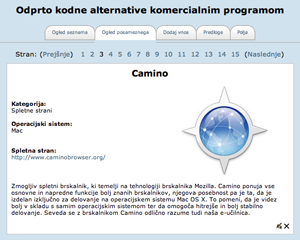
Database module in actionWe still have to test the Database module for teaching purposes (as a study activity), but what we were already able to do with this module is a database of open source free software that provides a good alternative to (sometimes better known) commercial software. Any registered user of our virtual classroom can also add his/her own favorite software to the list, and also post comments to the existing entries. Also, for this specific database I also created a custom template for displaying entries that looks really cool. I think this module provides teachers with great flexibility, and the only limitation when using this module is our imagination. Although it is a pity that there is yet no option for saving different database templates or the option of being able to choose from a given set of pre-made templates. For this reason I'm a bit afraid that teachers that aren't that familiar with HTML will refuse using the database module, as it might seem to difficult to set (although it really isn't).

Seeing that we were is a creative mood when preparing the new virtual classroom for students, we also decided to offer our instructions for students in a wiki version (as a supplement to the classical PDF version). For this specific wiki (that runs on eWiki) users don't have editing permission, as the wiki module wasn't yet used in our virtual classroom, and most of our students aren't familiar with the principles behind wikis and essential wiki markup. Of course, it is in our plan to try to change the situation by including lessons about wikis in different courses (like Business Informatics or E-business).

So far we still have no user feedback about these activities (that are by the way available on the first page of our virtual classroom to registered users). We are keeping an eye on the viewing reports for these activities, but I hope we'll be able to survey at least a few students about their opinions and experiences about the new ways of publishing information that hasn't been used until now. In fact, despite the different possibilities of material delivery that Moodle provides, we have been mainly using PDF files for course materials. And though PDFs are great for printing, they do lack a bit of interactivity and flexibility that the modules like wiki, database or glossary can offer.
When you need to share a list or task...

I’ve always wanted a simple and efficient way to share lists and notes online with other people and the option to access shared items anywhere (even on my mobile). And so it was that I finally found Backpack. Backpack is a great service for keeping list online and share them with other people. You can sign up at Backpack for free, though a free account has a few limitations (limited number of pages and no image sharing). Still, I found that the free account works just fine for me. I use it to keep a list of grocery shopping and a list of movies I want to see in the future - both list are shared with interested parties ;)

Also, I recently found an interesting service Monkey on Your Back that lets you send email “monkeys” that remind other people of their tasks. Unfortunately, other users can also send you reminder monkey, so watch out for monkeys on your back! ;) (A free account only lets you have 5 active monkeys at a time.)

Why do I “Google”?

One of the most interesting blog posts I’ve come across in the past days was certainly a post on the Official Google Blog with the title Do you “Google”?. In the post the author argues about the usage of the the trademark “Google” in everyday language. Though most of the bloggers that link to this post seem upset about it, I think it’s a great post that shows the playful and clever spirit of everything that Google does.

Anyhow, not wanting to piss more people off, I’d like to write I few lines about why do I personally Google in many way with a variety of Google products. Well, first of all, I must make a confession - at the end of the 90-ies and at the start of the new millennium I was a great Yahoo!, but then a couple of years ago I finally made my switch to Google because of the simplicity and usefulness of their services. And the switch has been almost as good as the switch from Windows PCs to a Mac ;)

One of the things that made me in love with Google was certainly Gmail. It meant goodbye to 2 MB inbox limits and hello 1 GB mail limit! Plus simplicity, mail labels, and the ability to check my mail in any way I like (mobile phone, resident mail application). And also, now I don’t have to worry about what will happen to my mails if my mail program or computer malfunction. Like most of us, I am also pretty lazy when it comes to backups. Yes, I know, we should make regular backups blah blah - but to tell the truth, you always remember about making backups just a few seconds after something terrible happens with your data. Now, with Gmail I just don’t have that worry anymore. I also use my mail account to send myself working copies of important documents, and all my important mails are on the Web, so should my computer crash I can all get it back quite painlessly.

And then, now we also have Google Docs & Spreadsheets that enables online editing, creating and sharing of text documents and spreadsheets. I still have to give this new service a try, but Google again seems one step ahead of me once more :)

Moving on, we still have other great products and services from Google. Google Earth is already a classic app, and recently I discovered Google SketchUp, with which I was able to make plans for a room renovation!?! Really Google, what’s next?

Not to be too long, I’d finally like to add the link to a quite recent site Google for Educators that lists all the great Google stuff that can be used for education purposes. All I can say to that is: keep ‘em coming Google! :)

(Btw: Google also thinks of Mac users - check out the Official Google Mac Blog.)

Applying market research to product strategy


One of the toughest tasks in the tech industry is using market research to help you make product feature decisions. A lot of people in tech feel you shouldn't do it at all – that customers aren't capable of envisioning what could be built, and if you ask them you'll just distract yourself from your vision.

On the other hand, there are a lot of companies that use market research very heavily in their product decision-making, so much so that they're reluctant to make any decisions without tangible evidence to back them up.

I think there's a middle ground, in which you can use research to help inform your decisions but not to make them for you. If you're interested in the details, you're welcome to visit the latest chapter in my online book-in-progress, Stop Flying Blind.

Why blog?

Before filling my blog with any serious posts, I'd also like to explain the motives that made me start this blog.

Firstly, out of gratitude towards many of the blogs I’ve been visiting lately (check my links to blogs), and that have shown me the value of sharing great ideas that can help to improve the overall quality of e-learning (both for me personally and the students at our faculty). And for this reason I felt that I can offer my share of ideas that will hopefully inspire somebody out there and make learning more fun and efficient.

Secondly, I realized that the number of my bookmarks and saved articles on the broad subject of e-learning is rapidly increasing and that I need a way to keep track of all the interesting things I stumble upon during my research work. And so I got the idea that I could use a blog to keep some sort of list of interesting subjects, sites, ideas, and thoughts that I encounter on a daily basis. And, as already mentioned, I can also hope that my journal of thought stimulating posts can help others that are (like me) surfing the cyberspace for new ideas.

And so it was (lo and behold!) that with a few clicks my blog was born. And to keep true to the purpose of the blog, here’s an article about blogging in education I found today and that provides links to a few interesting articles on the subject (and yes, a few of them already made it to my “interesting articles” folder :) ).

Here we go...

So, finally my new blog is online and running. Serious posts are soon to come, I promise :)

Who reads Carnival of the Mobilists?

Last week I was guest host of the Carnival of the Mobilists, a weekly collection of interesting mobile-related posts from all over the web. Along with the Carnival, I ran a little survey on its readers. Some of the results surprised me.

The poll results below are fun, but not scientific. All they tell us is the opinions of Mobilist readers who like to fill out surveys; we don't know what the rest of the readership thinks. On the other hand, about 25% of the readers filled out the survey, so that's a pretty good sample. Here's what we learned:

Our most popular services: Text, browsing, e-mail. Other than making voice calls, our most popular usages of mobile devices are, in order: texting, browsing the web, and email. But we hate downloading ringtones and photo messaging.

So much for convergence. Almost all of us carry more than one mobile device on a regular basis.

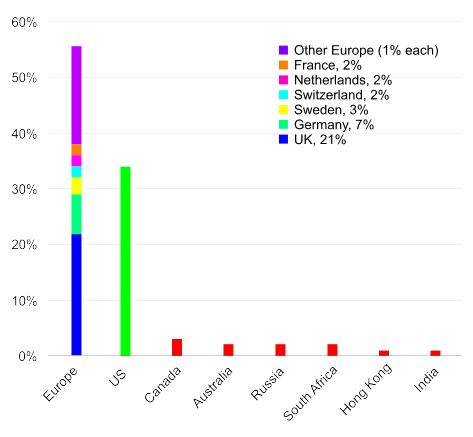
Majority European. About 55% of us are from Europe, with 21% from the UK alone. 34% are from the US. The Carnival is generally a Euro-American thing, with some Canadians and Australians spicing up the mix. I was disappointed that we have very few readers from India, Japan, southern Europe, and all of Asia other than Australia.

We are Nokia bigots. We lust after Nokia far more than any other brand of mobile device, followed distantly by Apple and SonyEricsson. There were big variations by region, though.

We're generally satisfied with the Carnival. Most of us are very happy with the Carnival. That's not too surprising – anyone who hated it would probably stop reading it, huh? But there were also a number of good suggestions, which I'll list below.


The details

Good turnout. We had 115 responses, which is about a quarter of the people who dropped by to read the Carnival that week. That's a very good response rate for this sort of survey. Thanks very much to everyone who responded!

Demographics: we're running a Euro-American stag party. We are 80-85% males, across all regions. The readership is also overwhelmingly European and American, with very few visitors from other places that do a lot of blogging in English, such as India. There are also very few readers from the southern European countries -- Italy, France, Spain, etc. Here's where the readers come from:


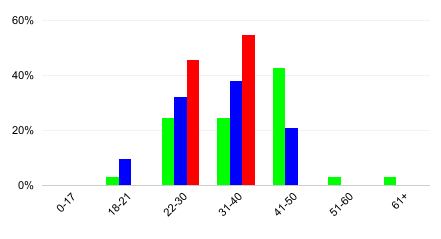
But we're not all the same age. The Americans among us are, on average, older than the Europeans. I don't know what to think of that.

(Unless otherwise noted, the color scheme for all the charts is: green=US; blue=Europe; and red=rest of world. If you are color-blind, the order is, from left to right: US, Europe, rest of world.)

Age of Carnival readers:


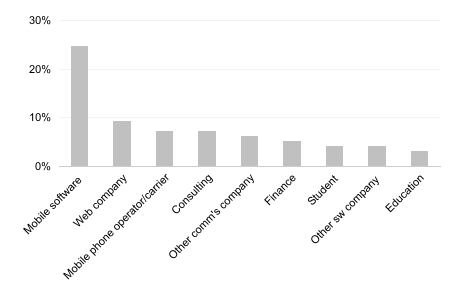
We also asked about occuptaions. There were too many different occupations to cut the results by country, but overall the largest job category was mobile software company. If you add the top four categories – mobile software company, web company, operator, and consultant – they accounted for about 50% of the total.

What type of company readers work for:


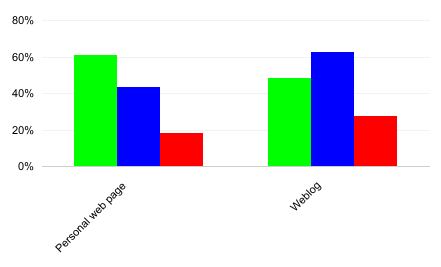
It's often said that blog authors communicate only to other blog authors. That's half true for the Carnival – about half of us have our own blogs, with the highest percentage of bloggers being in Europe.

Percent of readers having a...


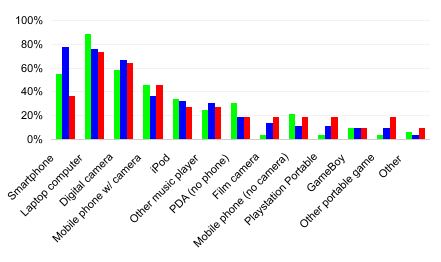
To converge or not to converge? Not. I'm sure to take some flak for my interpretation of this one, but I think it's fascinating that most of us carry more than one mobile device on a regular basis. The most popular mobile device is the laptop everywhere except Europe, where the smartphone is the narrow winner.

Percent of readers carrying a particular type of device on a regular basis:


So at this point, even among the elite Mobilist readership, the smartphone is not heavily replacing the laptop for most of us. More surprising to me, the smartphone isn't at this point replacing a lot of other things either. Even if you exclude the laptop, 86% of smartphone owners carry at least one other mobile device on a regular basis.

Here are the other devices carried by smartphone owners:


More than 60% of the smartphone owners also carry a digital camera. About 60% carry an iPod or other music player. About 30% carry a game player of some sort, and 25% carry a cameraphone in addition to their smartphone.

I know there are strong advocates of convergence among the Mobilist base, and maybe it'll happen in the future. But we haven't converged yet.

By the way, 3G penetration is higher in Europe than in the rest of the world. Here's the percent of us with 3G:


What do you do with your mobile device (other than voice calls)? Short answer: a lot. The chart below shows the percent of us who use a feature more than once a day:


There were significant variations by region. In Europe (blue), texting is by far the king. In the US (green), the champs are e-mail and browsing. In the rest of world (red), games spiked quite a bit (although the sample is so small that I'm reluctant to draw any conclusions about that).

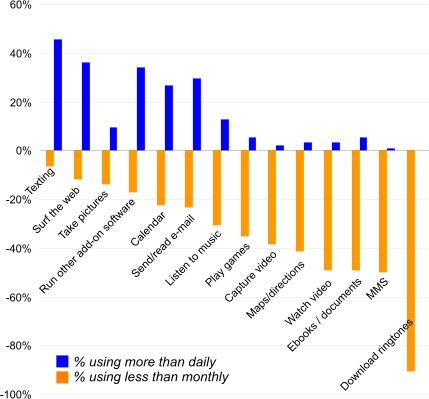
I was intrigued by the low scores for MMS, maps, and video – those are supposed to be three of the hottest growth areas for mobile data. So I took a different look at the data, comparing the percent of us who use a feature very frequently to the percent using it very infrequently. That lets you see which features are not used at all, versus which ones are used sometimes.

So, for example, about 30% of us use e-mail on our mobiles more than once a day, while about 25% almost never use it. The rest of us are somewhere in-between:


By this measure, we all hate downloading ringtones, which is very ironic since they're one of the most popular features among phone users as a whole. We also do very little picture messaging, e-book reading, and video watching. From the chart, it looks as if taking videos scored a little better, but 20% of us said our phones can't capture video. That doesn't show up in this chart, but if it did, the usage of video capture would be very low.


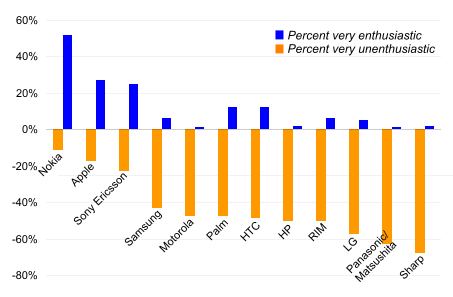
Which brands make us drool? Nokia. I was surprised by this one. Nokia inspired far, far more product lust than any other mobile brand we tested. I expected them to do well, but not this well. There were important differences by region, though – Nokia was less dominant in the US, and Palm was relatively weak in Europe.

I was shocked at the low scores we gave to RIM and Motorola. There are in this world Razr and Blackberry fanatics, but we haven't managed to include them in our readership.

This chart shows the percent of us giving a brand a seven or eight on a 1-8 scale, with eight being most lustworthy:


To understand the numbers better, I made a chart comparing the highest and lowest scores. The upper bar shows the percent of us giving a brand a score of 7 or 8 (the top of the scale), while the lower bar shows the percent of us who are very indifferent to a brand (a score of 1 or 2, or had no opinion of the brand at all):


So Nokia is extremely strong, and Apple and SonyEricsson are also doing quite well (less than 20% of us were indifferent to them). Palm and HTC both had significant numbers of very enthusiastic people, although their share of indifferent people was pretty high.

I'm disappointed by the poor score we gave Sharp. Over the years, they have consistently created some of the most fascinating mobile devices. Unfortunately, most of them never make it out of Japan. And since we have virtually no Japanese readers, most of us are unaware of what Sharp's doing.


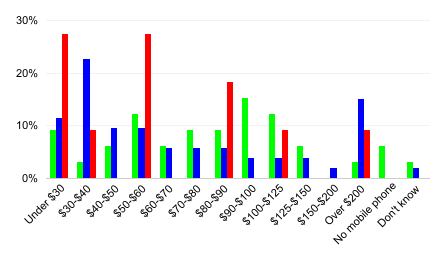
Monthly phone bill: All over the map. Usually when you ask a question like this, there's a definite curve – the responses tend to cluster in one part of the chart and then taper at either extreme. The striking thing about this chart is that there's almost no curve at all. Our phone costs are all over the map. Fifteen percent of us in Europe have monthly phone bills over $200 a month. Is this what happens when the operators don't offer flat rate data plans?


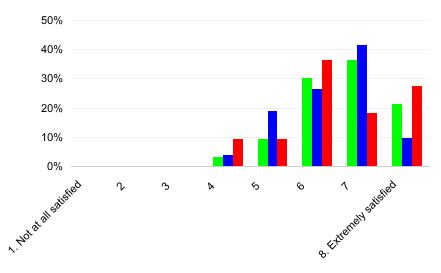
Satisfied with the Carnival. Most of us are satisfied with the Carnival, although that's to be expected since people who hate it would stop reading.


In this case, I think the written comments are more interesting than the numbers. Here they are, with groupings and a few editorial asides from me...


Happy people

Love it - great reads. I must admit I do skip some articles and only read the ones that appeal to me each week. I hope to be able to contribute later this year.

Keep up the brilliant work.

Good job everybody!

It's very good as it is.

Just keep going and keep a good balance between visionary items, technical & practical observations, entertainment stuff, usability and mobile lifestyle.

It seems quite good as it is.


Suggested features

Possibly more "Get the most out of (Insert mobile device with recently released software here) Guides"?

More information about the mobile internet - current status and future predictions.

A killer feature would be some sort of searchable catalog of past carnivals, with inclusion of their sub-links of course. [Cool! How about a meta-index of all the past Carnivals, kind of like the yearly indexes that some magazines produce? –Mike]

More photos. A forum for commentary on each article of the carnival. Creating a dialog between readers will allow more views and solutions to our wild jungle of an industry.

I find many of the articles are marketing based, this is no doubt an important area of discussion but not one which interests me much. The most interesting articles for me are those concerning everyday users and ways to make your device work best for you.

It would be cool to see how people have customised their mobiles within the community - each week have a new phone that has the best personalisation more stories about how mobile is used by the youth and generally more stories about how the people in the community use their mobile daily - my mobile day

I would like to see more articles on the mobile space in Africa, specifically South Africa where the mobile space is as advanced as any in the world, bar the far east. Certainly more advanced than the USA. Mobile technology is having a profound effect in the lives of many Africans. It is in fact helping a lot of countries bridge the technological devide.

Please more technical content. More critical. Tell me what you like/hate.

I noticed that there are only few articles in the Carnival that cover topics like PIM or alike. This is what many Smartphone-users heavily rely on...


General feedback

My original understanding was that Carnival hosts were obliged to publish every submission they received. I don't think there are a lot of low-quality posts, but there have been a few that hosts have included apparently believing that they had no say in the matter. I know this is in the host FAQ but could we clarify it somehow? [Good point, and I think we should have a discussion about this. It does vary by host. Some seem to be selective about what they link to, others (like me) link to every article that comes in during a week. My philosophy is that I don't know what info you need, so I'll let you decide. But I give much more prominent placement to the posts that I like best. –Mike]

I think the Carnival happens too frequently, which in turn lowers the quality of the writing. Most contributors are regulars and it's difficult to come up with something original every week. If I wanted to read from the same author each week, I'd probably follow his/her blog instead. I suggest to do the Carnival once per month or introduce some other measure to reduce the amount of articles/higher their quality. Maybe let the readers vote for the Top 5 articles per month.

Great summary of what is written on blogs. I would appreciate - moderated discussion as soon as carnival is released to be able to ask some questions to the authors - more insight about user experience for new services. [I like the intent behind this one, but I have a feeling that most Carnival participants would not want to move discussion of their posts off of their own blogs. Maybe I'm wrong, though. –Mike]

Often very wide range of participants. Sometimes I would have liked some focus.

Original content is what I'm looking for. There are a million aggregators but few producing thought provoking content.

Results of this survey. more questions about info or discussions, maybe some reader suggested ones.


Formatting/tone

More humour!

The themes are cute but get in the way of fast reading and comprehension. I'd also like to see a survey of posts rather than a description of submitted posts ... a little less self-promotion. Perhaps bloggers can submit their sites for weekly consideration?

Some of the authors seem to regularly write about things that are not mobile related, what's with that? Some of the Carnival hosts are too rambling, it can be hard to find the meat.

Maybe make the presentation a bit less geeky/weirdo. The first time i heard about the carnival (via a link on AAS home page), i went to the carnival's page, saw weird carnival pictures (nothing on the page that would give a hint that it was all about mobile devices) and loads of text with plenty links and inside jokes and no explanation really of what this was all about. Since i didn't have much time, I just closed the window since I couldn't quickly figure out what was happening here and the presentation just didn't appeal to me at all. It's only a few weeks later that i tried it again. This time I took the time to follow the link and eventually understood what it was all about. I'm now a regular reader but, frankly, if you wanted to do your best to scare newbies away, you couldn't do better. That said, now that i know what the carnival is, the presentation is fine to me. It's just that my first impression was one of confusion and "why the hell did AAS link to this weird thing?". Apart from that, the carnival really is a brilliant idea and it's always a joy to discover the new links every week. There's always loads of interesting things to read on various topic so keep up the good work.

[Ouch! I'm one of the guilty parties on this one. Bloggers tend to be kind of showoffs, and it's very tempting to try to find the ultimate Carnival photo or come up with a cute new Carnival-related theme. But I can see how that would be intimidating to a new reader. When I host in the future I'll try to make my write-up more accessible to newbies. Hey, how about we come up with a standard couple of lines explaining what the carnival is? Each host could put that near the top of their edition of the Carnival, to make sure new readers would know what they're seeing... –Mike]


Want more information on the survey results? Come to this address and you can analyze them for yourself.

_______

PS: Thanks to the folks at MobHappy for including my post on smartphones vs. PCs in the latest Carnival.