Showing posts with label Moodle. Show all posts

iMoot 2011 to explore New Directions

MoodleMoots, conferences dedicated to users, administrators and developers of Moodle, our beloved open-source learning management system, have always been my favorite events for exchanging learning and teaching experiences. This year, I'm particularly excited about attending iMoot2011, the second annual web based International Moodle Moot.

iMoot2011 will be running from 30th April to 3rd May 2011, 24 hours a day to accommodate different time zones. If you want to get involved as a presenter, you can submit presentation proposals and academic papers by February 19th, or register as an attendee (got my early bird registration yesterday!).


The theme for iMoot2011 is New Directions, a fitting title considering Moodle 2.0 has finally been released at the end of last year. However, it's good to know that Moodle's new directions won't be the main focus on the conference; instead, the goal of the conference will be to explore the potential of using new technologies and pedagogical ideas in an evolving online learning space, where Moodle is just a piece of the puzzle.

You can find more info about the conference on the official iMoot2011 website. I'm certainly looking forward to participating in the conference, getting new ideas and meeting new and old Moolde buddies. Will you be joining us?

Imagining a mobile Moodle

For this year's 4th International Slovenian MoodleMoot I decided to explore the efforts being made to bring Moodle to mobile devices. I found several interesting projects in this field, although I think we're just starting to explore all possibilities, and that more interesting developments will follow in the next few years, especially when teachers start experimenting with things like geolocation, augmented reality and resources that can interact with sensors on mobile devices.

The main goal of my paper and presentation was to invite teachers to think about possibilities that mobile devices can offer for education and the ways we could embed mobile learning in Moodle, a well established Learning Management System.

Here's the abstract from my paper Taking Moodle Out of the Classroom: Making Learning Mobile, Context-Aware and Fun:

"Mobile devices are becoming increasingly more powerful, better connected and are able to provide better user experience and new services based around location and context of users, which opens new possibilities for learning. The paper presents an overview of mobile learning and the efforts being made to provide better support for mobile devices and learning activities/resources in Moodle. In conclusion we also present some future trends in mobile computing that could also provide new ways of learning on the go."

You can see a video of my presentation at the conference on YouTube (total length 15 min):


And if you'd like to learn more about the topic, you can read my full paper on Scribd:

Virtual worlds in education and Moodle

Today I'd like to share with you my recent paper about using virtual worlds in education, with a special focus on how we can use virtual worlds with Moodle. I wanted this paper to be a basic introduction to why virtual worlds are good for education, and also provide a basic overview of some of the most interesting virtual worlds/tools on the market today.
Here is the embedded version from Scribd:
I presented this paper at the 3rd International Slovenian MoodleMoot with a live demonstration of Webline.lite (a super easy way to add avatars to any website), and I hope I managed to encourage some teachers to think about virtual worlds as a possible addition to their online courses. This year I was positively surprised to hear so many teachers using blogs and wikis in their classrooms, so perhaps next year I won't be the only weirdo talking about virtual worlds anymore :)

New Moodle Presentation

It's been almost two years since I created a brief video presentation of Moodle, and now I finally took the time to update it with a new version. Initially, I just wanted to update the usage statistics, but I ended up doing a redesign, and I also added some information, so it's slightly longer than the previous version. In addition to that, the video is now available in better quality and in widescreen format. And now, without further ado, I present you the new, improved Moodle Presentation:


You can view the video presentation on YouTube, Vimeo, and blip.tv. I created the presentation in Apple's Keynote, so you can also view the slides that I used on SlideShare.

I hope you enjoy this presentation; and feel free to use it to spread the word about Moodle!

Interested in Moodle? Find a MoodleMoot to attend!

Moodle is a great open source and freely available online learning management system, but what really makes it special is the large community of teachers and administrators that are using it in many different and innovative ways. And that is why Moodle conferences called MoodleMoots (gatherings of wise Moodle users) are always great events to attend for anyone already using Moodle or trying to learn more about it. They are a great opportunity for people to share best practices and to find new connections and even friendships.

And it is with great pleasure that I'm now helping organize the 3rd International Slovenian MoodleMoot, which will take place on May 22nd in the lovely and sunny coastal city of Koper, Slovenia (my birth place!). I would like to invite you all to attend our Moot and present your experience with Moodle; and if you can't make the trip to Koper, you can even present remotely via Skype. If you'd like to learn more about our MoodleMoot, see the official Call for International Presentations.

In case the timing of our conference isn't right for you, I'd also like to encourage you to take a look at the list of other MoodleMoots that are being organized all over the world. So far I was only able to attend the Austrian Moot once, but I sure hope I get the chance to visit others as well! Moodlers are usually a really great crowd, and I'm already looking forward to seeing some great practical uses of Moodle and related tools at our Moot. I hope to see you there too! :)


P.S.: Speaking of great conferences... don't miss The Virtual World Best Practices in Education (VWBPE) conference this weekend (March 27-29) - it's a free conference taking place in the virtual world of Second Life.

Improving student engagement with game mechanics and a smart progress bar

Keeping students motivated and interested can often be challenging; even more so when you're dealing with distance learning. There are of course several pedagogical approaches that we can use to keep students motivated, but lately I've been thinking about how we could make the tools that we already use in education more student friendly, more engaging and fun to use. And here's an idea I've been playing with in my mind lately: the integration of smart progress bars into a LMS (Learning Management System) to increase student engagement.

Progress bars on the web - nothing new

I've noticed that several websites are using progress bars to encourage users to fill out their profiles. You've probably seen this on LinkedIn or SlideShare and even in various tutorials. Another thing I've noticed is that these progress bars really work on me! Every time I see one of these I try to increase the level of completeness; I admit that it even convinced me to give out my e-mail address to a Facebook app! What is great about these progress bars is that they usually suggest the next step you should take to increase the completeness. "Want more? Add this box to your profile!" It's simple, easy to follow, and you get something new to do each time.
LinkedIn profile completeness
It's also common to show some kind of progress bars in learning activities such as online lessons. You've probably seen this too: "You've completed 80% of this lesson". Unfortunately, these progress indicators are often way too impersonal too provide anything else than plain information. And this can be quite boring. You know in advance that all you have to do is keep clicking the Next button and you'll eventually get to the end.

Integrating progress bars with smart suggestions into a LMS

Now, what if we would try to integrate the interesting type of progress bars in e-learning courses? I'm thinking about some sort of course-wide (and even site-wide) progress indicators. Let me explain what I mean.

You have an online course, and you're using a LMS; let's say Moodle (the LMS I'm most familiar with). And you have a set of activities students have to complete. Your LMS allows you to group these activities by weeks or topics. Now you also have a tool that allows you to set the connections between activities. For example, a student should first read the introductory article, then discuss it on the forums, and at the end of the week write a blog post about the subject or make a podcast about it. And let's also say that you could define a set of activities that have to be completed to unlock the next section.

Now, imagine a block that would show each student how much of the activities have been completed or how many points the student has accumulated in the current week/topic. At the bottom of the block there is a link that says: "Well done Lucy, you've completed 80% of this week activities! Click here to find out what else you can do this week." or "Great job Lucy, you've earned 80% of the available points for this topic! Click here to find what you can do next to get that perfect score!"

A sample Moodle block with a progress bar
After clicking the link, our student, Lucy, gets a list of activities that she hasn't completed yet or that she can improve. It's not necessary to show all activities; the LMS only shows activities that make sense for Lucy at that time. Just a few of activities that Lucy can do next. If we want to get really smart, we could even suggest activities that best suit Lucy's learning style. Let's say we know that Lucy likes doing podcasts, but hates writing. In this case, the LMS would just suggest Lucy to do a podcast, and leave the option of blogging out (Lucy could of course change her preferences at any time and choose from a full set of activities).

At any time in the course, Lucy can also get the info about how successful she was in previous weeks/topics and have a look at the course overall progress bar. To make things more interesting for Lucy, we focus on the overall course goal, and reward her each time she completes one with activity with another activity that bring her closer to achieving the overall goal. Lucy is also getting curious about what kind of activities she'll get to do after she completes the current section. She knows her teacher always find interesting things to read and do. And you know what? I also think Lucy has been a good student so far, so she certainly deserves a special reward each time she completes a section of activities. We can display another star next to her name, and this week she also made it on our list of top students! Hurray Lucy! You're so close to becoming the master of the course and save the princess!

Ah yes, these are all well known game mechanics, but we're currently not doing a very good job at implementing them in education, so why don't we try do engage Lucy by giving her a clear sense of achievement in each course she's taking? And if Lucy is doing really well, we might even give her the option to tell her Facebook friends about how good she is by allowing her to export some of this info into her Facebook stream.

The same principle could also be implemented site-wide. For example, upon login in her school's LMS, Lucy can see how much of the activities she completed in the current semester/year/program and receive suggestions on what activities she should do next - across different courses. If we want to get really, really smart, we can let Lucy tell us how much time she has available and suggest an activity that she can do in that amount of time or let's try to guess which subject would most suit Lucy on a Monday morning! And again, we can also take into account her learning style preferences or even what we know about her past behaviors.

Should we do it?

Showing students exactly where they are and what their next steps can/should be is very important. And I think that progress bars and smart suggestions could provide an interesting motivational tool and a powerful way to help students organize their study and follow the progress of their study or a course.

Technically speaking, integrating the progress bar in a LMS course or site shouldn't be too difficult. It might get a bit more tricky to develop a really smart suggestion system, so I don't expect to see that one soon. Right now, I'd really be happy just with a smart and personalized progress bar :)

Now, I've seen a lot of individual online activities that provide some sort of progress bar and feedback (for instance, the Moodle Lesson module), but I haven't yet come across any LMS that would provide this for the entire course or site and that would allow teachers to easily and precisely define the flow of different types of course activities. And I also haven't seen any smart suggestion systems for learning activities. Am I missing something or is this something that hasn't been done yet? Is anyone up to the challenge of implementing the described game mechanics into our courses? Let me know!

Slovenian MoodleMoot'08 International Section Speaker List

The preparations for the upcoming MoodleMoot in Koper, Slovenia are in full swing not just in real life, but also (this year for the first time!) in Second Life. Today we've just successfully installed and tested the Sloodle WebIntercom, which will make communication between real and virtual conference attendees even easier through the conference Moodle site. And we also have the list of presenters for the International Section of the conference, which will be partially broadcasted into Second Life and partially taking place in SL. Many thanks to all that agreed to present!

So here is the basic info for the international section:


2nd International Slovenian MoodleMoot 2008
Friday, June 6th, 2008

International Section – between real and Second Life®

SLURL: http://slurl.com/secondlife/Rockcliffe%20X/131/38/21

CET 5 PM – 6.30 PM
SLT 8 AM - 9.30 AM
(Check your time zone)


Real life

Using Moodle for the international study programme Media Production Management
dr. Peter Purg, University of Primorska, Faculty of management Koper and Institute and academia for multimedia Ljubljana

Moodling in a business school in Slovenia
dr. Viktorija Sulčič, University of Primorska, Faculty of management Koper
Alja Sulčič, Artesia Ljubljana, Slovenia


Second Life

Second Life Education: In Medius Rez
Chris Surridge (SL Christopher Flow), South Korea

Sloodle community
Giannina Rossini, UK

Sloodle 0.3 – Improving Web and Virtual World Integration
dr. Daniel Livingstone (SL Buddy Sprocket), University of Paisley, UK


Hope to see you there! :)

Slovenian MoodleMoot 2008 - Call for Presentations

Today I have the pleasure to invite you all to attend or present at the upcoming Slovenian MoodleMoot. Some of you may remember me writing about last year's (first) Slovenian Moodle conference, but the big change this year is that we're making the conference more international and more accessible to a wider audience. We will be in fact broadcasting the international section of the conference live in Second Life and we're also looking for international presenters that are willing to present their experience with Moodle or Sloodle to the Slovenian and Second Life audience through Second Life. The combination of physical and virtual presentations will be the first of its kind for everyone involved, so I hope we can get the technology to cooperate ;)

And here's more info about the conference and about how international guests and presenters can get involved:


When: June 6th, 2008
Where: Koper, Slovenia; Second Life®
Deadline for application: May 31st, 2008
Contact info: cei@fm-kp.si

About the conference

Last year the Faculty of Management decided to host the first Slovenian Moodle conference (also known as a MoodleMoot) to bring together users, developers and administrators of Moodle, one of the most popular online learning management systems in Slovenia. This year we decided to make the Slovenian MoodleMoot international and invite Moodle enthusiast from all over the world to share their Moodle experience and meet with Slovenian Moodle fans. The 2nd Slovenian MoodleMoot will feature several presentations from Slovenian users, but also a real life and a virtual international section in English. The international section will be broadcasted into the virtual world of Second Life.

Call for presentations

We invite you to present your experience with using Moodle or Sloodle either at the real life conference location or in Second Life. Presenters in Second Life will be asked to use Skype during their presentation and can use presenter slides and other visualization tools. If you would like to present at the Slovenian MoodleMoot, send us an e-mail at cei@fm-kp.si by May 31st that includes:
  • your name (SL presenters also add your SL name) and affiliation,
  • chosen presentation mode (real life or Second Life),
  • the title and a short abstract (no more than 500 words) of your presentation,
  • special requirements for the presentation (if any).
Presentations should be limited to 15 minutes.

Attending the conference

You can attend the international section of the conference for free either in real life in the sunny coastal city of Koper, Slovenia or in the virtual world of Second Life (exact location to be announced). If you plan on attending the conference in Koper, Slovenia, we ask you to announce your attendance by May 31st at cei@fm-kp.si. Second Life attendance does not require prior registration.

Other info

We expect the international section to be scheduled at 5 PM CET (8 AM SLT) on Friday, June 6th, 2008. You can send additional questions about the conference at cei@fm-kp.si or post them on the conference Moodle site. For additional information about presenting in Second Life, you can also contact Alja Sulčič (SL iAlja Writer) directly in Second Life or through e-mail (alja@artesia.si).

The conference is organized by the Centre for e-learning at the Faculty of Management Koper in collaboration with Artesia, Open Source Center Slovenia, and National School for Leadership in Education.

Random thoughts about the future of Moodle

Lately I've been spending a lot of time in Moodle; mainly of course as part of my Moodle Teacher Certificate (MTC) program (which I successfully completed last week), but also because of the Austrian Moodle conference, which I attended on Thursday and Friday in Graz (I had a presentation about the Sloodle project). I've been using Moodle in different roles (admin, tutor, user) for quite some years now, and I believe that Moodle is a great platform for e-learning because it's powerful, relatively easy to use, and also expandable and customizable for different needs. What is also great is the fact that the Moodle developer community is very active and always making sure new versions have useful new features and improvements of previous standard modules.

I had the pleasure to attend Martin Dougiamas' virtual presentation about the future of Moodle at the Austrian Moodle conference a few days ago, and I'm really excited about some of the features we'll be soon seeing in version 1.9, and also the roadmap for Moodle 2.0, which in my opinion has the potential of making Moodle 2.0 a great member of the Web 2.0 family. In this post I'd like to share with you some of my thoughts on the future of Moodle. I believe that Moodle has a sustainable future, so I'll focus mainly on discussing upcoming Moodle features and possible future developments.

Among Moodle 1.9 features that Martin presented on Thursday, I was most impressed by the added social networking features. I think it's a great step towards making Moodle even more flexible and user friendly. If you're a Moodle.org site user, make sure you edit your profile and add your interests and try finding users with common interests (check out the page for the tag "moodle" - cool, isn't it?). Right now I sometimes feel limited by the rigid course structure in Moodle, and I really can't wait to have a better way to connect with other Moodle users through tags and shared interests (similar to what Elgg offers). And one of the next steps is hopefully the ability to mark Moodle items (forum posts, resources etc.) as favorites, so each user could create his/her own library of favorite resources.

However, another problem I've been seeing with Moodle for some time now from the perspective of a common user (i.e. student role with no editing rights), was not just being closed in courses, but also being closed and limited to a certain Moodle site. I often found the thought that students lose access to their Moodle resources/activities/data after a course or study year is over disturbing. Of course, teachers have many options to export/import content and date, and move content/data among their courses and among Moodle sites. But the students don't have any easy way to export their work and move it to a new Moodle site or to their personal archive somewhere else. So, I think one of the next steps in Moodle development should also be empowering users and enabling them to create their library of resources and also their Moodle portfolio that they (the students, not the teachers or administrators!) could take to another Moodle site (when changing schools for example). The Moodle development roadmap shows plans of enabling easier connections between different Moodle sites through the Moodle Network, which plans to provide a Moodle Community Hub for sharing content, user info, and enabling better peer interaction. However, I think that moving between Moodles should also be made easy for students, and not just for the teachers.
What I'd also like to see, is improvements in helping students getting around their Moodle courses. Moodle provides a block, which shows recent activity since the last login for each course, and also an overview of your course through the My Moodle page (though I really wonder how many administrators/teachers/students are aware of this option?). Still, I think the overview of my courses pages could and should be further improved by adding more flexibility and customization options. This could be very important for large Moodle sites with a lot of activity (like the moodle.org site, which I find very challenging to follow!). What I would like to see on the overview page is something closer to Facebook News feed page. Students should be able to control what appears on this page, in what order, and in how much detail. Some sort of personal dashboard with more user-centric widgets. Now you can of course add some standard blocks to the overview page, but I miss more tools to help the users organize and plan their learning activities and perhaps an option to set up custom e-mail alerts that relate to specific course events. I really don't like to receive e-mails for every Moodle post in a certain forum (especially for the most active ones), but I think it'd be useful to be able to add a rule to receive an e-mail update whenever a new resource/activity is posted (in any of courses you're enrolled in) or when new topics that match your interests (keyword watcher) are started.

All in all I'm really excited about Moodle adding more social networking features and establishing better connections between different Moodle installations and also the rest of the web. With all these improvements I'm beginning to wonder if in the future we could see Moodle also become a standardized personal learning environment with users in control of their learning data and the ability to move from one Moodle site to another (of course with the choice of moving only necessary portions of your Moodle profile data/library/portfolio)? We'll see what future Moodle development brings us. I certainly think Moodle is worth keeping an eye on, and I can't wait to get my hands on the upcoming Moodle versions :)

4th International Austrian Moodle Conference

In case you missed the announcement at Moodle.org, I'd like to invite everyone to attend the 4th International Austrian Moodle Conference this September in the lovely city of Graz (Austria). The conference has no participation fee and it will be a great opportunity to exchange Moodle experiences, and of course make new friends and get some fresh ideas for the new study year. I will most certainly be attending the conference, so I hope I can also meet some of you, dear readers of my blog, there :)

More info about the conference can be found on the conference Moodle site, where you can also download the Call for Papers (also in German).

See you all in Graz!

Report: First Slovenian Moodle Moot

The first Slovenian Moodle Moot took place yesterday in Koper (my hometown :) ). The Moot was hosted at my faculty, and we had over 60 delegates from all over our country (and also abroad). We were able to listen to over 30 interesting presentations, during which we learned about how Moodle is being used in different schools, at different levels, and for different course subjects. It was also a great opportunity to meet new people, exchange ideas, and also have a great time on the Slovenian coast (we managed to arrange a nice, warm and sunny day ;) ).

Most of the conference was in Slovenian, but we also had an international section, in which our Austrian and Italian friends presented their work. I was especially excited about having our Austrian friends over, whom we actually met through moodle.org! Thank you so much Peter and Sabrina for coming and presenting some of your work! :)

Here is a photo from the beginning of the international section, with me as the section moderator, and Peter and Sabrina preparing for their presentation, which was supported by Persony, a really great web conferencing tool:

Photo by Alen Ježovnik

At the conference I also presented my own paper on the subject of Sloodle. My presentation was the last of the day, and I think I did a decent job - judging from the feedback from the audience and their questions :) After the conference I also had a brief presentation of Second Life for those that were interested, and I hope I managed to present the existing potential of virtual worlds well enough.

So, the event was delivered without any major problems, and I think that all of our delegates were able to find something useful at our first Moodle Moot. I definitely hope we'll have another event like this again in the next year.

I'd like to finish this report by posting my own Sloodle presentation, and the two videos I've used during my presentation (I only had 10 minutes to present everything, so I had to keep the videos short). Here are the slides I used (translated in English):

A short video about Second Life (it was played on slide 3):

And a short demonstration of how the Sloodle Toolbar works (played on slide 7):

(By the way: we also had my Moodle presentation video playing in the coffee room and before the start of the conference.)

If you'd like to know more about our conference or my presentation, please leave a comment here or email me (ialja(at)mac(dot)com).

Moodle Presentation: feedback needed

The past few weeks have really been busy for me, so I don't get nearly as much time to blog as I'd like to :( But today I'm really excited about the fact that I can finally share a Moodle presentation that I've been working on for some time. The presentation will be used at the first Moodle Moot in Slovenia that my faculty is organizing on May 18th. The plan is to have the video play during the conference (at the beginning or/and during coffee breaks), and also include a copy on the conference CD that our attendees will get after the conference.

So, if you have 2 minutes to spare, please take a look at my Moodle Presentation draft:

I'd really like to get some feedback on this video, so don't hesitate to leave your comments or suggestions here on my blog or on YouTube :)


(Small print: this presentation is actually a translation of the original presentation that I made in Slovenian, so I apologize in advance for any awkward translations :") )

First Moodle Moot in Slovenia!

At last! I am happy and proud to announce that the first Moodle Moot in Slovenia will be held on May 18th 2007 in Koper, Slovenia. Moodle Moots are conferences for Moodle users that Moodle lovers organize all around the world (more info can be found here). Since we opened Moodle.si (an online community for Moodle users in Slovenia) it's also been our wish to organize a live event where Moodle users can meet in person and exchange tips and tricks ;-) Now, after a few months of planning, meetings and ideas of all sorts we are finally a step closer to making our wish come true.
More info about our moodle.si conference can be found here, although the site is in Slovenian language only. If you don't understand Slovenian and would like to know more about the conference or even participate in some way, please feel free to leave a comment on this post or email me :-)

Moodle.si - at last!

Yay! Today is a good day! We finally managed to open all content of the site Moodle.si to the public! Moodle.si is an attempt to establish an online community of Moodle users in Slovenia, so anybody from Slovenia that is reading this post and is a Moodle user is invited to join the community ;) (By the way - the site is exclusively in Slovenian language, so if you're looking for a Moodle community in English I suggest the official Moodle site.)

And what can be found on the site? So far we created a database activity where users can add info about their Moodle sites and a database activity where users can post their favorite teaching/learning links. We also opened a general discussion forum and prepared a course for teacher/tutor discussions that is available to registered users. In this course we created Wiki-based instructions for teachers on how to use Moodle (version 1.6.2) that users can freely edit, and opened forums that focus on teaching with Moodle. (If you don't speak Slovenian and would like to know more about our content, feel free to contact me.)

Today we also sent out invitations to Moodle users that are listed on the Moodle site and now we are anxious to receive feedback from the first users that will be joining the community. I really hope people will like and accept this idea and that the site will become a place where we'll share ideas, experiences, and construct new knowledge :)

Need help with Moodle?

So far I haven't been posting as much about Moodle as I intended to, so to make up for that I'd like to post some resources for using Moodle (for teachers):
These resources were really useful to me when I helping to rewrite the new Moodle manual for teachers of our faculty. I've also been working on a Wiki version of the manual (in Slovenian) and I hope it will be soon available to the public through the new Moodle site we're preparing at our faculty :)

Using Moodle: Database and Wiki modules

This summer the servers of our faculty got a nice present - a new virtual classroom that is now supported with version 1.6.2 of our beloved LMS Moodle. The first great surprise with the new version was an improved translation (slovenian) of the whole system and of course the improvements in functionality. A new version also meant that instructions on how to use our faculty's Moodle had to be revised - both for students and teachers. In this process we had to include the new translation (that is now more complete and accurate), but while I was checking for changes in the system I was also very happy to discover new features, among which I was most impressed by the Database module. The module enables users to create databases with different fields that can include text, images, other files, numbers, URLs etc.

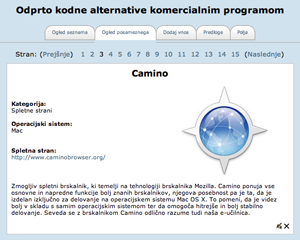
Database module in actionWe still have to test the Database module for teaching purposes (as a study activity), but what we were already able to do with this module is a database of open source free software that provides a good alternative to (sometimes better known) commercial software. Any registered user of our virtual classroom can also add his/her own favorite software to the list, and also post comments to the existing entries. Also, for this specific database I also created a custom template for displaying entries that looks really cool. I think this module provides teachers with great flexibility, and the only limitation when using this module is our imagination. Although it is a pity that there is yet no option for saving different database templates or the option of being able to choose from a given set of pre-made templates. For this reason I'm a bit afraid that teachers that aren't that familiar with HTML will refuse using the database module, as it might seem to difficult to set (although it really isn't).

Seeing that we were is a creative mood when preparing the new virtual classroom for students, we also decided to offer our instructions for students in a wiki version (as a supplement to the classical PDF version). For this specific wiki (that runs on eWiki) users don't have editing permission, as the wiki module wasn't yet used in our virtual classroom, and most of our students aren't familiar with the principles behind wikis and essential wiki markup. Of course, it is in our plan to try to change the situation by including lessons about wikis in different courses (like Business Informatics or E-business).

So far we still have no user feedback about these activities (that are by the way available on the first page of our virtual classroom to registered users). We are keeping an eye on the viewing reports for these activities, but I hope we'll be able to survey at least a few students about their opinions and experiences about the new ways of publishing information that hasn't been used until now. In fact, despite the different possibilities of material delivery that Moodle provides, we have been mainly using PDF files for course materials. And though PDFs are great for printing, they do lack a bit of interactivity and flexibility that the modules like wiki, database or glossary can offer.