Mozilla Seabird 2D
Showing posts with label Concepts. Show all posts
Showing posts with label Concepts. Show all posts
Philips Fluid smartphone with flexible OLED display
With modern gadgets getting smaller and better to replace the jewelry or fashion accessories, the contemporary jewelry designers may have to face a tough time in the days to come. Yesterday we covered the Bricell Jewelry Phone in the blog, and now it’s time for another stylish gadget to tickle the trendy users. Conceived by Brazilian designer Dinard da Mata, the “Fluid” is a smartphone concept that as suggested by its name features a flexible OLED display to allow better mobility and ease of use. Designed for Philips, the mobile phone wraps around the wrist to become a bracelet for the fashionable, while gives an easy access on the go.

source

source
Concept of periscopical camera
At the present moment on the market for digital cameras is a huge amount of models. However, the differences between the models as a whole not too much - clear boundary can be conducted only between [tsifrokompaktami] and specular cameras. Each user can select apparatus conformably to its budget and needs, although sometimes the difference between the models of compacts is reduced to the field of design. Mirrorless cameras with change optics separately stand. And also separately can become the concept, devised by designer [Yaniv] Berg (Yaniv Of berg).


It created the [tsifrozerkalnuyu] camera, which is periscopical. Camera has change optics and possesses the bent housing, in which is hidden the system of mirrors. The key advantage of this construction becomes the possibility to look in viewfinder not directly, but on top or from below. In such a way that to photographer is not required to retain camera in face - it can hold it at the level of breast, or in another convenient manner, in this case obtaining the same possibility to look through optics as in [tsifrozerkalke] of traditional construction.
No information about the actual possibilities of the obtained prototype it communicates. It is also unknown, did draw concept the attention of the important producers of photographic technique.

Microsoft showed the prototype of device from the project Of menlo
Microsoft Of research published information about the mysterious project by the name Of menlo. In effect nothing there was nothing known to the present moment about it, but now appeared the first details. The company Of microsoft demonstrated the mobile device, connected with the project Of menlo. It is more precise, this is the prototype, which can so not receive commercial propagation. Device is equipped with the 4,1- one inch capacitive sensory display, whose permission composes 800x480 of points, works apparatus on the base Windows Of embedded CE 6.0 R2.

Device is equipped with the accelerometer Of bosch BMA150 and with the digital sensor of the pressure Of bosch BMP085. And on it will be tested the navigation application by the name Of greenfield, it uses given sensors. It is assumed that Menlo - this not device itself, the negative experience with the models Of kin the company Of microsoft to, apparently, repeat is not intended. This development is the program platform, which maximally uses possibilities of sensors, and this prototype - this simply demonstration.

Device is equipped with the accelerometer Of bosch BMA150 and with the digital sensor of the pressure Of bosch BMP085. And on it will be tested the navigation application by the name Of greenfield, it uses given sensors. It is assumed that Menlo - this not device itself, the negative experience with the models Of kin the company Of microsoft to, apparently, repeat is not intended. This development is the program platform, which maximally uses possibilities of sensors, and this prototype - this simply demonstration.
The Turning Point For A Phone
I love covering concept phones that may not have substance to them (tech-backing), but nevertheless are fun to read about. Featured here is a concept Sony Ericsson FH Mobile Phone that has a pivotal point to it. It flips vertical on a pivot to mimic a phone and rotates sideways to become a viewing screen for the media functions and web browsing. The phone even becomes an intercom of sorts when split into two, allowing easy communication between the two parties holding each end. What a high-tech walkie-talkie this would make!


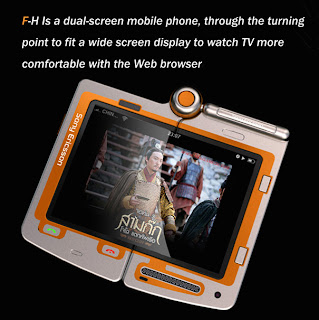

Designer: Du Jun
source


Designer: Du Jun
source
Microsoft Research shows off a prototype 'Menlo' mobile phone
For the past few months, I’ve been trying to piece together what Microsoft codename “Menlo” is. My tipsters described it as a project by Microsoft Researchers to investigate new operating system possibilities in the mobile space.
One of the research papers I mentioned in my original blog post about Menlo has now been published. (Thanks to reader Charon of Ma-Config.com for the tip about the paper’s availability.)
Lo and behold, there’s more in that paper, entitled “User Experiences with Activity-Based Navigation on Mobile Devices,” about Menlo. From that paper:
“Menlo is a prototype mobile device with a capacitive touch screen (4.1‖ diagonal, 800×480) running Microsoft Windows Embedded CE 6.0 R2 which incorporates a Bosch BMA150 3-axis accelerometer and Bosch BMP085 digital pressure sensor (barometer).”
(Microsoft included an image of a Menlo device in the paper, which I’ve included at right.)
Running on top of the Menlo platform is a new Microsoft Research Silverlight application codenamed “Greenfield,” which is a sensor-centric program allowing users to retrace their footsteps when seeking to find their cars.
Galen Hunt, the Microsoft researcher in charge of the cross-divisional Menlo project, mentioned in his LinkedIn profile that he “negotiated production of custom phone prototypes, designed and implemented major kernel and OS components, implemented runtime and compiler features, and wrote code for demo” as part of his Menlo work.
(Hunt also is the leader of Microsoft’s Singularity project. Singularity is a microkernel operating system which Microsoft Research has made available for license. Singularity also was/is the heart of Microsoft’s Midori distributed operating system incubation project.)
I mentioned in my original blog post a few of the other Microsoft researchers working on Menlo. The new paper on Greenfield/Menlo lists some others, including a couple of user-interface specialists and senosr researchers. Amy Karlson, who is listed as one of the authors of the paper, also is working on Microsoft Research’s “Courier.” (No, no the cancelled dual-screen Courier; the Courier phone-based file exchange system that is one of the projects of MSR’s Cross-Device User Experience team. This team is focused on understanding how to make PC-phone experiences more seamless.)
So what to make of all this? I don’t think Microsoft is going to build its own Menlo phone. (Been there, done that with the failed Kin.) I do think the Menlo team is continuing to focus on a new mobile operating system — not just the existing Windows Embedded Compact-based ones — that will work on a variety of processors.
source
Design by Community sketches – the votes are in
GLOBAL – Last week, we asked you to choose between three different designs for the Nokia U, the concept device whose features and specifications have been voted for by Conversations readers. Well, now the votes are in, the ballot boxes have been emptied and it’s time to reveal the final results for each of the candidates. Read on to find out more.
You had to choose between three sketches created by the design team to meet the specifications set by you. Over 18,000
Sketch one wins with 7276 votes. It’s a margin of just 1754 votes over the closest runner-up, number two. That’s just 11 per cent more of the vote. But a win nonetheless.
It’s a lot closer than you might have anticipated. But what does that mean? The first thing it might suggest is that people’s tastes are more varied than most of us think. There’s clearly a market for more than one model out there and no such thing as the ‘perfect’ design: even when the required specification meant they’re not radically different from each other. Also, they are all handsome in their own way. As Adam F said in the comments, “All three look good, let’s make ‘em!”.
A lot of people commented – quite rightly – that the designs resemble existing or announced product lines. The design team told us that they’d used the existing “design language” of Nokia’s devices to produce the sketches. This means that they are all identifiably Nokia phones. They were also cautious about releasing “spoilers” of device designs that may or may not appear in the future.
A number of people said that they still wanted keys, either in the form of an Eseries-style candybar or hidden away like the Nokia N97. Unfortunately, though, that vote took place in March and more people voted for a touchscreen. We’re sympathetic at the same time – and fortunately, in real life, there will always be a variety of models to choose from.
And finally, it became abundantly clear that making everyone happy isn’t going to happen. Here are two comments from the Chinese blog that perhaps demonstrate this best:
hillguy said: I like Sketch Two, because I love the two green lines.
toyawork said: I like Sketch Two, except for the two green lines.
Ah well. There were always going to be winners and losers from the start. But on to the next stage. We’ll take the winning design back to the team for them to model and render. Look out for more updates in the near future.
[Concept Art] HTC HD3 running WP7 & HTC Sense 3 (2010-07-31)
This is my second HD3 Concept. I made the first one (link) in February 2010 - back then people didn't knew much about Windows Phone 7. I thought it's going to be similar to 6.5.x and that - at some point - we'll be able to flash it on our current devices.
That's why I came up with a phone running Windows Mobile 7 and which looked like a kitchen knife (and what's with that huge weather animation?! ).
The Concept got some attention and was mentioned on several websites and blogs all over the world. That's when I learned that Google Translate has no problems translating "What an ugly phone!" from Russian and Turkish to English. Although I designed it for my graphic novel which takes place in 2015, my futuristic HD3 specifications were taken seriously so I was heavily criticized for the hardware.
Now, a few months later, I present to you my latest HD3 Concept.
Since everyone would like to see different specs I've decided to give you guys a chance of writing your own. I will update the threat with realistic specifications written by someone who knows what he/she's talking about.
As you can see, my new HD3 has two Build-in Speakers on both sides of the screen (I really liked that about my previous concept), a front facing Camera, HDMI output and a Micro-USB port. There are 6 hardware buttons (Power, Volume Up and Down and 3 WP7 buttons). You can come up with the rest.
I decided to make WP7 more customizable so I skinned it with Sense 3 (do you REALLY think HTC would release a phone without Sense? I know Microsoft claims that all WP7 devices should use Metro, but Sense is HTC's trademark). Of course you could still change the wallpaper:


Finally, before you start complaining about the hardware buttons, he's an alternative version with buttons that would give actual feedback (though I think they make the phone look ugly):
source
Phone Support For Beauty
You got to agree that the skeletal system is a genius of design; it protects the delicate organs inside while giving support to our lustrous skin. If we were to apply the same design for our mobile phones then it’s quite possible to wipe out the peripheral “phone covers and cases” industry. I’m talking about the LG Exo Smartphone Concept. The key feature in this concept is a high strength polymer exoskeleton for protecting the delicate internal components while supporting its external rubber skin.
The end result is a good-looking phone that does not require any protective case that mars its beauty. You get to enjoy the phone in its intended avatar! The reason why I relate to this concept is that my gorgeous iPhone lies hidden beneath this hideous cover, lest it falls down and cracks!


Designer: Benjamin Lotte
source
What are you expecting from Nokia’s MeeGo phone in order for it to become successful?
A lot of hopes are resting on MeeGo phone to be instrumental in Nokia’s reclamation of the high end smartphone arena.
There’s the N8, and other rumoured Symbian^3 devices which are awesome in their own right. But some would argue that they are high-mid and not completely and convincingly all high end.

It seems for the best of the very best Nokia will have to offer, the responsibility lies of MeeGo Phone.
What are you expecting from the Nokia MeeGo Phone in order for it to become successful?
I could mention precise hardware specifications/expectations from the OS, but I’ll leave that for the comments. Is there anything in particular that MeeGo phone cannot do without?
I’ll blanket statement with,
“MeeGo phone must be exceptional. Anything other than being an over achiever is a ‘fail’. There isn’t any room for compromises any more now that all eyes are on Nokia to deliver a class leading flagship. One that deserves the flagship name in not just being the best out of your own portfolio but sets the bar for your competition. There can’t be any penny pinching, no leaving out of features to place into a future handset. It must at the very least, be as good as the best currently out there and then some. Don’t just be a jack of all trades master of none, but similarly, you can’t do with only having one strong facet. MeeGo phone should be Nokia’s opportunity to show the rest of the world exactly everything their capable of, strengthen their brand image and justify their position as the number one phone manufacturer in the world”
If MeeGo phone doesn’t deliver to expectations, it’s unfortunately too late for any changes to happen, what with Nokia World 2010 just over a month to go.
Even if Nokia’s MeeGo phone turns out to be amazing, some may still find other excuses as to why it would suck, such as the ecosystem. That in itself would be another post. (As is the possibility of Nokia’s own MeeGo phone being outclassed by another manufacturer)
source
Subscribe to:
Posts (Atom)