I'm giving a talk on the ebook business at a publishing industry conference in New York in late February. I should have some spare time between sessions. If you're in New York and would like to chat during that week, please contact me here.
My talk is about the many ways the ebook industry has failed in the past, but my real focus is on how to avoid those problems in the future. As you know if you've read this blog for a while, you know I am pretty passionate on this subject (link). With all the recent goings-on between Apple, Amazon, Macmillan, etc, we have a lot to discuss.
Here's a synopsis of my talk. If you have any other ebook questions you'd like to see me cover in it, post a comment here.
Check Out My Scars: Seven Lessons from the Failure of Ebooks in 2000, and What They Mean to the Future of Electronic Publishing
1:40pm Tuesday, 02/23/2010
O'Reilly Tools of Change for Publishing (link)
The tech industry has a long history of celebrating its successes and forgetting its failures. We honor the IBM PC but forget the DEC Rainbow and Kaypro II. We put the iPhone and BlackBerry on a pedestal but sweep the Qualcomm PDQ and Ericsson R380 under the rug.
That selective memory is often helpful in the development of a new technology, as it prevents companies from being held back by other companies’ failures. But it also makes tech companies prone to repeating the same mistakes over and over again. So it’s useful to look back at previous efforts to make ebooks successful, both as standalone reader products and as software for other mobile devices.
When you do that, there are seven lessons that emerge for today’s e-publishers:
1. Beware the chicken and the egg. Purchasing a dedicated e-book reader is a major decision for most users. Even though reader devices aren’t all that expensive, they cost a lot more than a couple of books, and so the user needs to have a fairly high motivation before they’ll buy. But the most enthusiastic readers – the people most likely to pay for an ebook reader – are also the people who care the about having a wide selection of ebooks available before they buy the device.
Meanwhile, publishers look at the uncertainties and expenses of preparing an ebook edition, and are reluctant to convert their entire catalogs unless they’re convinced that a huge installed base of reader devices will be available.
This creates a classic chicken-and-egg situation in which the publishers won’t jump on board until there are a lot of reader devices, and users won’t buy the devices until there are a lot of books available. This was the root cause of the failure of ebook devices in 2000.
Amazon and Sony, to their credit, have been trying to power through the chicken and egg situation through very aggressive marketing and price subsidies. They have made progress, but the reader market is not yet self-supporting, in part because of issue #2:
2. Ebook customers are cheap. It would be much easier for book publishers to embrace the ebook market if they could charge more for an electronic edition than they get for a hardcover book. That way they wouldn’t worry about cannibalizing their traditional channels. The reality is just the opposite—consumers generally view an electronic edition as less valuable than a hardcover. Even though an ebook is easier to carry, it’s viewed as evanescent, without the seriousness and tactile quality of a hardcover. As a result, many people are reluctant to pay more than paperback prices for ebooks.
But the book enthusiasts who are likely to be interested in ebook devices are the sort of people who want to read the latest releases, rather than waiting for a paperback edition. They want hardcover content at paperback prices. So Amazon and Sony have been forced to subsidize the sales of ebooks, paying hardcover prices to publishers but collecting lower revenue from their customers.
This doesn’t bode well for the economics of the reader device market. Instead, a lot of people are hoping that other reader devices will emerge, like smartphones. That brings us to the third lesson…
3. Mobile usage patterns are hostile to most publishing. Most print publishing is built around the idea of an extended reading session – the customer settles down with a book or a newspaper and reads through it cover to cover. Mobile devices have a completely different usage pattern. People use them on the go – they pull out the device when they have a minute free, use it briefly, and then put it away.
The usage pattern is more like eating bon-bons than sitting down to a meal.
That means there are strong, natural limits on the amount of text content that many people will consume on a smartphone or other small mobile device. If you’re publishing a joke book, a mobile device may be the perfect distribution medium for you. But unless you are publishing in a country where most people commute by mass transit for long distances (Japan, Korea), extended reading on mobiles is likely to remain a niche for a long time.
4. Periodicals are promising. Combine points 2 and 3 and they indicate an interesting possibility for e-publishing: Magazines. Other than National Geographic, most magazines are viewed as disposable after they’re read. And many of them are read in short sessions rather than all at once. So there is not as much customer resistance to paying the full list price for an e-magazine, and the format is more compatible with a mobile device. Plus, an e-magazine can be delivered faster than a print version, giving the e-edition an advantage.
The challenge for magazines is that the ad-heavy format of a traditional print magazine does not translate well to an electronic device. On an electronic device, people expect to jump straight to content rather than thumbing past ads they way they do in a print magazine. That’s why software products that replicate a print magazine on screen haven’t taken off. The usage pattern is just different.
So the challenge for magazine publishers is to remake their business models, balancing much lower printing and distribution costs against reduced (or different) ad revenue. No one has perfected that balance yet.
5. How do you get a better experience than paper? Here are the first two sentences of Sony’s online pitch for its Pocket Reader: “Carry hundreds of books in your pocket. The Reader Pocket Edition lets you access up to 350 of your favorite books from anywhere.” The problem with this reasoning is that almost no one wants or needs to carry 350 books at once; you can only read one at a time. So Sony’s touting an advantage that’s not actually advantageous.
If they want to win over users, ebook companies need to offer a product that’s actually superior to paper. Amazon’s instant download of books is a good start, but another promising opportunity is the backlist. Even popular authors routinely go out of print on their less well-known titles, and once an author dies their work can virtually vanish from the marketplace.
For example, in science fiction the late Robert Heinlein is considered a giant in the field, but about half of his titles listed on Amazon.com are out of print.
The enthusiastic readers who make up the core market for ebook devices would respond very well to a device that made large numbers of out of print books available, but the process of getting them available has been very slow. This is another area where Amazon is making some progress through the application of money.
6. Beware the tipping point. For book publishers, there is an economic cliff lurking somewhere on the horizon. Once ebook reader devices do take off, there is a point where it will make economic success for a successful author to completely bypass print publishing and self-publish electronically.
The economics work like this: An author typically gets about 15% of revenue as royalties. But a self-published e-author could retain a much larger cut—up to 70% if e-book stores come to resemble the iPhone app store. At that royalty rate, an author would make more money as soon as about 20% of the book-buying public has e-readers.
The actual location of the tipping point will vary for different types of books, and the situation is quite different for new authors who can’t generate demand for themselves. But in general, e-publishing changes the economic balance between authors and publishers, and it would be healthy for publishers to get ahead of that transition rather than waiting for it the way the music business has done.
(In the session I’ll flesh out this analysis more, with pointers to help publishers identify where the tipping point is and what it’ll mean.)
7. Be careful what you wish for. Beyond the financial tipping point, there’s another trend that will likely affect publishing: the rise of free. In both music and consumer software, prices have been inexorably trending toward zero. On the Apple App Store, for example, ASPs are steadily declining. Authors and publishers both should be thinking now about how they’ll maintain the perceived value of written content, and what other models they might use to monetize it.
(In the session we’ll discuss what some of those models might be, based on what’s happening in other types of content.)
================
A couple of unrelated links:
--We've posted the Rubicon "Competitive Idea Book," a collection of famous competitive strategies designed to help companies think about their businesses creatively (link).
--Thanks to WAP Review for including my post about the iPad in the latest Carnival of the Mobilists.
Showing posts with label amazon. Show all posts
Showing posts with label amazon. Show all posts
Retrolink NES Classic Controller USB - $8 at Amazon
 My cousin actually gave me one of these for Christmas. This is a retrolink-NES USB controller, perfect for them ROMs and Emulators. I noticed it going for $8 (shipped free if you are an Amazon Prime account holder). This is for a pre-order so they won't have stock until sometimes in Feb; better snag it when its cheap!
Mobile Web+iPhone+BlackBerry+Android=AMAZON Rocks!
 Mobile Website + iPhone App + BlackBerry App + Android App = Amazon is probably the best eCommerce/mCommerce player in the world. I've personally placed several orders off of my iPhone Amazon App and I am just that impressed with their effort in rolling out an almost complete mobile shopping experience. I am willing to bet they are working on a Palm Pre app right now and maybe, just maybe, the Symbian and WM folks might just have a shot, until then, there is always the Mobile Web!
Kindle DX for $500, Whats Amazon Thinking?
 I don't get it. I just don't. The original Kindle ebook reader concept was on the fence for me. It was a great MVNO solution at a questionable asking price of $360. While some can argue that for this price, you can buy enough books for a couple of years worth of consumption, I'll give the Kindle some credit for its ability to download news and buy books over the air (and its green factor).
Today, Amazon announced Kindle DX. Its physically bigger, holds more memory and cost much more as well. At $499 or the cost of roughly 50 paperbacks, thats a lot of money to pay for a gadget that have actually gotten larger. Based on preliminary hands-on feedback, this thing is pretty much the same as Kindle 2, except for its BIGGER. The increase size makes it non-mobile friendly and good luck trying to fit that in your pocket.
Nokia E71x for Free on Amazon
 Nokia E71x finally made its way to AT&T. The news hasn't even cooled off yet, and I found it on Amazon for $0.01. Yes... its practically free for a 2 year contract (as opposed to AT&T's price of $99 with the same 2 year contract). Other than its robust features as a business smartphone (WiFi, aGPS, MicroSDHC, 3.2MP cam, etc...), I was really surprised to see how thin it is considering it has a massive 1500mAh battery. Of course, you can always buy an unlocked E71 for a little of 3 bills.
My First Mobile Purchase over a Smartphone
 I placed an order on my iPhone with the Amazon.com App on my way to work this morning. This action signifies a number “first’ moments: 1). this is the first time I’ve ever placed an order over a mobile platform. 2). this is the first time I’ve ever placed an order on an iPhone and 3). this is the first time I’ve ever placed an order over Amazon’s iPhone app.
Prior to this, I’ve always felt there was something missing with the mobile commerce. Either the speed is too slow or the interface is not big enough for me, a very research-oriented shopper, to do my homework before placing a purchase. Back then, my mobile experience was limited to basic utilities (checking news, weather, stocks, directions, maps, score, etc…). With my recent acquisition of a 3G iPhone and the progress made by the app community, things are starting to cook for the mobile commerce.
Here are the reasons why I finally made my purchase:
 3G Internet – Wireless data plan is a must for mCommerce to take off. Having 3G network more readily available across the coverage map will convince more people to do more transaction over their mobile device. As for me, I recently upgraded to an iPhone 3G. The data speed is consistent enough for me to be more involved with the apps downloaded from the iPhone store. It has turned my commute into a more productive session, reading up on emails, news, and social media sites without having to wait until I get to the office. (If only it can make me a cup of coffee too!). All said, the 3G data empowers me to shift more of my tasks towards an otherwise in efficient use of time.
iPhone – the iPhone is just a marvelous device in doing the following task: receive information, extract the relevant parts and present it in a simple and powerful display. The concept is simple but no one (thus far) does it better than Apple. With the App store, Apple has given developers the power to expand on that concept and thus challenging the mobile community to take after that philosophy. The end result: consumers are the winners benefiting from some of the most powerful apps ever made, period!
 Amazon App – The Amazon iPhone application is a perfect segue from the last paragraph. These guys get eCommerce and they also understand how to build a solid mobile application. Utilizing iPhone’s UI, Amazon dev team created, in my opinion, one of the best mobile application. All the things we love about Amazon is here: product reviews, images, pricing, add to cart, save for later, move to cart, one-click checkout. It is so intuitive that I don’t feel like I have to have a desktop to do anything. My purchase was not an easy one. From prior desktop sessions, I had already added the Henckels Knife Block to my “Save for Later” cart. Amazon’s iPhone app was able to let me see that list and move it into the cart easily (much like the edit function in mail). I was also able to switch the payment type in the one-click checkout setting as well as choose the right shipping address from my contact book. Finally, I was even able to add in an e-certificate code to my order before checking out. All of this is taking place while I am on my morning bus ride into NYC. If you look at the time sequence on my screen shots, within minutes, I was able to receive an email confirmation on the my iPhone for my purchase. The only question I have for Amazon is: Where is your app for the Android?
This is by far, the best mobile experience I have had. It was a flawless and smooth transaction and I can see myself shifting more transactions on my iPhone. Excellent job to Apple, Amazon and 3G mobile internet(AT&T).
Amazon's 30-Day Price Protection Cancelled!
From two of my previous entries about PS3 version of Fallout at amazing low prices, its obvious that if you had purchased it during my first post, you would have paid $12.01 more ($46.99 instead of $34.98). I remembered Amazon offering a 30 day price protection in the past that I was able to use from time to time but to my surprise, this is the lame response I received:
Thanks for writing to us about the recent price change on item "Fallout 3". I understand you bought this item from us just recently at a different price. Unfortunately, we cannot extend a refund to you for the difference between the original price and the lower price you saw posted on our website.Its pretty ridiculous that in less than 48 hours, price dropped nearly 25% and they would not do anything about this to their loyal customers. Their approach is completely non-customer-centric despite what their signature line at the closing paragraph says. This is a major turn off for me; even brick and mortar stores offer price adjustments for a limited time (14 days or so...). Buyer's beware!
While we don't always beat the best available price on every product, we do offer deep discounts on many thousands of items. From time to time, prices on some items will change due to special offers from suppliers and manufacturers or our inventory and sales volumes. When we can offer a lower price for new purchases we will, but we cannot extend these discounts to completed orders.
I understand you may have taken advantage of a 30-day price guarantee policy in the past. However, that policy was discontinued on September 1, 2008.
I hope you'll be able to take advantage of the many discounts we offer on your next visit to our store.
Amazon.com
We're Building Earth's Most Customer-Centric Company
Pre-Order Resistance Retribution PSP and get Demo Early
If you pre-order a copy of Resistance: Retribution for your PSP (which I know I will) before Jan 12th, you can get your paws on an early demo of the game. No words on when the demo will be released, some folks are guessing Jan 15th is when the Demo can be downloaded over PS network. I made it easy for you to pre-order with the image-link to the left.
Blu Ray Movies w/ Digital Copy
 I just got started in the whole Blu Ray movie thing since my acquisition of a PS3. When "the dark knight" came out on Tuesday, I bought a copy of it and noticed it has a second DVD disc labeled "Digital Copy". As it turns out, its a special feature some blu-ray movies provide. Allowing you to view the movie in a digital/portable player, such as an iPod or Zune. After launching the program, it will launch iTunes and ask for a code that comes with the Blu Ray disc insert. Once the code has been submitted, it will proceed to download from iTunes for free since you already paid for it. See my screen shots. PS - I pre-ordered "the dark knight" from Amazon and what was cool is, on the day of release, Amazon offered to let me watch the movie over their movie network "Amazon On-Demand".

PSP3000 Black Limited Edition in Stock at Amazon
 I thought the official release date for PSP3000 Piano Black finish is December 15th. Looks like Amazon.com has the PSP3000 limited edition w/ Ratchet and National Treasure DVD already in stock. I will let you know if this is true. To test this, I even upgraded my account to the free Amazon Prime to get two-day shipping for free. They are saying I should see this by this Friday. We shall see!
Amazon Smartphone Deals Today Only
 Got an email this morning from Amazon.com saying that they have a 1-day only sale on Smartphones
 (ie. Gold Box offer). Just like last year, when the whole iPhone frenzy was at its peak, Amazon drastically reduced its pricing on a lot of smartphones as well. Giving the iPhone 3G is a major rip-off in terms of monthly pricing, you may end up with a better ROI the phones from this offer. Get the LG Vu for a mere $99 and AT&T Tilt for $79 after rebate!

As more Unlocked Phones Become Available, is the Game Changing?
 Last week, I read about BestBuy.com to start selling HTC Touch Dual unlocked to its web customers. I went to Bestbuy.com and found a dedicated a space they are using to educate consumers about buying unlocked phones and its ability to work with different telecoms. While unlocked phones on the page are limited in quantity (18 available online at time of writing), it is still a noteworthy movement. Lately, I've noticed consumers now have more places to buy unlocked phones (ie. Amazon.com, Buy.com, MobileCity, etc.) and it may be a shift in trend and mobile knowledge for U.S. consumers.
 For far too long, have the U.S. mobile market been locked. We, as the consumers, were never educated about the intricate relationship between SIM Cards, GSM phones, locked or unlocked and roaming vs using other network SIM. Whilst in Asia and Europe, consumers have always known and purchased unlocked phones since the beginning. It is all part of our telecoms' master plan, by keeping things simple, subsidized and locked; it removed many unnecessary Q&As about how all of this works. Just sign on a dotted line, pay a couple of bucks for a subsidized phone and you are off to chat and text away with your friends with a contract for the next 12 months (in the beginning) and 24 months (today). When asked about traveling to foreign lands or out of network area, they tell you that roaming charge will conveniently take care of your needs. After all, why benefit the consumers with knowledge that can save money by inserting a pre-paid SIM to an unlocked phone while on international land?
But going back on topic, there seems to be more unlocked phones within reach. With the simple economics of supply and demand, there must be a growing demand in buying unlocked phones. All of this demand may have been heightened by the infamous AT&T iPhone debacle where people finally realized how much of a hassle it is to have a locked phone working only under a 2-year contract (new or extension) an exclusive carrier. In the interest of wanting to get an iPhone unlocked, consumers may have inadvertently learned about how phones worked or should work. Hence more interest in unlocked phones in the marketplace.
So what does this mean regarding to the future of the U.S. mobile market? Probably nothing drastic; the benefit is that consumers will have more access in buying unlocked handsets of their choice; however this would come at the cost of paying full un-subsidized price for the phone. For those interested in paying close to nothing for a "branded" and "locked" phone, they will continue to sign on the dotted line for a 2 year contract. For those who value the freedom
of an unlocked phone w/o a contract, they will just have to pay full price for that mobile experience. Afterall, freedom is never free.
PS - Anyone interested in unlocking their contracted, subsidized phone can request their carrier to provide unlocking instructions. Generally speaking, if you've been a good standing customer for more than three months, your carrier would be willing to unlock it for you, I usually explain that my traveling requirements throughout Asia is the reason why I needed my phone unlocked, and they are usually very cool about it!
Amazon.com Ups mCommerce with TextBuyIt
 Amazon.com has been on the frontier of "m-commerce"; taking a strong position and making its online retail presence available to handsets/smartphones across the board. They've just upped the ante with a new service, known as TextBuyIt. As the program's name implies, you can now text or SMS an ISBN number of a product to "AMAZON" (262966) and expect to receive the price and some options to transact. Should you decide to reply with a response, a call will made to you by Amazon.com staff to help complete the transaction.
With TextBuyIT, Amazon now has added an extra level of coverage to their quest in mobile dominance. Considering only 19% of people have access to mobile internet, an astounding 69% uses text message service. If anything, I think this can create a simple comparison shopping engine effect when a customer is in a brick & mortar store. As matter a fact, other than being in a store, I can't think of another way to easily access an item's ISBN number. (Source: JupiterResearch and Internet Retailer)
The Mobile Experience has tested this service out for you. I typed in a book that I am currently reading which has the ISBN of 0-596-52733-0. Mind you that typing numbers in a text is a bit of a hassel, for instance, dailing a "5" would require me to hit that button four times. Imagine doing this for all ten figures. Within seconds, I received 2 emails. The first one just gives me a message on how to use TextBuyIt program via my reply. The second one gave me the book's name and price. No mentions of free shipping over $25. See the screenshots for yourself.


How to beat Google (and why Microsoft + Yahoo probably won't do it)
Could Yahoo be fixed and thrive as an independent company? I think it could, but now we'll probably never know, because Microsoft wants to buy it. There are reports that private equity firms, and possibly News Corp, also want to bid (link). Even Google has supposedly offered to help (link). But by declaring its desire for Yahoo, Microsoft has basically acknowledged that its own Internet business is failing. Now that Microsoft has said that in public, it has no choice but to outbid everyone else.
Which is a shame, because I think the combined companies are likely to fail. To explain why, I have to talk about the right and wrong ways to compete with an industry leader...
How to fight a leader
In my opinion, the best way to fight a dominant company at the top of their game is not to go head to head with them. You don't launch a competing line of mainframes against IBM in the 1960s, and you don't launch a consumer operating system against Microsoft in the mid-1990s. What you want to do is challenge them in a business they don't understand, or better yet an area where their own strengths make them weak. That's what Google did -- while Microsoft was focused on beating Netscape, AOL and the other first-generation Internet companies, Google quietly established a franchise in search advertising. It's now using this secure base to subsidize free online applications (and a mobile operating system) that compete with Microsoft.
Although Google's direct impact on Microsoft's applications business to date has been miniscule, Google's tactics will eventually present Microsoft with a Catch-22 situation: If it tries to hold the line on prices, its customers will gradually migrate away. If it matches Google on price, it destroys its own revenues.
Microsoft's response has been to try to get a piece of Google's advertising revenue. First it tried to build its own search and advertising business. Now that's failing, so it wants to buy Yahoo's to get critical mass.
The problem is that even with Yahoo, Microsoft will still be far behind Google in search advertising. Google has a huge lead, and is willing and able to spend lavishly to defend it if it has to. I think what Microsoft is doing is equivalent to leading an infantry charge uphill against an infinite number of machine guns.
If Microsoft really wants to spend $45 billion, I think it would be far better served by investing it to attack someplace where Google is weak.
Google's weaknesses
A dominant company's strengths are also usually its weaknesses. (For example, IBM was so deeply embedded in corporate big iron that it couldn't understand the PC business. Microsoft was so caught up in monetizing a computer platform that it couldn't picture someone giving away the whole thing.) Google's weakness is its beautifully managed and consistent corporate culture. Google hires only the best and brightest software engineers. It hires them young, so they can be molded, and it brags about screening them all for "Googliness." That consistent culture means it acts far more predictably than many technology companies, and it has very consistent blind spots.
One of Google's blind spots it that it can't tell the difference between usability and utility. Usability is the process of making software easy to learn without a manual or extensive training. Google is extremely good at designing for usability. Its interfaces are clear, uncluttered, and generally self-explanatory. Utility is the ability of a product to solve a major problem for a user. That requires the designer to get inside the head of the target customer, understanding not only his or her rational needs but also the emotional landscape. Google is terrible at designing for utility. It tends to attack problems that engineers care about, rather than normal people; and it often produces elegant technologies that don't engage people emotionally and fail to deliver the full solution they need. (If you want a great example of the difference between usability and utility, compare the old Google Video to YouTube. Google Video was cleaner and easier to use, but it was launched without sufficient content, and was about as emotionally engaging as a slab of concrete.)
One of the best ways to compete with Google, then, is to focus on utility -- to create online products and services that solve real problems for customers, and address both emotional and rational needs. That's what Amazon is doing with Amazon Web Services (although in this case the customers are developers rather than consumers.)
There are many, many more opportunities to create high-utility Internet applications. What you need is a critical mass of bright engineers, a product management culture that understands how to design for utility, and senior management that focuses the company on its best opportunities. Designing for utility takes more resources than just tossing a product out there, so management must restrict the number of projects the company undertakes.
Yahoo has plenty of bright engineers, and I think it understands utility better than Google. Ironically, Yahoo's attempt to make itself into a media company probably helped here, because it forced the company to learn about engaging people emotionally.
What Yahoo has lacked, in my opinion, is the awareness that it's actually a products company, not a media company; and the management discipline to focus on a small number of initiatives.
Will a buyout by Microsoft fix those problems? I don't think so. Microsoft itself isn't great at designing for utility. Mostly, it focuses on copying and adapting things that have been developed by others. One of the most depressing documents I've seen on the Web recently was the alleged plan for Windows Mobile 7 (link). Assuming that the plan is genuine, it shows that rather than trying to do something new in mobiles, Microsoft is slavishly trying to copy and "improve" on the interface of the iPhone (so, for example, rather than just using finger touches you can also shake the phone to make it do things). This comes after Microsoft spent the last couple of years trying to copy RIM, and before that Palm.
Even the bid for Yahoo is driven by Microsoft's desperate desire to copy and co-opt another company's business model. That's exactly what Yahoo doesn't need. Rather than focused management that can pick out the most disruptive embers in Yahoo's portfolio and fan them into bonfires, Yahoo is likely to get layers of well-meaning ROI analysis, a distracting flood of resources, political integration hassles, cultural conflicts, and a mandate to "concentrate on the core."
The process will probably strangle Yahoo and distract Microsoft. I really hope I'm wrong, but I think there's a very good chance that the merger will be the beginning of the end for both companies.
Which is a shame, because I think the combined companies are likely to fail. To explain why, I have to talk about the right and wrong ways to compete with an industry leader...
How to fight a leader
In my opinion, the best way to fight a dominant company at the top of their game is not to go head to head with them. You don't launch a competing line of mainframes against IBM in the 1960s, and you don't launch a consumer operating system against Microsoft in the mid-1990s. What you want to do is challenge them in a business they don't understand, or better yet an area where their own strengths make them weak. That's what Google did -- while Microsoft was focused on beating Netscape, AOL and the other first-generation Internet companies, Google quietly established a franchise in search advertising. It's now using this secure base to subsidize free online applications (and a mobile operating system) that compete with Microsoft.
Although Google's direct impact on Microsoft's applications business to date has been miniscule, Google's tactics will eventually present Microsoft with a Catch-22 situation: If it tries to hold the line on prices, its customers will gradually migrate away. If it matches Google on price, it destroys its own revenues.
Microsoft's response has been to try to get a piece of Google's advertising revenue. First it tried to build its own search and advertising business. Now that's failing, so it wants to buy Yahoo's to get critical mass.
The problem is that even with Yahoo, Microsoft will still be far behind Google in search advertising. Google has a huge lead, and is willing and able to spend lavishly to defend it if it has to. I think what Microsoft is doing is equivalent to leading an infantry charge uphill against an infinite number of machine guns.
If Microsoft really wants to spend $45 billion, I think it would be far better served by investing it to attack someplace where Google is weak.
Google's weaknesses
A dominant company's strengths are also usually its weaknesses. (For example, IBM was so deeply embedded in corporate big iron that it couldn't understand the PC business. Microsoft was so caught up in monetizing a computer platform that it couldn't picture someone giving away the whole thing.) Google's weakness is its beautifully managed and consistent corporate culture. Google hires only the best and brightest software engineers. It hires them young, so they can be molded, and it brags about screening them all for "Googliness." That consistent culture means it acts far more predictably than many technology companies, and it has very consistent blind spots.
One of Google's blind spots it that it can't tell the difference between usability and utility. Usability is the process of making software easy to learn without a manual or extensive training. Google is extremely good at designing for usability. Its interfaces are clear, uncluttered, and generally self-explanatory. Utility is the ability of a product to solve a major problem for a user. That requires the designer to get inside the head of the target customer, understanding not only his or her rational needs but also the emotional landscape. Google is terrible at designing for utility. It tends to attack problems that engineers care about, rather than normal people; and it often produces elegant technologies that don't engage people emotionally and fail to deliver the full solution they need. (If you want a great example of the difference between usability and utility, compare the old Google Video to YouTube. Google Video was cleaner and easier to use, but it was launched without sufficient content, and was about as emotionally engaging as a slab of concrete.)
One of the best ways to compete with Google, then, is to focus on utility -- to create online products and services that solve real problems for customers, and address both emotional and rational needs. That's what Amazon is doing with Amazon Web Services (although in this case the customers are developers rather than consumers.)
There are many, many more opportunities to create high-utility Internet applications. What you need is a critical mass of bright engineers, a product management culture that understands how to design for utility, and senior management that focuses the company on its best opportunities. Designing for utility takes more resources than just tossing a product out there, so management must restrict the number of projects the company undertakes.
Yahoo has plenty of bright engineers, and I think it understands utility better than Google. Ironically, Yahoo's attempt to make itself into a media company probably helped here, because it forced the company to learn about engaging people emotionally.
What Yahoo has lacked, in my opinion, is the awareness that it's actually a products company, not a media company; and the management discipline to focus on a small number of initiatives.
Will a buyout by Microsoft fix those problems? I don't think so. Microsoft itself isn't great at designing for utility. Mostly, it focuses on copying and adapting things that have been developed by others. One of the most depressing documents I've seen on the Web recently was the alleged plan for Windows Mobile 7 (link). Assuming that the plan is genuine, it shows that rather than trying to do something new in mobiles, Microsoft is slavishly trying to copy and "improve" on the interface of the iPhone (so, for example, rather than just using finger touches you can also shake the phone to make it do things). This comes after Microsoft spent the last couple of years trying to copy RIM, and before that Palm.
Even the bid for Yahoo is driven by Microsoft's desperate desire to copy and co-opt another company's business model. That's exactly what Yahoo doesn't need. Rather than focused management that can pick out the most disruptive embers in Yahoo's portfolio and fan them into bonfires, Yahoo is likely to get layers of well-meaning ROI analysis, a distracting flood of resources, political integration hassles, cultural conflicts, and a mandate to "concentrate on the core."
The process will probably strangle Yahoo and distract Microsoft. I really hope I'm wrong, but I think there's a very good chance that the merger will be the beginning of the end for both companies.
Amazon Kindle: Not a home run, but an interesting start
By now I assume you've read about Amazon's Kindle e-book device. I think it's interesting and important, but more for its business infrastructure than for the device itself. And I'm not at all sure that it'll be a commercial success, unless it gets a lot more content quickly.
What they announced
Kindle's hardware is a lot like that of the Sony and Iliad e-book readers. I won't bother repeating all of the specs; you can find a good summary on Engadget here and here and in a lengthy Newsweek essay here.
The industrial design of the device looks uninspiring to me. It's made of white plastic, a color scheme that most people associate with ease of use, low price, and limited features. Considering Amazon's strong emphasis on ease of use in its announcement today, I guess the color makes sense, but it's at odds with the $399 price.
I haven't touched a Kindle yet, so maybe it looks nicer in person. But in the photographs its sloping edges and slant-key keyboard do nothing for me. It looks a bit like a badly-carved wedge of Parmesan cheese. There are a total of 54 buttons, controls, and keys on the face of the device, so naturally it looks cluttered. There's virtually none of the lust-inducing elegance of the iPhone; the design screams "utilitarian."
The design is not necessarily a bad thing; the device is going to live or die based on its usefulness, not its looks. But the lack of a lust factor makes people much more willing to nit-pick its features and price. So far Kindle is rated 2.5 out of 5 stars on Amazon's own website, with most of the negative ratings coming from people who have never even touched the device.
Clever wireless, vulnerable business model
Interesting use of the network. Things get a lot more elegant when you look at the services attached to Kindle. Amazon has built in a radio that talks to Sprint's EVDO data network. Wireless is used to deliver almost all content to the device (except for MP3 files, which sync via a USB cable). This is both attractive and disturbing.
The attractive part is that Amazon can pre-test each Kindle device to make sure they connect to the Sprint network before they get shipped to the customer. This is a huge advantage over WiFi. One of the dirty little secrets of WiFi is that non-PCs often have a lot of trouble connecting to WiFi routers in homes and offices. I don't know why this happens, but I suspect it's because the router vendors test their hardware mostly against PCs, and never find the bugs in connecting to other devices. Trouble-shooting a Kindle that couldn't find the network would be a nightmare, and Amazon has bypassed the whole issue by leaving WiFi out of the device.
I also like Amazon's decision not to hit its users with a monthly fee to access the network. Instead, the charges are embedded in the cost of downloaded content. This means that users who buy a lot of content will be subsidizing the ones who read only a little, but Amazon has hidden the charges so well that I don't think anyone will notice. Kindle makes the wireless network do what it should do: Disappear.
I have two worries about the use of EVDO. The first is that if someone lives outside of network coverage (like at my house) their Kindle won't work properly. I would have preferred to see WiFi included as a backup. The second problem is that because Amazon has to pay for that wireless connection, it has to tax virtually any information transmitted to the device. You can load documents onto the device by sending it an e-mail, but you'll pay 10 cents for every message. That doesn't sound like much, but it's annoying to have to pay anything at all for something that's normally free.
Likewise weblogs: You have to pay $1-2 per month for every weblog that you want delivered to your device. That's understandable if you look at Amazon's expenses, but it's astonishing for something that's free on a PC. What's worse, the most enthusiastic readers -- the people most likely to buy Kindle -- are the people likely to be scanning 20 blogs a day. They won't pay $20-$40 a month just to read blogs.
One workaround would be to subscribe to an e-mail blog aggregator like Feed Blitz and have it send a daily digest to your Kindle. That'll presumably cost 10 cents a day -- $3 a month, for unlimited blogs. That is, assuming Amazon doesn't put a size limit on the messages sent to Kindle.
The relatively closed nature of Kindle has led to some angry commentary on ebook enthusiast sites that you'd expect to cheer the product. For an example, there's an essay on Mobile Read here.
Self-publishing: Nice idea, but...
I was delighted to see that Amazon is allowing authors to self-publish e-books for the Kindle. You just submit them to the Amazon Digital Text Platform, set the suggested price, and Amazon adds them to its catalog (link).
The catch is that Amazon pays you only 35% of the suggested price of the book (link). They keep 65% -- for the amazing service of adding your book to their catalog (basically, they shift some bits around on a server). And by the way, if there is any bad debt, Amazon doesn't pay you any royalties at all on that sale, even though they're the ones who failed to collect.
By comparison, Apple takes 30% of iTunes revenue, and NTT DoCoMo takes about 11% of revenue from content and apps sold over its network.
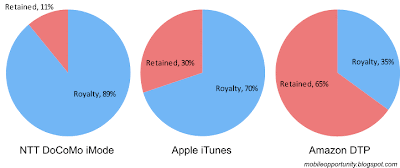
I'd love to hear from the folks at Amazon if there's a reasonable business justification for keeping such a huge cut of self-publishing revenue, but I think it's probably for two reasons:
--Amazon is greedy, and/or
--They don't want to completely undercut the royalty structure of print publishers (who typically pay up to 15% royalties on a printed book)
Either way, Amazon's royalty structure is outrageous. And it won't last. One of the most important aspects of electronic publishing is its ability to change the wretched economic structure of the industry so authors get the majority of the revenue for their work (I've written about the economics of it here). The change is inevitable, and if Amazon tries to hold its current royalty structure it'll eventually just drive people to other e-book platforms that don't rip off authors.
Will it succeed? It's the content, dummy.
All of the issues covered above will affect the success of Kindle, but ultimately the sales of an ebook reader depend on having a huge library of reasonably priced content -- books and periodicals. Lack of sufficient books is what killed the last generation of ebook readers, Rocket eBook and Softbook (I worked at Softbook for a short while, so I saw the situation there first hand).
Judged by that standard, Kindle is off to a surprisingly mediocre start. There are some promising signs. For example, people don't like paying hardcover prices for intangible ebooks, so Amazon is pricing current best-sellers at $9.99, compared to about $15-$16 for hardcover. There are hints in some articles that Amazon is even subsidizing some books to hit this price. The price difference isn't big enough to make people buy Kindle, but it helps to overcome resistance. Good move.
The problem is in the library of other books. Or I should say the non-library. There are supposedly about 90,000 books available for Kindle currently, which sounds like a lot but actually makes for a poor selection. To get an idea of what was available, I took a quick look at the titles available from several prominent science fiction authors -- Niven, Brin, Asimov, Simak, Vinge, etc. (hey, I work in the tech industry, that's what I read). The selection is quite bad -- for many authors, the only Kindle editions are their second-rate books. Or there are a bunch of individual short stories available for 99 cents each, but not most of the novels. I strongly suspect that Amazon is counting each of those short stories as one of the 90,000 "books," because they are all labeled as books in the website. If true, that means the actual number of real books for the device has been heavily exaggerated.
Try the test yourself -- go to the search page here and type in your favorite author's name. Let me know what you find. Maybe fields other than science fiction have a better selection. I hope so.
There's nothing that makes an ebook customer angrier than paying $400 for a device and then finding that most of the things they want to read on it are not available. The iPod succeeded even though a lot of songs were missing from iTunes at first -- but remember that people could rip their own CD collections, and install MP3s for free. Amazon doesn't have a base of content that its users can shift to the reader, and it charges money for any document transferred to the device. So it has to fill the library on its own, quickly.
I think Amazon has a lot of work to do here.
I'm intrigued that about 16 newspapers and magazines are available for Kindle. Unlike books, newspapers and magazines are viewed as disposable, so people are less resistant to buying them electronically. And getting instant delivery of a weekly magazine is a significant advantage over waiting a few days for it to appear in the mail.
Judging by Amazon's price to receive the San Jose Mercury News (Silicon Valley's Incredible Shrinking Newspaper) on Kindle, prices are about 40% less than print subscription. That's not bad. What I don't know is whether the Kindle editions of the papers and magazines will be the full text of the print version, or just excerpts. If anything's left out, people will be turned off.
Amazon must get a critical mass of content -- meaning a lot more magazines and newspapers, and rapid growth in books. If it can do that, Kindle may finally jump-start the ebook industry. It won't explode overnight, but Amazon has a long history of forcing its investors to wait years for the full payoff on investments. If Amazon can maintain that patience, I think it Kindle has a chance.
But I sure hope they make the next version of it look nicer.
What they announced
Kindle's hardware is a lot like that of the Sony and Iliad e-book readers. I won't bother repeating all of the specs; you can find a good summary on Engadget here and here and in a lengthy Newsweek essay here.
The industrial design of the device looks uninspiring to me. It's made of white plastic, a color scheme that most people associate with ease of use, low price, and limited features. Considering Amazon's strong emphasis on ease of use in its announcement today, I guess the color makes sense, but it's at odds with the $399 price.
I haven't touched a Kindle yet, so maybe it looks nicer in person. But in the photographs its sloping edges and slant-key keyboard do nothing for me. It looks a bit like a badly-carved wedge of Parmesan cheese. There are a total of 54 buttons, controls, and keys on the face of the device, so naturally it looks cluttered. There's virtually none of the lust-inducing elegance of the iPhone; the design screams "utilitarian."
"Is it just me or is that thing one hell of an ugly thing to walk around with?" --Comment posted to Newsweek's article on the Kindle
The design is not necessarily a bad thing; the device is going to live or die based on its usefulness, not its looks. But the lack of a lust factor makes people much more willing to nit-pick its features and price. So far Kindle is rated 2.5 out of 5 stars on Amazon's own website, with most of the negative ratings coming from people who have never even touched the device.
Clever wireless, vulnerable business model
Interesting use of the network. Things get a lot more elegant when you look at the services attached to Kindle. Amazon has built in a radio that talks to Sprint's EVDO data network. Wireless is used to deliver almost all content to the device (except for MP3 files, which sync via a USB cable). This is both attractive and disturbing.
The attractive part is that Amazon can pre-test each Kindle device to make sure they connect to the Sprint network before they get shipped to the customer. This is a huge advantage over WiFi. One of the dirty little secrets of WiFi is that non-PCs often have a lot of trouble connecting to WiFi routers in homes and offices. I don't know why this happens, but I suspect it's because the router vendors test their hardware mostly against PCs, and never find the bugs in connecting to other devices. Trouble-shooting a Kindle that couldn't find the network would be a nightmare, and Amazon has bypassed the whole issue by leaving WiFi out of the device.
I also like Amazon's decision not to hit its users with a monthly fee to access the network. Instead, the charges are embedded in the cost of downloaded content. This means that users who buy a lot of content will be subsidizing the ones who read only a little, but Amazon has hidden the charges so well that I don't think anyone will notice. Kindle makes the wireless network do what it should do: Disappear.
I have two worries about the use of EVDO. The first is that if someone lives outside of network coverage (like at my house) their Kindle won't work properly. I would have preferred to see WiFi included as a backup. The second problem is that because Amazon has to pay for that wireless connection, it has to tax virtually any information transmitted to the device. You can load documents onto the device by sending it an e-mail, but you'll pay 10 cents for every message. That doesn't sound like much, but it's annoying to have to pay anything at all for something that's normally free.
Likewise weblogs: You have to pay $1-2 per month for every weblog that you want delivered to your device. That's understandable if you look at Amazon's expenses, but it's astonishing for something that's free on a PC. What's worse, the most enthusiastic readers -- the people most likely to buy Kindle -- are the people likely to be scanning 20 blogs a day. They won't pay $20-$40 a month just to read blogs.
One workaround would be to subscribe to an e-mail blog aggregator like Feed Blitz and have it send a daily digest to your Kindle. That'll presumably cost 10 cents a day -- $3 a month, for unlimited blogs. That is, assuming Amazon doesn't put a size limit on the messages sent to Kindle.
The relatively closed nature of Kindle has led to some angry commentary on ebook enthusiast sites that you'd expect to cheer the product. For an example, there's an essay on Mobile Read here.
Self-publishing: Nice idea, but...
I was delighted to see that Amazon is allowing authors to self-publish e-books for the Kindle. You just submit them to the Amazon Digital Text Platform, set the suggested price, and Amazon adds them to its catalog (link).
The catch is that Amazon pays you only 35% of the suggested price of the book (link). They keep 65% -- for the amazing service of adding your book to their catalog (basically, they shift some bits around on a server). And by the way, if there is any bad debt, Amazon doesn't pay you any royalties at all on that sale, even though they're the ones who failed to collect.
By comparison, Apple takes 30% of iTunes revenue, and NTT DoCoMo takes about 11% of revenue from content and apps sold over its network.

I'd love to hear from the folks at Amazon if there's a reasonable business justification for keeping such a huge cut of self-publishing revenue, but I think it's probably for two reasons:
--Amazon is greedy, and/or
--They don't want to completely undercut the royalty structure of print publishers (who typically pay up to 15% royalties on a printed book)
Either way, Amazon's royalty structure is outrageous. And it won't last. One of the most important aspects of electronic publishing is its ability to change the wretched economic structure of the industry so authors get the majority of the revenue for their work (I've written about the economics of it here). The change is inevitable, and if Amazon tries to hold its current royalty structure it'll eventually just drive people to other e-book platforms that don't rip off authors.
Will it succeed? It's the content, dummy.
All of the issues covered above will affect the success of Kindle, but ultimately the sales of an ebook reader depend on having a huge library of reasonably priced content -- books and periodicals. Lack of sufficient books is what killed the last generation of ebook readers, Rocket eBook and Softbook (I worked at Softbook for a short while, so I saw the situation there first hand).
Judged by that standard, Kindle is off to a surprisingly mediocre start. There are some promising signs. For example, people don't like paying hardcover prices for intangible ebooks, so Amazon is pricing current best-sellers at $9.99, compared to about $15-$16 for hardcover. There are hints in some articles that Amazon is even subsidizing some books to hit this price. The price difference isn't big enough to make people buy Kindle, but it helps to overcome resistance. Good move.
The problem is in the library of other books. Or I should say the non-library. There are supposedly about 90,000 books available for Kindle currently, which sounds like a lot but actually makes for a poor selection. To get an idea of what was available, I took a quick look at the titles available from several prominent science fiction authors -- Niven, Brin, Asimov, Simak, Vinge, etc. (hey, I work in the tech industry, that's what I read). The selection is quite bad -- for many authors, the only Kindle editions are their second-rate books. Or there are a bunch of individual short stories available for 99 cents each, but not most of the novels. I strongly suspect that Amazon is counting each of those short stories as one of the 90,000 "books," because they are all labeled as books in the website. If true, that means the actual number of real books for the device has been heavily exaggerated.
Try the test yourself -- go to the search page here and type in your favorite author's name. Let me know what you find. Maybe fields other than science fiction have a better selection. I hope so.
There's nothing that makes an ebook customer angrier than paying $400 for a device and then finding that most of the things they want to read on it are not available. The iPod succeeded even though a lot of songs were missing from iTunes at first -- but remember that people could rip their own CD collections, and install MP3s for free. Amazon doesn't have a base of content that its users can shift to the reader, and it charges money for any document transferred to the device. So it has to fill the library on its own, quickly.
I think Amazon has a lot of work to do here.
I'm intrigued that about 16 newspapers and magazines are available for Kindle. Unlike books, newspapers and magazines are viewed as disposable, so people are less resistant to buying them electronically. And getting instant delivery of a weekly magazine is a significant advantage over waiting a few days for it to appear in the mail.
Judging by Amazon's price to receive the San Jose Mercury News (Silicon Valley's Incredible Shrinking Newspaper) on Kindle, prices are about 40% less than print subscription. That's not bad. What I don't know is whether the Kindle editions of the papers and magazines will be the full text of the print version, or just excerpts. If anything's left out, people will be turned off.
Amazon must get a critical mass of content -- meaning a lot more magazines and newspapers, and rapid growth in books. If it can do that, Kindle may finally jump-start the ebook industry. It won't explode overnight, but Amazon has a long history of forcing its investors to wait years for the full payoff on investments. If Amazon can maintain that patience, I think it Kindle has a chance.
But I sure hope they make the next version of it look nicer.
Impact of Amazon Flexible Payments Service: Computing as a utility
The announcement of Amazon FPS made my whole week, on a lot of different levels. I'm excited about the service itself, I'm excited about what it means for the development of web applications, and I'm excited about what it'll eventually do for the mobile data world.
Okay, I'm just excited.
About FPS. Before I talk about what it means, I should give a quick overview of what it is. FPS is a web service, meaning it's a set of online APIs that the creator of a website or web application can use to perform tasks. What FPS does for you is billing -- you can use it to accept payments for something you sell online. Basically, you transmit the customer's info to Amazon, and they take care of the credit check, credit card processing, billing, and so on. They send you the money, less a percentage cut that they take.
That's not at all revolutionary. PayPal and Google Checkout offer the same thing already. Amazon's cut is about the same as PayPal -- about 2% to 3% of your revenue, depending on the amount of business you do, plus 30 cents per transaction. Google is a tad cheaper, plus you get AdSense credits for using it.
(For more information on FPS, there are good articles here and here).
What impressed me about FPS is its flexibility. Amazon says you can set different payment terms for every customer, set up subscriptions and multiple payment schedules, manage a store in which you pass payments from a customer to your suppliers, set up either pre- or post-payment systems, and most importantly you can manage micropayments down to a couple of pennies per transactions (link).
The competing systems either don't offer this at all, or do it badly. I think FPS is a really important change to the competitive situation in payment services. And, because the payment services are all available to any website, that means it's an important change to the whole web platform.
New forms of online business. So far, e-commerce online has been limited mostly to selling things that we could already get through regular stores -- books, clothing, software, etc. One of the main culprits for this was payments. The current credit card system, with its strong discouragement of small transactions, makes it very hard to sell anything priced below a few dollars online. I think the most interesting use of online commerce will be the creation of markets for things that we can't buy through stores today. Most of those things are intellectual property of various sorts, and the natural market for them is a buck or less a copy. So the payment system is a big barrier.
I won't recap my whole argument for minipayments; I wrote about it recently, and you can read it here. Minipayments have already changed the world in music, where Apple's proprietary minipayment system in iTunes has revived the market for music singles, something that was virtually dead in stores. Another example: iStockPhoto has created a market for low-cost stock photography. By creating an easy system of practical minipayments, Amazon FPS will help to enable the creation of lots of iTunes and iStockPhoto equivalents for other products and forms of intellectual property. Think short stories, art, games, and probably a lot of other things we haven't even thought of yet.
I know FPS isn't perfect -- for example, small payments have to be aggregated and then billed in a single larger transaction. But it advances the state of the art dramatically, and more importantly it challenges Google and PayPal to improve their own minipayment handling. That competitive dynamic should eventually result in a truly great minipayment mechanism online, no matter who makes it.
Amazon vs. Google: A contrast in strategies. I think Amazon's approach to web services makes Google look bad. Both companies are taking on PayPal, but Google's approach so far has been pure blunt force -- duplicate PayPal's features, underprice them a bit, and tie it to another Google product (you get AdSense credits for using Google Checkout). Let's see...you compete by duplicating someone else's features, underpricing, and tying back to your dominant product. Does that remind you of a certain company in Redmond?
In contrast, Amazon has been trying to find holes in the infrastructure that nobody has filled yet. Its storage and compute services provided very important infrastructure that helped accelerate the growth of Web 2.0 companies. Although its payment system is not as unique, the emphasis on minipayments is, and I think it too will play an important part in the online ecosystem.
Bottom line: Google is often copying, Amazon innovating. I'd say that I'm disappointed in Google, but actually given their size they would crush everyone else if they were also innovative. So maybe we should be grateful.
What will Amazon do next? Their pattern is clear -- they're picking out things that they know how to do well (because of their retail operation) and turning them into services for other developers. A logical next step would be if they offered developers the infrastructure needed to set up an online store -- order tracking, support request tracking, inventory, displaying merchandise, etc. That would work with their other services, and would put them in a position to start draining business from eBay.
I'd also love to see them offer some sort of unified product and content discovery system. One of the things missing from the online ecosystem is an easy way to find goods and services that are for sale online, and comparison shop between them. You can use search for it, but it's not very well organized, and comparisons are difficult. eBay kind of does that, but you have to be registered as one of their sellers, and eBay does the billing. I'd love to see a looser directory than eBay that doesn't take the payments directly, but just points you to things you can buy.
That's what I thought Google Base would evolve into, but Google hasn't made the move yet, so there's still time for Amazon to seize that territory.
What it means for mobile. You can probably guess what I'm going to say here. The operators consistently charge up to about 50% of revenue for any songs, games, or other content sold through their networks. The mobile software stores like Motricity and Handango charge about the same. Amazon, Google, and PayPal each take about 2-3% of revenue, and that cost is likely to decline due to competition. As the wireless Internet takes hold, how many users will be willing to pay 50% extra just for the pleasure of having a game appear on their Sprint or Verizon bill rather than their Amazon bill?
If an operator bit the bullet now and priced competitively, they might be able to hold onto about 10% of revenue in exchange for the greater convenience of running content purchases through the mobile bill. But a 50% cut is like waving a red flag in front of a bull. There's no way Amazon and friends will be able to resist the temptation to target the mobile web. The question is not if, it's when.
The name of the game is infrastructure. In an open, decentralized computing environment like the Web, the best way for a software company to succeed is to create a control point -- to offer a piece of critical infrastructure that others need, and build a franchise around it.
Google understood that concept with search + advertising, and did well with maps, but has been remarkably inept at creating other strong points. I think that's because, to be blunt, engineering PhDs don't necessarily make the best business strategists. Google, if you want to go to the next level, ya got to hire business people who are as smart as your technical people. And you have to give them some authority.
Microsoft seems to get it, but is still trying to retrofit its applications into services rather than really thinking through what's needed in an online ecosystem. Apple seems to understand, but so far hasn't been interested in opening up its services to others (it could easily have turned iTunes into a content discovery and billing service, long before either Google or Amazon hit the market). Some other big Internet companies, like Yahoo, don't seem to really understand yet that this is the competitive battleground of their future.
Amazon is the one major web company that seems to both understand the situation, and be able to consistently come up with good new services. They already have two strong points (computing services and storage), and payments looks to be the third. If some of the other players don't wake up soon, Amazon's going to end up in an extremely powerful position online.
Okay, I'm just excited.
About FPS. Before I talk about what it means, I should give a quick overview of what it is. FPS is a web service, meaning it's a set of online APIs that the creator of a website or web application can use to perform tasks. What FPS does for you is billing -- you can use it to accept payments for something you sell online. Basically, you transmit the customer's info to Amazon, and they take care of the credit check, credit card processing, billing, and so on. They send you the money, less a percentage cut that they take.
That's not at all revolutionary. PayPal and Google Checkout offer the same thing already. Amazon's cut is about the same as PayPal -- about 2% to 3% of your revenue, depending on the amount of business you do, plus 30 cents per transaction. Google is a tad cheaper, plus you get AdSense credits for using it.
(For more information on FPS, there are good articles here and here).
What impressed me about FPS is its flexibility. Amazon says you can set different payment terms for every customer, set up subscriptions and multiple payment schedules, manage a store in which you pass payments from a customer to your suppliers, set up either pre- or post-payment systems, and most importantly you can manage micropayments down to a couple of pennies per transactions (link).
The competing systems either don't offer this at all, or do it badly. I think FPS is a really important change to the competitive situation in payment services. And, because the payment services are all available to any website, that means it's an important change to the whole web platform.
New forms of online business. So far, e-commerce online has been limited mostly to selling things that we could already get through regular stores -- books, clothing, software, etc. One of the main culprits for this was payments. The current credit card system, with its strong discouragement of small transactions, makes it very hard to sell anything priced below a few dollars online. I think the most interesting use of online commerce will be the creation of markets for things that we can't buy through stores today. Most of those things are intellectual property of various sorts, and the natural market for them is a buck or less a copy. So the payment system is a big barrier.
I won't recap my whole argument for minipayments; I wrote about it recently, and you can read it here. Minipayments have already changed the world in music, where Apple's proprietary minipayment system in iTunes has revived the market for music singles, something that was virtually dead in stores. Another example: iStockPhoto has created a market for low-cost stock photography. By creating an easy system of practical minipayments, Amazon FPS will help to enable the creation of lots of iTunes and iStockPhoto equivalents for other products and forms of intellectual property. Think short stories, art, games, and probably a lot of other things we haven't even thought of yet.
I know FPS isn't perfect -- for example, small payments have to be aggregated and then billed in a single larger transaction. But it advances the state of the art dramatically, and more importantly it challenges Google and PayPal to improve their own minipayment handling. That competitive dynamic should eventually result in a truly great minipayment mechanism online, no matter who makes it.
Amazon vs. Google: A contrast in strategies. I think Amazon's approach to web services makes Google look bad. Both companies are taking on PayPal, but Google's approach so far has been pure blunt force -- duplicate PayPal's features, underprice them a bit, and tie it to another Google product (you get AdSense credits for using Google Checkout). Let's see...you compete by duplicating someone else's features, underpricing, and tying back to your dominant product. Does that remind you of a certain company in Redmond?
In contrast, Amazon has been trying to find holes in the infrastructure that nobody has filled yet. Its storage and compute services provided very important infrastructure that helped accelerate the growth of Web 2.0 companies. Although its payment system is not as unique, the emphasis on minipayments is, and I think it too will play an important part in the online ecosystem.
Bottom line: Google is often copying, Amazon innovating. I'd say that I'm disappointed in Google, but actually given their size they would crush everyone else if they were also innovative. So maybe we should be grateful.
What will Amazon do next? Their pattern is clear -- they're picking out things that they know how to do well (because of their retail operation) and turning them into services for other developers. A logical next step would be if they offered developers the infrastructure needed to set up an online store -- order tracking, support request tracking, inventory, displaying merchandise, etc. That would work with their other services, and would put them in a position to start draining business from eBay.
I'd also love to see them offer some sort of unified product and content discovery system. One of the things missing from the online ecosystem is an easy way to find goods and services that are for sale online, and comparison shop between them. You can use search for it, but it's not very well organized, and comparisons are difficult. eBay kind of does that, but you have to be registered as one of their sellers, and eBay does the billing. I'd love to see a looser directory than eBay that doesn't take the payments directly, but just points you to things you can buy.
That's what I thought Google Base would evolve into, but Google hasn't made the move yet, so there's still time for Amazon to seize that territory.
What it means for mobile. You can probably guess what I'm going to say here. The operators consistently charge up to about 50% of revenue for any songs, games, or other content sold through their networks. The mobile software stores like Motricity and Handango charge about the same. Amazon, Google, and PayPal each take about 2-3% of revenue, and that cost is likely to decline due to competition. As the wireless Internet takes hold, how many users will be willing to pay 50% extra just for the pleasure of having a game appear on their Sprint or Verizon bill rather than their Amazon bill?
If an operator bit the bullet now and priced competitively, they might be able to hold onto about 10% of revenue in exchange for the greater convenience of running content purchases through the mobile bill. But a 50% cut is like waving a red flag in front of a bull. There's no way Amazon and friends will be able to resist the temptation to target the mobile web. The question is not if, it's when.
The name of the game is infrastructure. In an open, decentralized computing environment like the Web, the best way for a software company to succeed is to create a control point -- to offer a piece of critical infrastructure that others need, and build a franchise around it.
Google understood that concept with search + advertising, and did well with maps, but has been remarkably inept at creating other strong points. I think that's because, to be blunt, engineering PhDs don't necessarily make the best business strategists. Google, if you want to go to the next level, ya got to hire business people who are as smart as your technical people. And you have to give them some authority.
Microsoft seems to get it, but is still trying to retrofit its applications into services rather than really thinking through what's needed in an online ecosystem. Apple seems to understand, but so far hasn't been interested in opening up its services to others (it could easily have turned iTunes into a content discovery and billing service, long before either Google or Amazon hit the market). Some other big Internet companies, like Yahoo, don't seem to really understand yet that this is the competitive battleground of their future.
Amazon is the one major web company that seems to both understand the situation, and be able to consistently come up with good new services. They already have two strong points (computing services and storage), and payments looks to be the third. If some of the other players don't wake up soon, Amazon's going to end up in an extremely powerful position online.
Subscribe to:
Posts (Atom)